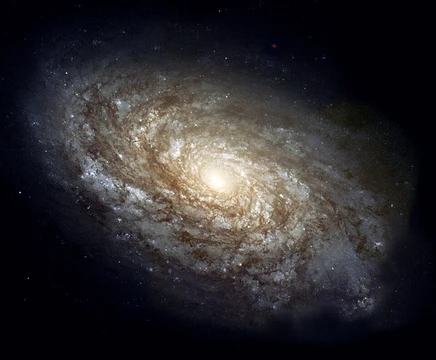
Boötes II
A faint dwarf spheroidal satellite of the Milky Way.

Boötes II is a dwarf spheroidal galaxy in the constellation Boötes, discovered in data from the Sloan Digital Sky Survey. It is one of the smallest and faintest satellites of the Milky Way, notable for its extremely low luminosity and high mass-to-light ratio.
Quick Facts
- Epoch
- J2000
- Ra
- 13 · 58 · 00
- Dec
- +12 · 51 · 00
- Dist Ly
- 136 ± 7 kly (42 ± 2 kpc)
- H Radial V
- −126 km/s
- Appmag V
- 15.8 ± 0.5
- Constellation Name
- Boötes
- Names
- Boo II, PGC 4713552
Facts from the source article.
Lore & Background
Boötes II was identified in 2007 from Sloan Digital Sky Survey data. It is classified as a dwarf spheroidal galaxy, with an approximately round shape and a half-light radius of about 51 pc. Its stellar population consists mainly of moderately old stars formed 10–12 billion years ago, with very low metallicity—200 times less heavy elements than the Sun. No current star formation is present, and no neutral hydrogen has been detected, with an upper limit of 86 solar masses.
The galaxy lies only 1.5 degrees (about 1.6 kpc) from another dwarf galaxy, Boötes I, but the two are unlikely to be physically associated because they move in opposite directions relative to the Milky Way, with a relative velocity of about 200 km/s. Boötes II is more likely associated with the Sagittarius Stream and thus with the Sagittarius Dwarf Elliptical Galaxy (SagDEG). It may be either a satellite galaxy of SagDEG or one of its star clusters torn from the main galaxy 4–7 billion years ago.
Reader's Guide
Boötes II holds significance as one of the smallest and faintest known satellites of the Milky Way, with an integrated luminosity of only about 1,000 times that of the Sun—much lower than that of most globular clusters. Despite its dimness, its mass is substantial, yielding a mass-to-light ratio exceeding 100, indicating a high dark matter content. Its low metallicity and old stellar population (10–12 billion years) provide clues to early galaxy formation processes. The absence of neutral hydrogen and current star formation suggests it has been quenched for billions of years. Its proximity to Boötes I and possible connection to the Sagittarius Stream and SagDEG offer insights into the accretion history of the Milky Way, though the exact nature of its association remains uncertain. The galaxy's discovery via the Sloan Digital Sky Survey highlights the role of wide-field surveys in uncovering ultra-faint dwarf galaxies that challenge models of galaxy formation and dark matter distribution.
Did You Know?
- Boötes II has a mass-to-light ratio greater than 100, indicating a high dark matter content.
- Its stars formed 10–12 billion years ago and have 200 times fewer heavy elements than the Sun.
- No neutral hydrogen has been detected in Boötes II, with an upper limit of 86 solar masses.
- It may be associated with the Sagittarius Dwarf Elliptical Galaxy via the Sagittarius Stream.
More in Elliptical and Irregular Galaxies, Part 5 1-24
Spotted an error? Know more?
Reader corrections go straight into our review queue. Suggest an edit · How this site is sourced