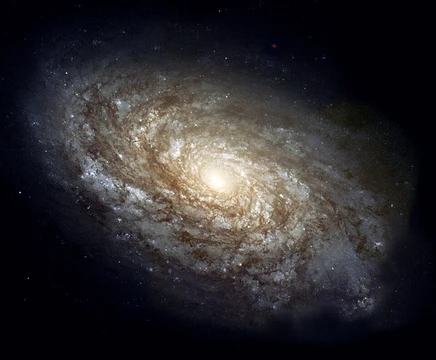
Bedin I
An isolated dwarf spheroidal galaxy and early-universe fossil.

Bedin I is a dwarf spheroidal galaxy in the constellation Pavo, located approximately 28.38 million light-years from Earth behind the globular cluster NGC 6752. It is considered one of the oldest known galaxies, having formed around 10–13 billion years ago, and is one of the most isolated dwarf galaxies known, situated about 2.12 million light-years from its nearest neighbor, NGC 6744. Its age and isolation have led astronomers to classify it as a 'fossil' from the early universe.
Quick Facts
- Epoch
- J2000
- Constellation Name
- Pavo
- Ra
- 19 · 10 · 45.41
- Dec
- -59 · 55 · 04.32
- Dist Ly
- 8.7 · +0.5 · −0.7 Mpc
- Appmag V
- 19.94
- Absmag V
- −9.76
Facts from the source article.
Lore & Background
Bedin I was accidentally discovered in September 2018 by a team led by Italian astronomer Luigi Bedin, who was studying white dwarfs in the globular cluster NGC 6752 using the Hubble Space Telescope. The galaxy appeared in the field of view during program GO-15096, which used the Advanced Camera for Surveys over 40 orbits. The discovery was announced in a paper published in January 2019 in Monthly Notices of the Royal Astronomical Society: Letters. Bedin was credited as the sole discoverer, and the team chose the name to avoid an anonymous coordinate-based designation.
The galaxy is a dwarf spheroidal with characteristics similar to KKR 25 and the Tucana Dwarf Galaxy. Its population consists of metal-poor red giant stars, and its luminosity is roughly a thousand times dimmer than the Milky Way, with an absolute magnitude of −9.76. Bedin I is believed to have formed 10–13 billion years ago with no subsequent star formation, making it one of the oldest galaxies known. It is also possibly the most isolated dwarf galaxy, located at least 2.12 million light-years from NGC 6744, though a physical association has been speculated due to their close angular distance and similar distances from Earth.
Bedin I is situated behind foreground stars within NGC 6752, one of the brightest globular clusters in the sky. Its visibility is significantly decreased by the cluster's glare. The galaxy measures about 20 by 8 arcseconds across and has an apparent magnitude of 19.94. A second observing program of 40 orbits was scheduled for late 2019.
Reader's Guide
Bedin I holds significance as one of the oldest known galaxies, having formed 10–13 billion years ago with no star formation since, preserving a record of conditions in the early universe. Its extreme isolation—at least 2.12 million light-years from its nearest neighbor—makes it a rare example of a dwarf galaxy that has likely never interacted with other galaxies, allowing astronomers to study a pristine, undisturbed system. This isolation, combined with its age, has led to its classification as a 'fossil' from the early universe. The accidental discovery by Luigi Bedin's team while studying white dwarfs in NGC 6752 highlights the serendipitous nature of astronomical research. The galaxy's naming after its discoverer, rather than an anonymous coordinate designation, reflects the team's intent to personalize the find. Bedin I's legacy lies in providing a unique window into the early cosmos, offering insights into galaxy formation and evolution in a state unaltered by external influences.
Did You Know?
- Bedin I was accidentally discovered while studying white dwarfs in the globular cluster NGC 6752.
- It is located about 2.12 million light-years from its nearest neighbor, NGC 6744, a distance similar to that between the Milky Way and Andromeda.
- The galaxy is named after Italian astronomer Luigi Bedin, who was credited as its sole discoverer.
- Bedin I is estimated to be 10–13 billion years old and has experienced no star formation since its formation.
More in Elliptical and Irregular Galaxies, Part 5 1-24
Spotted an error? Know more?
Reader corrections go straight into our review queue. Suggest an edit · How this site is sourced