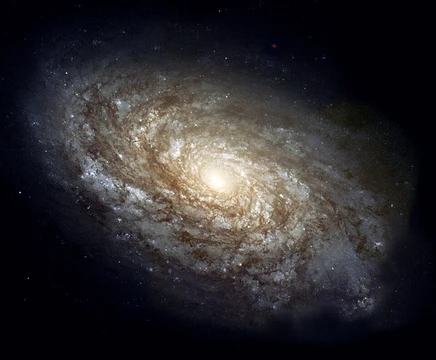
Andromeda II
Dwarf spheroidal galaxy with a merger history and dark matter content.

Andromeda II (And II) is a dwarf spheroidal galaxy located approximately 2.22 million light-years away in the constellation Pisces. It is a member of the Local Group, though its status as a satellite of either the Andromeda Galaxy or the Triangulum Galaxy remains uncertain. Discovered in the early 1970s, Andromeda II is notable for its complex stellar populations and evidence of a past merger event.
Quick Facts
- Epoch
- J2000
- Ra
- 01 · 16 · 29.8
- Dec
- +33 · 25 · 09
- Dist Ly
- 2.22 ± 0.07 Mly (680 ± 20 kpc)
- Z
- −188 ± 3 km/s
- Appmag V
- 13.5
- Constellation Name
- Pisces
- Notes
- satellite galaxy of M31
- Names
- Andromeda II Dwarf Spheroidal, · PGC 4601, And II
Facts from the source article.
Lore & Background
Andromeda II was discovered by Sidney Van den Bergh in a survey of photographic plates taken with the Palomar 48-inch Schmidt telescope in 1970 and 1971, along with Andromeda I, Andromeda III, and the presumable non- or background galaxy Andromeda IV. It has also been given the alias Pisces II by Martin et al. (2009), though that name was later used by a different group for a separate galaxy. Spectroscopic observations using the Keck telescope in 1999 measured an average velocity of −188 ± 3 km/s and a velocity dispersion of 9.2 ± 2.6 km/s, yielding a mass-to-light ratio of 21+14−10 solar units, indicating a significant dark matter component. The same year, spectra of 42 red giants gave an average metallicity of −1.47 ± 0.19 with a dispersion of 0.35 ± 0.10 dex. A color-magnitude diagram study from 1999 found that most stars in Andromeda II have ages between 6 and 9 Gyr, but the presence of RR Lyrae variables and blue horizontal-branch stars reveals a population older than 10 Gyr. Unlike Andromeda I, Andromeda II shows no radial gradient in horizontal-branch morphology and has a significantly larger abundance dispersion, suggesting very different evolutionary histories for the two dwarf spheroidal companions. Andromeda II possesses a stellar stream, indicative of a past merger event, and its characteristics are best explained by the merger of two disky dwarf galaxies approximately 5 billion years ago.
Reader's Guide
Andromeda II holds significance as a dwarf spheroidal galaxy whose properties challenge simple models of satellite evolution. Its high mass-to-light ratio points to a substantial dark matter component, making it a useful target for studying dark matter in low-mass systems. The presence of a stellar stream and the inferred merger of two disky dwarf galaxies about 5 billion years ago provide direct evidence that even small galaxies can undergo major mergers, shaping their stellar populations and kinematics. The contrast with Andromeda I—particularly the lack of a radial horizontal-branch gradient and the larger metallicity dispersion in Andromeda II—raises questions about what factors drive such differences among dwarf spheroidal galaxies. Its uncertain affiliation with either the Andromeda Galaxy or the Triangulum Galaxy adds to its interest as a possible tracer of the dynamical history of the Local Group. The alias confusion with Pisces II further highlights the challenges of naming conventions in extragalactic astronomy.
Did You Know?
- Andromeda II was discovered by Sidney Van den Bergh using photographic plates from the Palomar 48-inch Schmidt telescope.
- Most of its stars are between 6 and 9 billion years old, but a population older than 10 billion years also exists.
- The galaxy possesses a stellar stream, likely from the merger of two disky dwarf galaxies about 5 billion years ago.
More in Elliptical and Irregular Galaxies, Part 5 1-24
Spotted an error? Know more?
Reader corrections go straight into our review queue. Suggest an edit · How this site is sourced