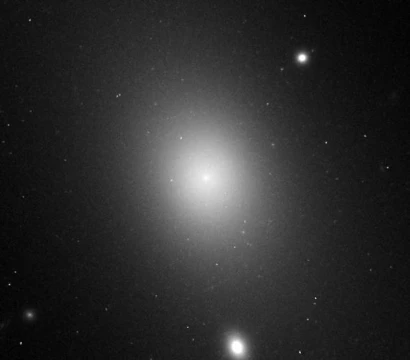
NGC 511
Elliptical galaxy in Pisces with concentric rings.

NGC 511, also cataloged as PGC 5103 and UGC 936, is an elliptical galaxy situated in the constellation Pisces. It lies roughly 499 million light-years from our Solar System, with French astronomer Édouard Stephan first spotting it on October 26, 1876.
Stephan observed the object using the 31-inch silver-glass reflecting telescope at the Marseille Observatory, noting it appeared diffuse with two faint stars to its west. His recorded description and position align with UGC 936 and PGC 5103, confirming they are the same object. John Louis Emil Dreyer, who compiled the New General Catalogue, later described NGC 511 as “extremely faint, very small, small (faint) star involved, small star attached,” referring to the two stars west of the galaxy.
The galaxy spans an apparent size of 1.1 by 1.1 arcminutes and has a recessional velocity of about 10,954 kilometers per second. It features several concentric rings. Applying Hubble’s law to its velocity yields an estimated distance of nearly 500 million light-years from the Sun.
Quick Facts
- Epoch
- J2000
- Ra
- 01 · 23 · 30.7
- Dec
- +11 · 17 · 28
- Constellation Name
- Pisces
- Appmag B
- 14.9
- Appmag V
- 13.9
- H Radial V
- (10954 ± 44) km/s
- Dist Ly
- 499 Mly
- Z
- 0.03723 ± 0.00015
- Names
- PGC 5103, UGC 936, GC 5174, MGC +02-04-033, 2MASS J01233074+1117274
Facts from the source article.
Lore & Background
NGC 511 was discovered on 26 October 1876 by French astronomer Édouard Stephan using the 31-inch silver-glass reflecting telescope at the Marseille Observatory. Stephan described his discovery as diffuse, with two faint stars on the west side. The description and position given in his notes matches UGC 936 and PGC 5103, thus the objects are widely recognized as the same.
John Louis Emil Dreyer, creator of the New General Catalogue, described the galaxy as 'extremely faint, very small, small (faint) star involved, small star attached', with the two stars being the objects to the west of NGC 511. The galaxy has an apparent size of 1.1 × 1.1 arcmins and a recessional velocity of approximately 10954 kilometers per second. It also contains multiple concentric rings.
The distance of NGC 511 from the Solar System can be estimated using Hubble's law, which puts the object at nearly 500 million light-years from the Sun.
Reader's Guide
NGC 511 is significant as an elliptical galaxy in the constellation Pisces, discovered by Édouard Stephan in 1876. Its identification is confirmed by matching Stephan's notes with the designations PGC 5103 and UGC 936. The galaxy's description by John Louis Emil Dreyer in the New General Catalogue as 'extremely faint, very small' with a faint star involved and a small star attached highlights its subtle appearance. The presence of multiple concentric rings is a notable structural feature. Its recessional velocity of about 10954 kilometers per second, combined with Hubble's law, yields a distance estimate of nearly 500 million light-years. This object contributes to the study of elliptical galaxies and their ring structures, and its historical discovery using a silver-glass reflecting telescope at the Marseille Observatory underscores the observational techniques of the late 19th century.
Did You Know?
- NGC 511 is also known as PGC 5103 and UGC 936.
- The galaxy contains multiple concentric rings.
- Its recessional velocity is approximately 10954 kilometers per second.
More in Elliptical and Irregular Galaxies, Part 3 1-24
Spotted an error? Know more?
Reader corrections go straight into our review queue. Suggest an edit · How this site is sourced