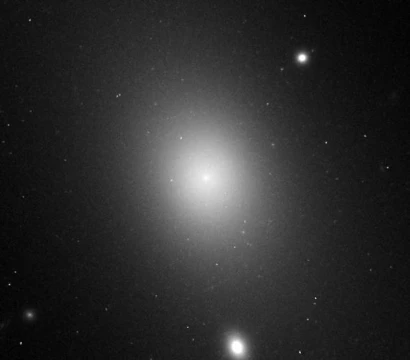
Holmberg 15A
Supergiant elliptical galaxy with a disputed massive core.

Holmberg 15A, also known as Holm 15A, is a supergiant elliptical galaxy located about 787.3 million light-years from Earth in the constellation Cetus. It is the brightest member of the Abell 85 galaxy cluster. Discovered around 1937 by Erik Holmberg, the galaxy gained attention after being claimed to have the largest galactic core ever observed, roughly 15,000 light-years across, though this finding was later disproven. At the center of Holm 15A, astronomers suspect a supermassive black hole, though its mass has not been directly measured. Estimates vary widely. One recent study suggests a mass of 40 billion solar masses, plus or minus 8 billion. Earlier work by Lauer and colleagues, using the gamma-ray break radius method, proposed a much higher figure of 310 billion solar masses. Kormendy and Bender, in 2009, estimated 260 billion solar masses. Lower estimates, based on the M–sigma relation and the galaxy's outer bulge size, came from Kormendy and Ho in 2013, who gave values of 2.1 and 9.2 billion solar masses. Another team, Lopez-Cruz et al., conservatively suggested a mass of 10 billion solar masses. Rusli and colleagues, using break radius methodology, derived 170 billion solar masses. The velocity dispersion of the dark matter halo in Abell 85 is about 750 km/s, which would require a black hole exceeding 150 billion solar masses, though Kormendy and Ho noted that dark matter halos are scale-free and the coevolution of supermassive black holes and dark matter is independent of baryonic effects. Because of these high estimates, the object is considered an ultramassive black hole and one of the most massive ever discovered.
Quick Facts
- Epoch
- J2000.0
- Constellation Name
- Cetus
- Ra
- 00 · 41 · 50.5
- Dec
- -09 · 18 · 11
- Z
- 0.055359 · 0.000016
- Dist Ly
- 241.4 +/-0.6774 / (Comoving) · 753 Mly0.6774 / (Light-travel)
- Group Cluster
- Abell 85
- Appmag V
- 14.7
- Names
- Abell 85-BCG, PGC 2501
Facts from the source article.
Lore & Background
Holmberg 15A was discovered c. 1937 by Erik Holmberg. It gained attention when it was reported to have the largest galactic core ever observed, spanning about 15,000 light years, but this claim was later refuted. The galaxy is the brightest member of the Abell 85 galaxy cluster. It has been postulated that the primary component of its core is a supermassive black hole with a mass of 40 ± 8 billion solar masses, although no direct measurement has yet been made. Previous estimates have varied widely: Lauer et al. gave a mass as high as 310 billion solar masses using the gamma ray point break radius method; Kormendy and Bender gave 260 billion solar masses in a 2009 paper; lower estimates were given by Kormendy and Ho et al. in 2013 at . Lopez-Cruz et al. conservatively suggested a mass of 10^10 solar masses. Rusli et al. derived a value of 170 billion solar masses using break radius methodology. The velocity dispersion of the dark matter halo of Abell 85 is about 750 km/s, which could be explained only by a black hole with a mass greater than 150 billion solar masses, though Kormendy and Ho et al. stated that dark matter halos are scale-free and the supermassive black hole–dark matter coevolution is independent from baryonic effects. This makes it one of the most massive black holes ever discovered, classified as an ultramassive black hole.
Reader's Guide
Holmberg 15A is significant primarily for the extreme mass estimates of its central supermassive black hole, which place it among the most massive black holes known, classified as an ultramassive black hole. The article highlights a wide range of mass estimates—from 2.1 billion to 310 billion solar masses—derived from different methods, including the M–sigma relation, outer bulge size, gamma ray point break radius, and break radius methodology. No direct measurement has been made, and the most recent estimate from Mehrgan et al. (2019) gives 40 ± 8 billion solar masses. The galaxy was also notable for a reported largest core ever observed, spanning 15,000 light years, but this was subsequently refuted. Its legacy lies in illustrating the challenges of measuring supermassive black hole masses and the ongoing debate over the true mass of Holm 15A's central object, as well as its role as the brightest galaxy in the Abell 85 cluster.
Did You Know?
- It was reported to have the largest core ever observed in a galaxy, spanning 15,000 light years, but this was subsequently refuted.
- The supermassive black hole at its center has been estimated at 40 ± 8 billion solar masses, though no direct measurement has been made.
Nature and Classification
Holmberg 15A is classified as a supergiant elliptical galaxy, placing it among the most massive and luminous types of galaxies known. Unlike the spiral or irregular forms that dominate much of the night sky, elliptical galaxies are characterized by their smooth, featureless appearance and lack of significant disk structure. Its designation as a supergiant signals that it far exceeds typical elliptical galaxies in scale and brightness. Located in the constellation Cetus, this object occupies a position in the southern celestial sphere where the waters of the sea monster are depicted. What distinguishes Holmberg 15A from many other ellipticals is its role as the central dominant galaxy of the Abell 85 galaxy cluster, meaning it sits at the gravitational heart of a vast collection of galaxies bound together. This central position implies it has likely grown through mergers and accretion over cosmic time, accumulating mass from smaller companion systems within its cluster environment.
The Holmberg Naming Legacy
The name Holmberg 15A honors the astronomer Erik Holmberg, who described multiple galaxies that subsequently carried his name. Among his eponymous objects are Holmberg II, a dwarf irregular galaxy in the M81 Group roughly 9.8 million light-years distant, and Holmberg IX, a dwarf irregular satellite of Messier 81. Holmberg 15A stands apart from these smaller companions in both type and scale, being a supergiant elliptical rather than a dwarf irregular. The broader pattern of astronomical naming reflects a long tradition in which deep-sky objects receive the name of the individual who first discovered, catalogued, or scientifically studied them. This convention applies across stars, clusters, galaxies, and comets alike. In the case of galaxies specifically, the named person is typically the one who first brought the object to scientific attention or conducted the earliest rigorous study of it. Holmberg's contribution to galactic astronomy thus lives on through multiple objects spanning very different classes of galaxies.
Heart of the Abell 85 Cluster
As the central dominant galaxy of the Abell 85 galaxy cluster, Holmberg 15A occupies the most gravitationally significant position within that assembly. Galaxy clusters are among the largest gravitationally bound structures in the universe, and the central dominant galaxy typically represents the most massive member, having grown over billions of years through the merging of smaller systems. The Abell 85 designation itself connects to the broader Abell catalogue, a comprehensive survey of approximately four thousand galaxy clusters compiled by George O. Abell. Being listed as the central dominant of a cluster in this well-known catalogue underscores Holmberg 15A's importance in the study of large-scale galactic structure. Its location in Cetus places it in a region of sky associated with the southern celestial sphere. The relationship between a dominant central galaxy and its surrounding cluster members provides astronomers with a natural laboratory for studying how gravity, dark matter, and stellar dynamics shape the largest structures in the cosmos.
Astronomical Naming Conventions and Context
The naming of Holmberg 15A follows a well-established convention in astronomy where deep-sky objects are typically designated after the person who discovered or first scientifically studied them. This practice contrasts sharply with the naming of topological features on Solar System bodies, which often honor famous or historical figures from a wide range of fields. It also differs from the exclusion of mythological and fictional character names that applies to many astronomical catalogues. In the galaxy context, the named individual is usually the one who first identified the object, drew attention to its properties, or conducted the earliest systematic study. Comprehensive catalogues further layer this system: Messier numbers honor Charles Messier, Arp numbers honor Halton Arp, and Markarian designations honor Benjamin Markarian. Holmberg 15A fits within this tradition of personal attribution, preserving the legacy of Erik Holmberg's observational work while distinguishing it from the many other objects that carry his name across different galaxy types.
Frequently Asked Questions
What is Holmberg 15A?
Holmberg 15A (often shortened to Holm 15A) is a supergiant elliptical galaxy sitting in the constellation Cetus, roughly 787.3 million light-years (241.4 megaparsecs) from Earth. It holds the title of the brightest galaxy in the Abell 85 cluster.
What is Holmberg 15A's signature feature or 'power'?
The galaxy became famous for a claim that it harbors the largest galactic core ever observed, stretching about 15,000 light-years across, but that finding was subsequently disproven. Astronomers also suspect a supermassive black hole lurks at its center, though its mass remains unmeasured and estimates vary widely.
Who discovered Holmberg 15A and when?
Swedish astronomer Erik Holmberg identified the galaxy around 1937, and it has carried his name in the Holmberg catalogue ever since.
Where exactly can you find Holmberg 15A in the sky?
Look toward the constellation Cetus, the Sea Monster, in the southern sky. In terms of cosmic neighborhood, it is a core member of the Abell 85 galaxy cluster, where it outshines every other elliptical or irregular galaxy in the group.
Why does Holmberg 15A matter to galaxy enthusiasts?
As the brightest object in Abell 85 and a textbook example of a supergiant elliptical, it serves as a key reference point for studying how massive ellipticals dominate rich clusters. The back-and-forth over its allegedly record-breaking core also makes it a go-to case study in how astronomical claims can be overturned by later observations.
More in Elliptical and Irregular Galaxies, Part 3 1-24
Spotted an error? Know more?
Reader corrections go straight into our review queue. Suggest an edit · How this site is sourced