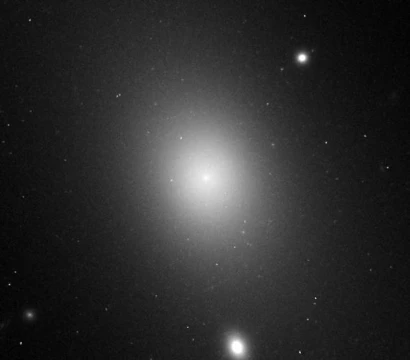
IC 1101
Largest known galactic core, one of the most massive black holes.

IC 1101 sits at the heart of the Abell 2029 galaxy cluster, classified as a supergiant lenticular (S0) galaxy of the cD type. Its isophotal diameter stretches between roughly 400,000 and 550,000 light-years (123.65 to 169.61 kiloparsecs). The galaxy is known for having the largest diffuse core of any galaxy yet observed, and it hosts a supermassive black hole that ranks among the most massive ever found. It lies about 1.15 billion light-years (354.0 megaparsecs) from Earth and was first spotted on 19 June 1790 by the German-British astronomer William Herschel. The galaxy received its common designation from the Index Catalogue, compiled between the late 1800s and early 1900s. In a 1964 study of galaxies with radio sources, IC 1101 was included among diffuse elliptical galaxies under investigation; although it had not previously been considered a radio source, radio emissions similar to those from known radio galaxies were detected. Over a decade later, in 1978, astronomer Alan Dressler examined 12 very rich galaxy clusters, including Abell 2029. The following year, he released a paper dedicated solely to IC 1101 and its related dynamics and properties, revealing a rising velocity dispersion profile, and later released an overview of his work on the cluster and the galaxy. In 1985, a team obtained spectra of gas in several X-ray-luminous galaxy clusters, among them Abell 2029, leading to a subsequent study of the dynamics of IC 1101 and nearby galaxies within a few hundred kiloparsecs. Because cluster centers are considered prime laboratories for studying galaxy and cluster evolution, numerous surveys of brightest cluster galaxies—including IC 1101—were published from the late 1980s into the early 1990s. R-band luminosity profiles later showed a very extensive halo of light extending more than several hundred kiloparsecs from the galaxy’s center. In 2002, Chandra X-ray surveys of the cluster were analyzed. A 2011 survey covered over 430 brightest cluster galaxies, including IC 1101. In 2017, a redshift survey of the cluster produced a list of velocity dispersions, constraining the cluster’s dynamics; that same year, Hubble Space Telescope images of the galaxy’s inner regions revealed a huge but diffuse core, along with mass estimates for the central supermassive black hole.
Quick Facts
- Epoch
- J2000
- Constellation Name
- Virgo
- Ra
- 15 · 10 · 56.1
- Dec
- +05 · 44 · 41
- Z
- 0.078054 · 0.000027
- H Radial V
- 22419 km/s
- Dist Ly
- 354.0 ±0.67
- Group Cluster
- Abell 2029
- Appmag V
- 13.22
Facts from the source article.
Lore & Background
IC 1101 was discovered on 19 June 1790 by the German-British astronomer William Herschel. It was later catalogued in the Index Catalogue of galaxies in the late 1800s to early 1900s, which is where the galaxy got its most-used designation. In a 1964 study of galaxies accompanied by radio sources, IC 1101 was listed as being among the diffuse elliptical galaxies chosen for the study, and radio emissions similar to galaxies with such emissions were detected. In 1978, astronomer Alan Dressler analyzed 12 very rich clusters of galaxies, among them Abell 2029, and the following year released a paper dedicated solely to IC 1101, revealing a rising velocity dispersion profile. During 1985, a team of astronomers obtained the spectra of the gas inside several galaxy clusters known to be luminous at X-ray wavelengths, including Abell 2029. R-band luminosity profiles obtained later revealed a very vast halo of light that could be traced out for more than several hundred kiloparsecs from the galaxy's center. In 2017, an analysis of the galaxy's inner regions using Hubble Space Telescope images found a huge yet diffuse galactic core, accompanied with mass estimates of the central supermassive black hole.
Reader's Guide
IC 1101 is significant as a supergiant lenticular galaxy with the largest known galactic core, a core radius of about 4.2 kiloparsecs, roughly an order of magnitude larger than cores of other large elliptical galaxies such as NGC 4889 and NGC 1600. Its central supermassive black hole is one of the most massive known, with estimates ranging from 35.5 billion to 269.1 billion solar masses, near the upper bound of cosmological limits and referred to as 'overmassive.' The galaxy's mass-to-light ratio is anomalously high, and its unique velocity dispersion profile indicates a massive dark matter halo. The Abell 2029 cluster accretes roughly 450 solar masses per year. IC 1101 lacks nuclear emission in visible light, signs of recent star formation, and evidence of dust lanes in the core. Its isophotes are predominantly boxy, and closer to the core they become elongated, suggesting a nuclear disc possibly due to an unresolved double nucleus. The galaxy's halo is twisted by 20 degrees from its main body and core, a feature that may contribute to its classification as lenticular in RC3. Defining the galaxy's size varies by method; photographic plates yield an effective radius of 65 ± 12 kpc, while a more recent measurement using ultra-deep imaging gives a diameter of 520 kiloparsecs (about 1.7 million light-years), making it one of the largest and most luminous galaxies known.
Did You Know?
- IC 1101's core radius of 4.2 ± 0.1 kpc is the largest core of any galaxy known to date.
- The galaxy's central black hole mass is estimated between 35.5 billion and 269.1 billion solar masses.
Morphology & Structural Character
As a member of the elliptical galaxy class, IC 1101 presents as a smooth, almost featureless ellipsoidal mass of stars. Unlike the flat, organized disks of spiral galaxies, this object is fundamentally three-dimensional, with its stellar population tracing orbits that are largely random around a central point rather than following a coherent rotational plane. The Hubble sequence, established by Edwin Hubble in his 1936 work The Realm of the Nebulae, places ellipticals alongside spirals and lenticulars as one of three principal galaxy types, and IC 1101 falls squarely within the early-type subset that also encompasses lenticular and intermediate ES galaxies. Its projected image lacks the spiral arms, dust lanes, and prominent young star-forming regions that characterize disk galaxies. Instead, the luminosity profile follows the mathematical description known as Sersic's law, a fitting function that unifies the structural appearance of ellipticals and galactic bulges alike. The degree of elongation visible in its image is quantified by the ratio of major to minor isophotal axes, yielding a Hubble type designation that reflects both its intrinsic geometry and the viewing angle from Earth.
Stellar Population & Chemical Heritage
The stars within IC 1101 are, on average, far older than those found in spiral galaxies, and this ancient stellar population imparts the galaxy its characteristic red hue. The interstellar medium is sparse, with very little gas or dust available to fuel new star formation. Open star clusters and young stellar objects are correspondingly rare. Instead, the galaxy is dominated by low-mass, evolved stars that have exhausted their nuclear fuel over billions of years. Large elliptical galaxies of this kind typically host extensive systems of globular clusters, and IC 1101, as a member of this class, would be expected to be surrounded by such populations. These globular clusters generally fall into two distinct groups: a redder, metal-rich population and a bluer, metal-poor population, reflecting different epochs or origins of formation. While star formation in elliptical galaxies is typically minimal, brief bursts can occur when the galaxy merges with a gas-rich companion, temporarily reigniting the birth of new stars before the available fuel is consumed.
The Heart of Abell 2029
IC 1101 holds the position of central galaxy within the Abell 2029 cluster, a role entirely consistent with the broader statistical pattern observed across the universe. Elliptical galaxies are statistically concentrated near the cores of galaxy clusters and within compact groups, and their dominance at these gravitational centers is a hallmark of their evolutionary history. Every massive elliptical galaxy is believed to harbor a supermassive black hole at its very center, and observations spanning dozens of such objects confirm that the mass of this black hole is inextricably linked to the total stellar mass of the host. This relationship, captured in the M–sigma relation, connects the velocity dispersion of the surrounding stellar population to the central black hole's mass, providing a powerful diagnostic tool for astronomers. As the gravitational anchor of Abell 2029, IC 1101 sits at the dynamical heart of its cluster, its immense stellar mass helping to define the potential well in which surrounding member galaxies orbit.
Dynamics & the Broader Early-Type Family
The dynamical behavior of IC 1101 and its fellow ellipticals shares deep similarities with the bulges of disk galaxies, suggesting that both structures may arise from comparable physical processes, though this connection remains a topic of ongoing debate. A range of scaling relations among structural parameters unifies the elliptical population, linking size, mass, and luminosity in predictable ways. Within this family, two broad morphological tendencies are sometimes distinguished: giant ellipticals whose isophotes appear slightly boxy due to anisotropic random stellar motion, and smaller disky ellipticals that retain a disk component. The existence of ES galaxies with intermediate-scale disks blurs the boundary between these categories. IC 1101, as a large elliptical at the center of its cluster, fits within this rich structural diversity. Its classification within Hubble's scheme, originally conceived in the 1930s, still provides the foundational language for describing its shape, even as modern spectroscopy has revealed that some galaxies once labeled as highly elongated ellipticals are actually inclined lenticular disks seen at oblique angles.
Frequently Asked Questions
What is IC 1101?
IC 1101 is a supergiant lenticular (cD-type) galaxy that anchors the center of the Abell 2029 cluster. It is widely regarded as one of the largest galaxies known in the observable universe.
How big is IC 1101 compared to other galaxies?
Its isophotal diameter stretches roughly 400,000 to 550,000 light-years (about 124 to 170 kiloparsecs), dwarfing the Milky Way by a factor of several. That sheer scale is a major reason it draws so much attention from galaxy enthusiasts.
What is special about IC 1101's core and central black hole?
It holds the record for the largest diffuse galactic core ever measured, with a radius of about 4.2 kiloparsecs (roughly 13,700 light-years). At its heart sits a supermassive black hole estimated near 97.7 billion solar masses, making it one of the heaviest black holes catalogued to date.
Who discovered IC 1101 and when?
German-British astronomer William Herschel first recorded the object on 19 June 1790. It later received its Index Catalogue designation, IC 1101, as part of the standard deep-sky cataloguing system.
How far is IC 1101 from Earth and where exactly is it located?
The galaxy sits approximately 1.15 billion light-years (354 megaparsecs) away, deep within the Abell 2029 galaxy cluster. Its position at the cluster's gravitational center is what makes it a natural focal point for studies of cluster dynamics.
More in Elliptical and Irregular Galaxies, Part 3 1-24
Spotted an error? Know more?
Reader corrections go straight into our review queue. Suggest an edit · How this site is sourced