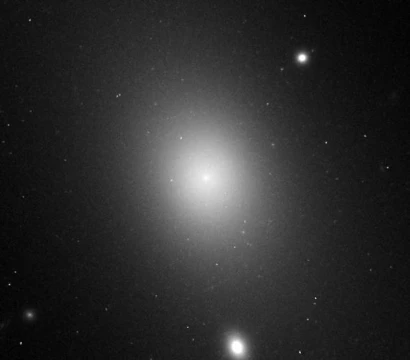
IC 2402
A restarted radio galaxy with dual FR classifications.

IC 2402 is a large elliptical galaxy located in the constellation of Cancer, approximately 940 million light-years from Earth. It is notable as the brightest cluster galaxy (BCG) of the galaxy cluster ZW 0844.5+3208 and is classified as a narrow-line Fanaroff-Riley type 2 (FR II) radio galaxy, though its radio lobes have also been classified as Fanaroff-Riley type 1 (FR I) in a 2005 survey, suggesting a restarted source with both recent and prior activity.
Quick Facts
- Epoch
- J2000
- Constellation Name
- Cancer
- Ra
- 08 · 47 · 59.0448
- Dec
- +31 · 47 · 08.463
- Z
- 0.067306
- H Radial V
- 20,178 km/s
- Dist Ly
- 938 Mly (287.59 Mpc)
- Group Cluster
- ZW 0844.5+3208
- Appmag V
- 14.7
- Notes
- Radio galaxy
- Names
- 4C +31.32, PGC 24720, B2 0844+31B, MCG +05-21-010, TXS 0844+319, ConFIG 032, 0844+31
Facts from the source article.
Lore & Background
IC 2402 was first discovered by Stéphane Javelle on 15 February 1896 and subsequently designated as 4C 31.32 by astronomers. It is the brightest cluster galaxy (BCG) of the galaxy cluster ZW 0844.5+3208. The galaxy's brightness profile follows the de Vancouleurs law, with isophotes twisted by 30 degrees from its nucleus to the external parts.
The radio structure, imaged at 0.6 and 1.4 GHz, shows a double source with low intensity regions along its eastern side. The two components have an increased spectral index towards the north, with a core-dominated central region. A radio jet becomes fainter and wider as it travels from the core, resolving into a main jet and counter-jet that both display sine wave type oscillations.
The radio lobes are polarized and symmetrical, but the southern lobe is significantly depolarized compared to the northern lobe, with depolarization ratios of 0.45 ± 0.1 and 0.85 ± 0.1, and a positive rotation measure of 25 rad m−2. Both lobes show spectral index variations, with outer ridges having spectral indices of ~0.8–0.9 and ~1.0. The lobes contain hot spots that are anti-symmetric in appearance.
Reader's Guide
IC 2402 holds significance as a restarted radio galaxy, a classification supported by a 2005 study using the Faint Images of the Radio Sky at Twenty-Centimeters (FIRST) survey conducted by the Very Large Array (VLA). The study classified the galaxy's radio lobes as Fanaroff-Riley type 1 (FR I), while the inner structure is classified as Fanaroff-Riley type 2 (FR II). This dual classification suggests the source has an FR I extended structure relating to prior activity, whereas the FR II inner structure originates from recent activity from the core. The lobes are located far from the nucleus beyond the hotspots, further supporting the restarted interpretation. The galaxy's legacy lies in its complex radio morphology and the evidence it provides for episodic nuclear activity in massive elliptical galaxies, making it a key object for studying the life cycles of radio galaxies.
Frequently Asked Questions
What is IC 2402?
IC 2402 is a large elliptical galaxy sitting in the constellation Cancer, roughly 940 million light-years away from Earth. It holds the title of brightest cluster galaxy within the cluster ZW 0844.5+3208.
How large is IC 2402?
The galaxy stretches about 370,000 light-years across, making it a genuinely massive elliptical system.
Why do astronomers disagree on IC 2402's radio classification?
One survey labels it a narrow-line Fanaroff-Riley type II source, while a 2005 study classified its lobes as FR I. The dual labeling is taken as evidence of a restarted radio galaxy that has experienced both earlier and more recent episodes of jet activity.
Who discovered IC 2402?
The galaxy was identified by Stéphane Javelle.
What other catalog designations does IC 2402 carry?
Beyond its IC number, the galaxy is also listed as B0844+31, B2 0844+31, and 4C 31.32 in various astronomical catalogs.
More in Elliptical and Irregular Galaxies, Part 3 1-24
Spotted an error? Know more?
Reader corrections go straight into our review queue. Suggest an edit · How this site is sourced