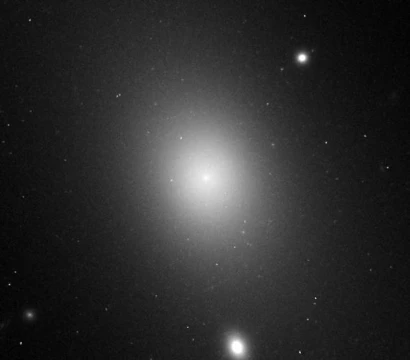
IC 3370
Elliptical galaxy with LINER and Seyfert II activity.

IC 3370 is an elliptical galaxy located in the constellation of Centaurus, approximately 156 million light-years from Earth. It is notable for its classification as both a LINER galaxy and a Seyfert type II galaxy, as well as its box-shaped appearance and evidence of past tidal interactions or mergers.
Quick Facts
- Epoch
- J2000
- Constellation Name
- Centaurus
- Ra
- 12 · 27 · 37.3283
- Dec
- -39 · 20 · 15.985
- Z
- 0.009773 ± 0.000080
- H Radial V
- 2,930 km/s
- Dist Ly
- 156 Mly (47.61 ± 3.37 Mpc)
- Appmag V
- 10.9
- Appmag B
- 11.9
Facts from the source article.
Lore & Background
IC 3370 is classified as an E2-E3 elliptical galaxy with a bright nucleus. It has a box-shaped appearance similar to LEDA 74886, though some studies have classified it as a peculiar lenticular galaxy (S0pec). The galaxy exhibits significant isophotal twisting in its galactic bulge between 0 and 70 arcseconds, suggesting it may have undergone a tidal encounter or a galaxy merger. Dust patches cover most of the nuclear regions, with signatures of X-ray isotopes and cylindrical rotation. The inner disk rotates at speeds of 100 km s⁻¹, and a dust lane runs through the galaxy's central region. According to the SIMBAD database, IC 3370 is said to be a LINER galaxy but also a Seyfert type II galaxy. Its luminosity is estimated to have a B magnitude of -22.3, similar to other elliptical galaxies. According to A. M. Garcia, IC 3370 belongs to the 79-member NGC 4696 galaxy group (also known as LGG 298), which includes NGC 4373, NGC 4499, NGC 4507, NGC 4553, NGC 4743, NGC 4744, NGC 4767, NGC 4811, NGC 4812, and NGC 4832.
Reader's Guide
IC 3370 is significant as an example of an elliptical galaxy that exhibits dual active galactic nucleus classifications—both LINER and Seyfert type II—as recorded in the SIMBAD database. Its box-shaped morphology and isophotal twisting between 0 and 70 arcseconds indicate a history of tidal encounters or mergers, providing insight into the dynamical evolution of elliptical galaxies. The presence of dust patches, X-ray isotopes, cylindrical rotation, and a central dust lane further characterize its complex structure. The galaxy's membership in the large NGC 4696 group (79 members) places it within a rich environment for studying galaxy interactions and group dynamics. Its discovery by Lewis Swift on 30 January 1898 adds historical context to the cataloging of deep-sky objects. The galaxy's B magnitude of -22.3 aligns it with typical elliptical galaxy luminosities, reinforcing its classification.
Frequently Asked Questions
What is IC 3370?
IC 3370 is an elliptical galaxy (classified E2–E3, though sometimes tagged as a peculiar lenticular) sitting in the southern constellation Centaurus. It lies roughly 156 million light-years from Earth and hosts both LINER and Seyfert type II nuclear activity.
Who discovered IC 3370 and when?
Lewis Swift first recorded the object on 30 January 1898. It was subsequently entered into the Index Catalogue of nebulae, receiving the designation IC 3370.
What makes IC 3370 stand out among other elliptical galaxies?
Most ellipticals are quiescent, yet IC 3370 shows active-nucleus signatures in both LINER and Seyfert II modes. It also exhibits a distinctive box-shaped light profile, which points to earlier tidal interactions or a merger event.
Where in the sky can I find IC 3370?
Look toward the constellation Centaurus in the southern sky; the galaxy sits about 156 million light-years away. Its B-band magnitude is listed at −22.3 in catalog data, though in practice it remains a faint, small smudge for visual observers.
What does IC 3370's boxy shape tell us about its history?
A box-shaped morphology in an elliptical is a strong indicator that the galaxy underwent a past gravitational encounter or merger with a companion. Combined with its active nucleus, the shape helps astronomers trace how ellipticals and their central engines evolve over time.
More in Elliptical and Irregular Galaxies, Part 3 1-24
Spotted an error? Know more?
Reader corrections go straight into our review queue. Suggest an edit · How this site is sourced