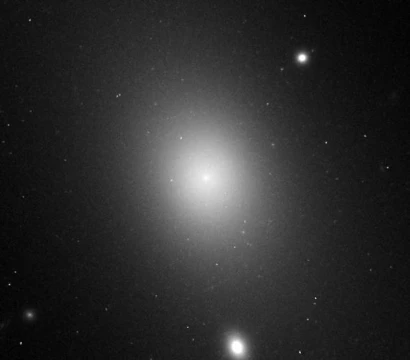
IC 1459
Giant elliptical galaxy with counter-rotating core and active nucleus.

IC 1459 (also catalogued as IC 5265) is a giant elliptical galaxy located in the constellation Grus, approximately 85 million light-years from Earth. It is notable for its fast counter-rotating stellar component, multiple shells and disturbed isophotes indicating past mergers, and an active nucleus classified as a LINER.
Quick Facts
- Epoch
- J2000
- Ra
- 22 · 57 · 10.6
- Dec
- -36 · 27 · 44
- Dist Ly
- 85 ± 27 Mly (26.2 ± 8.5 Mpc)
- Z
- 0.006011 ± 0.000039
- H Radial V
- 1,802 ± 12 km/s
- Appmag V
- 10.0
- Constellation Name
- Grus
- Notes
- Radio galaxy
- Names
- IC 5265, ESO 406- G030, AM 2254-364, MCG -06-50-016, PKS 2254-367, PGC 070090
Facts from the source article.
Lore & Background
IC 1459 was discovered by Edward Emerson Barnard in 1892. It is a giant elliptical galaxy with a fast counter-rotating stellar component in its core, estimated to have a total mass of 3×10^9 M☉. The stars of this component have circular orbits on a flat disk with a radius of less than two arcseconds. It has been suggested that these stars are of external origin, either from accretion of a stellar satellite or a dense molecular cloud. The galaxy also features multiple shells and disturbed isophotes, indicating it has accreted material via mergers of smaller galaxies. Enhanced photography revealed a diffuse spiral pattern in its outer regions.
A merger may have started a starburst event lasting less than 80 million years. Young stars make up approximately 3% of the total stellar population, with an average age of 400 million years. Metallicity decreases with radial distance from the center. The nucleus is active and classified as a LINER, with a supermassive black hole at its center. Estimates of the black hole's mass based on stellar velocities are (2.6±1.0)×10^9 M☉, while gas kinematics give lower estimates from (1-4)×10^8 to 10^9 M☉, though non-gravitational forces on the circumnuclear gas render those less accurate. The circumnuclear region contains dust with irregular distribution, indicating nonequilibrium motions.
The galaxy is low-power radio loud with a gigahertz-peaked spectrum and two symmetrical radio jets. It shows little variability over a 3.5-year observation period. Weak X-ray emission is present, with the nucleus appearing unabsorbed in lower energy X-rays (luminosity 7.9×10^40 ergs s-1). The Fe-Kα fluorescence line is not strong, and infrared emission is less than expected for an AGN hidden by a dust torus, indicating the AGN is seen unobstructed. The galaxy has an X-ray halo whose modeling indicates dark matter at distances larger than 3 effective radii. Hubble Space Telescope images revealed 199 globular clusters, with a decrease near the core and statistically non-significant evidence of dimodal color distribution.
Reader's Guide
IC 1459 is significant as the brightest galaxy in the IC 1459 group, a loose group with many spiral galaxies, including NGC 7418, NGC 7418A, NGC 7421, IC 5264, IC 5269, IC 5269B, IC 5270, and IC 5273. This group, along with the NGC 7582 group, forms the Grus cloud, a region of elevated galaxy density lying between the Local Supercluster and the Pavo–Indus Supercluster. The group features both diffuse X-ray emission from the intergalactic medium and HI emission, suggesting it is in early stages of assembly from different subgroups. Three HI clouds associated with the group are believed to have formed from gas stripped from galaxies due to interactions.
Its legacy lies in its complex internal dynamics and merger history, evidenced by the counter-rotating stellar disk, multiple shells, and disturbed isophotes. The active nucleus, with its unobstructed view and dual black hole mass estimates, provides a case study for AGN physics and the role of non-gravitational forces. The presence of dark matter in its X-ray halo and the detection of 199 globular clusters contribute to understanding galaxy formation and evolution in a group environment.
Did You Know?
- IC 1459 has a fast counter-rotating stellar component with a total mass of 3×10^9 M☉.
- The galaxy's supermassive black hole mass is estimated at (2.6±1.0)×10^9 M☉ based on stellar velocities.
- IC 1459 is the brightest galaxy in the IC 1459 group, which is part of the Grus cloud.
- The galaxy has two symmetrical radio jets and is classified as low-power radio loud with a gigahertz-peaked spectrum.
Frequently Asked Questions
What is IC 1459?
IC 1459, also listed under the alternate catalog number IC 5265, is a giant elliptical galaxy situated roughly 85 million light-years away in the southern constellation Grus. Its overall diameter spans about 130,000 light-years, making it a substantial member of the local universe.
What makes IC 1459's structure unusual for an elliptical galaxy?
It hosts a fast counter-rotating stellar component in its core, meaning a portion of its stars orbits in the opposite direction from the bulk of the galaxy. In addition, multiple tidal shells and disturbed isophotes across its light profile point to one or more past merger events that reshaped its form.
Who discovered IC 1459 and when?
The galaxy was first recorded by the American astronomer Edward Emerson Barnard in 1892. It has since been included in the Index Catalogue under its IC 1459 designation.
What kind of active nucleus does IC 1459 possess?
Its central region is classified as a LINER (Low-Ionization Nuclear Emission-line Region), a relatively low-power form of galactic nuclear activity. Spectroscopic measurements of the stellar velocity dispersion place the central supermassive black hole at roughly 2.6 billion solar masses, with an uncertainty of about 1 billion solar masses.
Why do astronomers consider IC 1459 important for studying galaxy evolution?
The combination of a counter-rotating core, visible merger shells, and an active LINER nucleus makes it a natural laboratory for understanding how elliptical galaxies grow through collisions and how their central engines evolve. Its relatively modest distance of 85 million light-years also allows detailed follow-up observations that are harder to perform on more distant ellipticals.
More in Elliptical and Irregular Galaxies, Part 3 1-24
Spotted an error? Know more?
Reader corrections go straight into our review queue. Suggest an edit · How this site is sourced