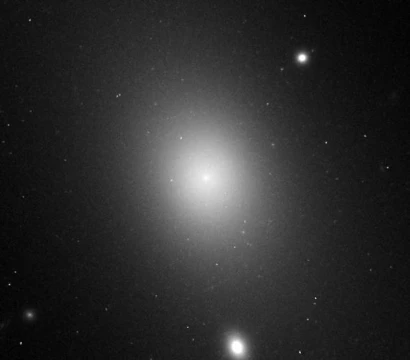
IC 711
Elliptical galaxy with the longest known head-tail radio source.

IC 711 is an elliptical galaxy in the constellation Ursa Major. It was first observed by American astronomer Lewis Swift on May 11, 1890, who described it as a typical elliptical in visible light. The galaxy has a redshift (z) of 0.031 and belongs to the Abell 1314 galaxy cluster, alongside IC 708, IC 709, and IC 712.
Classified as a narrow angle tail (NAT) radio galaxy, IC 711 features a head-tail radio source shared with IC 708. Observations from 1987 revealed a radio tail extending roughly 930 kiloparsecs from its nucleus, the longest known for this type of source. The radio head shows a strong polarization peak, indicating depolarization. Along the tail, the spectral index between 0.6 and 1.4 GHz generally increases, though it remains constant in some areas.
Further 2020 observations found the head’s spectral index is mostly flat between 240 and 1300 MHz. Using the Very Large Array, the approximate flux density is 25.92 ± 0.03 at 1.5 GHz, 24.30 ± 0.02 at 4.5 GHz, and 23.23 ± 0.01 at 7.5 GHz. The galaxy also contains twin-sided jets with an asymmetric appearance near the core. The tail is mostly straight, with at least two bends, and its spectrum steepens with distance from the head until the tail’s endpoints.
Quick Facts
- Constellation Name
- Ursa Major
- Epoch
- J2000
- Ra
- 11 · 34 · 46.55
- Dec
- +48 · 57 · 21.93
- Z
- 0.031567
- H Radial V
- 9,464 km/s ± 3
- Dist Ly
- 521 Mly (160 Mpc)
- Appmag V
- 14.1
- Names
- CGCG 242-053, MCG +08-21-062, PGC 35780, NSA 038413, WBL 339-003, NVSS J113446+485720, 2MASX J11344658+4857217
- Group Cluster
- Abell 1314
Facts from the source article.
Lore & Background
IC 711 was first discovered by American astronomer Lewis Swift on May 11, 1890, who described it as an ordinary elliptical when viewed in visible light. It is a member of the galaxy cluster Abell 1314, which also includes the galaxies IC 708, IC 709, and IC 712. When observed in 1987, it was found to display a radio tail structure extending outward from its nucleus with a wide distance of around 930 kiloparsecs, making this the longest known of this type. The galaxy hosts a head-tail radio source associated with it along with IC 708. There is a radio head feature that has signs of a major polarization peak, suggesting depolarization. From the head along the tail, the spectral index between 0.6 and 1.4 GHz frequencies is found to increase, although the spectrum does remain constant in some areas of the source. Further observations made in 2020 have shown the spectral index for the head feature is mainly flat between the frequencies of 240 and 1300 MHz, with Very Large Array showing the approximate flux density is 25.92 ± 0.03 when observed at 1.5 GHz, 24.30 ± 0.02 at 4.5 GHz, and 23.23 ± 0.01 at around 7.5 GHz. There are also twin-sided jets present in the galaxy, depicted having an asymmetric appearance in the innermost regions. Evidence also found the tail feature is mainly straight, showing at least two bends. The tail spectrum becomes more steep as the distance from the head feature increases until it reaches the end points of the tail.
Reader's Guide
IC 711 is significant as a narrow angle tail (NAT) radio galaxy, distinguished by its exceptionally long radio tail of approximately 930 kiloparsecs, the longest known of its type. This makes it a key object for studying the dynamics of head-tail radio sources in galaxy clusters. Its association with IC 708 in a head-tail radio source and its membership in Abell 1314 provide context for understanding radio galaxy interactions within clusters. The 1987 observations revealed the tail's structure, while 2020 observations using the Very Large Array provided detailed spectral index and flux density measurements across multiple frequencies, showing a flat spectral index in the head and a steepening tail spectrum. The presence of twin-sided asymmetric jets and at least two bends in the tail further characterize its morphology. These features contribute to the legacy of IC 711 as a benchmark for studying radio galaxy evolution and the effects of the intracluster medium on radio emission.
Did You Know?
- The radio tail of IC 711 extends approximately 930 kiloparsecs, the longest known of its type.
- The galaxy hosts twin-sided jets with an asymmetric appearance in the innermost regions.
Architecture and Member Composition
The Local Group takes on a distinctive dumbbell configuration, with two primary clusters of galaxies forming separate lobes. The Milky Way and its attendant satellites occupy one end, while the Andromeda Galaxy with its own retinue of companions forms the other. These two collections sit roughly 800 kiloparsecs apart and are currently closing the gap at a speed of 123 kilometers per second. Within one megaparsec of the group's center, astronomers have catalogued 134 member galaxies, the overwhelming majority being dwarf systems. Each of the two dominant spirals—both with masses near 10 to the 12th power solar masses—commands its own satellite family. Andromeda's system includes well-known objects like M32 and M110 alongside numerous fainter dwarfs, while the Milky Way's retinue spans from the Magellanic Clouds to ultra-faint spheroidals. The Triangulum Galaxy, at roughly 5 times 10 to the 10th solar masses, ranks as the third-largest member. A handful of irregular and dwarf galaxies, including IC 10 and IC 1613, appear gravitationally isolated from these major subgroups.
Scale, Mass, and Cosmic Context
The Local Group carries a total mass on the order of two trillion solar masses, equivalent to roughly 4 times 10 to the 42nd power kilograms, and spans a diameter of about 5.11 megaparsecs—approximately 17 million light-years—determined through density-matching analysis tied to its parent structure, the Local Sheet. The group's center of mass lies roughly 450 kiloparsecs from the Milky Way, placing it about 300 kiloparsecs closer to Andromeda, a positioning that hints at the latter's greater mass. In the early universe, roughly 700 million years after the Big Bang, the group's members were far more dispersed, stretching across approximately 7 megaparsecs. The Local Group does not exist in isolation; it is nested within the Local Volume, which in turn belongs to the Virgo Supercluster. Both the Virgo and the Pisces–Cetus Supercluster Complex are components of the even vaster Laniakea Supercluster, embedding our galactic neighborhood within a hierarchy of increasingly large gravitational structures.
Naming and Early Cataloguing
The very name Local Group traces back to Edwin Hubble's 1936 volume The Realm of the Nebulae, specifically Chapter VI. In that work, Hubble characterized the assembly as a representative small cluster of nebulae standing apart from the broader galactic field. He enumerated its members in order of decreasing luminosity, naming Andromeda, the Milky Way, the Triangulum Galaxy, both Magellanic Clouds, M32, NGC 205, NGC 6822, NGC 185, IC 1613, and NGC 147. He also flagged IC 10 as a probable member. Despite nearly a century of subsequent observation, the precise count of galaxies within the group remains elusive because the Milky Way's own disk obscures a portion of the sky, hiding fainter companions from detection. The current tally of 134 known members within one megaparsec of the center is therefore understood as a lower bound rather than a definitive census, and the ongoing discovery of additional ultra-faint dwarfs continues to refine the picture.
Future Coalescence and Structural Debate
Over a timescale stretching into the tens of billions of years, the mutual gravitational pull among the Local Group's members is expected to draw them together into a single, massive elliptical galaxy. The dominant event in this slow convergence will be the coalescence of Andromeda and the Milky Way, the two most massive spirals in the group. However, the precise morphological outcome remains a subject of active debate among astrophysicists. Some models predict that the merged object will assume an elliptical shape almost immediately after the collision, while others argue for an intermediate phase in which a spiral structure persists before gradually settling into ellipticity. A minority of theorists even speculate that the result could be a permanent superspiral or a transition toward a lenticular form rather than a classical ellipse. Additionally, as the combined mass of the merged galaxy grows, the zero-velocity surface of the group is expected to expand, potentially pulling currently unbound systems like the Antlia-Sextans Group into the Local Group's gravitational domain.
Frequently Asked Questions
What is IC 711 and where can it be found in the sky?
IC 711 is an elliptical galaxy located in the constellation Ursa Major. It was first catalogued by Lewis Swift in 1890, who noted its smooth, typical elliptical appearance in visible light.
What makes IC 711 stand out among other elliptical galaxies?
It is classified as a narrow-angle-tail radio galaxy and holds the record for the longest known head-tail radio source of its type. Observations from 1987 measured its radio tail stretching roughly 930 kiloparsecs from the galactic nucleus.
Who discovered IC 711 and when?
American astronomer Lewis Swift first observed IC 711 on May 11, 1890. At the time he simply described it as a typical elliptical galaxy visible in optical light.
Which galaxy cluster does IC 711 belong to?
IC 711 is a member of the Abell 1314 cluster, sharing that grouping with the nearby ellipticals IC 708, IC 709, and IC 712. Its redshift of 0.031 places it at a moderate cosmological distance.
Does IC 711 share its radio emission with any other galaxy?
Yes — its head-tail radio source is shared with IC 708, meaning the two galaxies are linked by the same extended radio structure. This shared emission is what makes the pair a notable example of a NAT radio galaxy system.
More in Elliptical and Irregular Galaxies, Part 3 1-24
Spotted an error? Know more?
Reader corrections go straight into our review queue. Suggest an edit · How this site is sourced