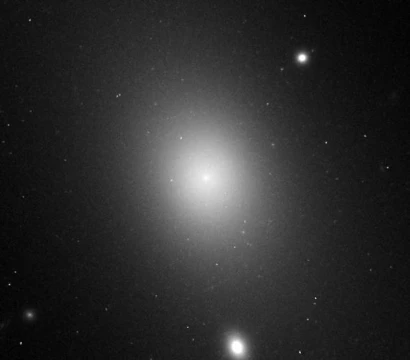
IC 2006
Small elliptical galaxy in Fornax with a counter-rotating ring.

IC 2006 is an elliptical galaxy in the constellation Eridanus, discovered on 3 October 1897 by the American astronomer Lewis A. Swift. It is notable as a small, early-type galaxy in the Fornax Cluster, with an estimated age of 8.1 ± 1.7 billion years and a ring that appears to rotate opposite to the rest of the galaxy.
Quick Facts
- Epoch
- J2000
- Constellation Name
- Eridanus
- Ra
- 03 · 54 · 28.427
- Dec
- -35 · 58 · 01.75
- Z
- 0.004610
- H Radial V
- 1382
- Dist Ly
- 20.04 +/-
- Group Cluster
- Fornax Cluster
- Appmag B
- 12.39
- Notes
- Early-type galaxy
- Names
- AM 0532-360, MGC-06-09-037, PGC 14077
Facts from the source article.
Lore & Background
IC 2006 was discovered on 3 October 1897 by the American astronomer Lewis A. Swift. It is located in the constellation Eridanus and is estimated to be around 60 to 70 million light years (20 megaparsecs) away, within the Fornax Cluster. The galaxy is one of the smaller in the cluster, with a diameter of only 35,000 light-years.
IC 2006 is an early-type galaxy with a Hubble classification of E1, but has also been listed as a lenticular galaxy with a morphological type of SA0−. Despite their name, early-type galaxies are much older than spiral galaxies, and mostly comprise old, red-colored stars. Very little star formation occurs in these galaxies; the lack of star formation in elliptical galaxies appears to start at the center and then slowly propagates outward. Its age is estimated to be 8.1 ± 1.7 billion years.
An image taken by the Hubble Space Telescope in 2015 shows a characteristically smooth profile, with no spiral arms. However, IC 2006 has a ring surrounding it. The ring appears to rotate in a direction opposite to the rest of the body, but this may be explained by a polar ring with an elliptical shape.
Reader's Guide
IC 2006 is significant as a small elliptical galaxy in the Fornax Cluster, providing an example of an early-type galaxy with a smooth profile and no spiral arms. Its estimated age of 8.1 ± 1.7 billion years and the observed cessation of star formation starting at the center and propagating outward offer insights into the evolution of elliptical galaxies. The galaxy's ring, which appears to rotate opposite to the rest of the body, is a notable feature that may be explained as a polar ring with an elliptical shape. This counter-rotation adds to the understanding of galaxy dynamics and formation. As one of the smaller members of the Fornax Cluster, IC 2006 contributes to studies of galaxy diversity within clusters. The Hubble Space Telescope image from 2015 highlights its smooth profile and the presence of the ring, underscoring its value for observational astronomy.
Did You Know?
- IC 2006 was discovered on 3 October 1897 by American astronomer Lewis A. Swift.
- It is one of the smaller galaxies in the Fornax Cluster, with a diameter of only 35,000 light-years.
Frequently Asked Questions
What is IC 2006?
IC 2006 is a small elliptical galaxy located in the constellation Eridanus, first spotted by Lewis A. Swift on October 3, 1897. It is a member of the Fornax Cluster and lies roughly 60 to 70 million light-years from Earth.
What is IC 2006's Hubble classification?
It is catalogued as E1, with some sources also listing it as SA0−, indicating a nearly spherical, early-stage elliptical with no discernible spiral structure or dust. Its smooth, featureless profile is typical of galaxies dominated by older stellar populations.
What makes IC 2006 unusual among ellipticals?
The standout feature is a ring that spins in the opposite direction from the galaxy's main body, a so-called counter-rotating ring. Astronomers suspect this oddity is the fossil record of a past merger or accretion event that flung material into a retrograde orbit.
How big and how old is IC 2006?
The galaxy spans roughly 35,000 light-years across, making it a compact elliptical compared to giants like M87. Its stellar population is estimated at about 8.1 billion years old, with an uncertainty of roughly ±1.7 billion years.
Why do fans and astronomers care about IC 2006?
Its counter-rotating ring serves as a natural laboratory for probing how galaxy mergers reshape orbital dynamics. As a small member of the dense Fornax Cluster, it also helps researchers understand how compact ellipticals evolve in crowded environments.
More in Elliptical and Irregular Galaxies, Part 3 1-24
Spotted an error? Know more?
Reader corrections go straight into our review queue. Suggest an edit · How this site is sourced