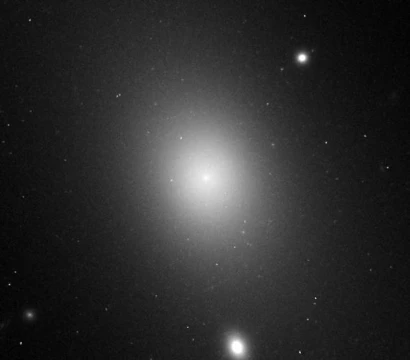
IC 708
Elliptical galaxy in Ursa Major, member of Abell 1314.

IC 708 is an elliptical galaxy situated in the constellation Ursa Major. It belongs to the galaxy cluster Abell 1314, which also contains IC 709, IC 711, and IC 712. The galaxy was first observed on May 11, 1890, by American astronomer Lewis Swift, who described it as faint, small, and round. With a redshift (z) of 0.031, IC 708 is classified as a wide-angle tail (WAT) radio galaxy, though some research also labels it a head-tail radio galaxy. Its structure includes twin jets with multiple knot features, ending at two radio lobes to the south and north, along with a nuclear radio component. Based on Very Large Array (VLA) imaging from a 1981 study, the radio structure shows a double hooked morphology, with two trails of radio emission flaring outward into diffuse emission wings about 35 kiloparsecs from the galaxy’s main optical position. This suggests gravitational interaction with IC 709. The linear polarization’s E-vector position angle roughly aligns with the jet from the core out to about 1.8 kiloparsecs, while polarized intensity drops by 0.3 mJy per beam area. From the core toward the jet axis, the linear polarization percentage increases from 1% to 10%.
Quick Facts
- Constellation Name
- Ursa Major
- Epoch
- J2000
- Ra
- 11 · 33 · 59.21
- Dec
- +49 · 03 · 43.43
- Z
- 0.031647
- H Radial V
- 9,487 km/s ± 2
- Dist Ly
- 456 Mly
- Appmag V
- 13.0
- Names
- UGC 6549, MCG +08-21-056, NFGS 086, PGC 35720, Papillon, WBL 339-001, CGCG 242-048
- Group Cluster
- Abell 1314
Facts from the source article.
Lore & Background
IC 708 was first discovered on May 11, 1890, by American astronomer Lewis Swift, who described it as faint, small, and a round object. It is a member of the galaxy cluster Abell 1314, which also includes IC 709, IC 711, and IC 712. The galaxy is categorized as a wide-angle tail (WAT) radio galaxy, though some studies have also categorized it as a head-tail radio galaxy. It contains twin jets displaying multiple knot features that terminate at the position of two radio lobes located to the south and north. A nuclear radio component is also present in the source.
A study published in 1981 found that the radio structure of IC 708 has a double hooked morphology based on Very Large Array (VLA) imaging. It has two trails of radio emission that flare outwards into a form of diffused emission wings located 35 kiloparsecs away from its main optical position, suggesting the galaxy is gravitationally interacting with IC 709. The E-vector position angle of linear polarization has a rough alignment towards the jet from the core position up to around 1.8 kiloparsecs, with the polarized intensity declining 0.3 mJy per the beam area. From the core towards the jet's axis, the linear polarization percentage rises from 1% to 10%.
Reader's Guide
IC 708 is significant as a wide-angle tail radio galaxy within the Abell 1314 cluster, with its radio morphology revealing complex interactions. The 1981 VLA imaging showed a double hooked structure, with twin jets and radio lobes to the north and south, and diffused emission wings 35 kiloparsecs from its optical center—indicating gravitational interaction with IC 709. The polarization data, showing a rough alignment of the E-vector along the jet and a rise in polarization percentage from 1% to 10% from core to jet axis, provides insight into the magnetic field structure. Its legacy lies in illustrating the dynamics of radio galaxies in clusters and the role of galaxy interactions in shaping radio emission, as preserved in the source article's findings.
Did You Know?
- A 1981 study using VLA imaging found its radio structure has a double hooked morphology.
- The galaxy's diffused emission wings are located 35 kiloparsecs from its main optical position.
The Bifurcated Serpent
Serpens holds a singular distinction among the 88 modern constellations recognized by the International Astronomical Union: it is the only one divided into two entirely non-contiguous patches of sky. The western fragment, Serpens Caput (the head), and the eastern fragment, Serpens Cauda (the tail), are separated by the continuous band of Ophiuchus, the Serpent-Bearer. In traditional figurative depictions, the serpent's body threads behind Ophiuchus, with the visual connection running between Mu Serpentis in the head and Nu Serpentis in the tail. This arrangement makes Serpens unusual not merely in its geometry but in its narrative dependency—it essentially requires another constellation to give it context and meaning. The head is bordered by Libra, Virgo, Boötes, Corona Borealis, Ophiuchus, and Hercules, while the tail sits adjacent to Sagittarius, Scutum, and Aquila. Together the two regions span 636.9 square degrees, placing Serpens 23rd in size among all modern constellations. Belgian astronomer Eugène Delporte formalized these boundaries in 1930, defining the head with a 10-sided polygon and the tail with a 22-sided polygon.
Mythological Roots Across Civilizations
In Greek mythology, the serpent is inextricably linked to Asclepius, the divine healer represented by Ophiuchus. According to legend, Asclepius once slew a snake, yet a second serpent revived the first by laying a healing herb upon it before it perished. Because snakes shed their skin annually, ancient Greeks associated them with rebirth, and the story suggests Asclepius learned to restore the dead through the same principle. The precise reason Serpens was placed alongside Ophiuchus in the sky remains uncertain, though this mythological pairing is the most commonly cited explanation. In Chinese astronomy, the stars of Serpens largely formed part of Tianshi, a wall enclosing a marketplace that also included portions of Ophiuchus and Hercules. Individual stars carried their own identities: Mu Serpentis marked Tianru, the crown prince's wet nurse or rain; other stars in the tail represented Shilou, a tower housing the market office, and Liesi, jewel shops. Babylonian astronomy recognized two serpent figures—Mušḫuššu, a dragon-lion-bird hybrid loosely matching Hydra, and Bašmu, a horned serpent corresponding to the constellation later formalized by Ptolemy in the second century.
A Treasury of Deep-Sky Wonders
Serpens Cauda is crossed by a segment of the Milky Way's galactic plane, making it exceptionally rich in deep-sky objects. The most celebrated is the Eagle Nebula, catalogued as IC 4703, which spans roughly 70 by 50 light-years and is home to the Pillars of Creation—three towering dust columns immortalized by the Hubble Space Telescope. The nebula is paired with the star cluster Messier 16. Also in the tail region are the Red Square Nebula, one of the very few astronomical objects to exhibit a genuinely square outline, and Westerhout 40, a massive nearby star-forming region comprising a molecular cloud and an H II region. Looking beyond our galaxy, Serpens harbors some of the most extreme extragalactic systems known: Seyfert's Sextet, one of the densest galaxy clusters identified; Arp 220, the prototypical ultraluminous infrared galaxy; and Hoag's Object, the most renowned member of the exceedingly rare ring-galaxy class. In Serpens Caput, the naked-eye globular cluster Messier 5 adds another layer to the constellation's deep-sky portfolio.
Stellar Highlights of the Serpent
The heart of the serpent is marked by Alpha Serpentis, traditionally named Unukalhai, a red giant of spectral type K2III that shines at apparent magnitude 2.63 and sits roughly 23 parsecs from Earth. Its warm glow is easily visible to the naked eye even under moderately light-polluted skies, and a faint companion star orbits nearby, though it eludes unaided observation. Close by, Lambda Serpentis offers a more familiar stellar profile: a magnitude 4.42 star resembling our Sun, located just 12 parsecs away, with a confirmed exoplanet in its orbit. Serpens Caput also hosts two naked-eye variable stars, R Serpentis and Tau4 Serpentis, whose brightness fluctuates over time. In total, 108 stars within the constellation exceed the traditional naked-eye visibility threshold of magnitude 6.5, and the principal asterism is built from 11 of them. The constellation's stars carry their own Bayer designations, separate from Ophiuchus's, a legacy of Johann Bayer's early seventeenth-century cataloguing. The IAU adopted the three-letter abbreviation "Ser" in 1922 to identify the constellation in modern astronomical literature.
Frequently Asked Questions
What is IC 708?
IC 708 is an elliptical galaxy found in the constellation Ursa Major at a redshift of 0.031. It is best known for its distinctive radio emission structure.
Who discovered IC 708 and when?
American astronomer Lewis Swift first noted the galaxy on May 11, 1890. In his description, he characterized it as faint, small, and round.
What galaxy cluster is IC 708 a member of?
IC 708 belongs to the Abell 1314 galaxy cluster. Fellow members of this group include IC 709, IC 711, and IC 712.
How is IC 708 classified in radio astronomy?
It is most commonly identified as a wide-angle tail (WAT) radio galaxy, though some researchers also label it a head-tail radio galaxy. Its structure includes twin jets with multiple knots that terminate in northern and southern lobes, along with a nuclear radio component.
What is special about IC 708's jet structure?
The galaxy exhibits twin jets containing several knot features that end at two radio lobes oriented to the south and north. A nuclear radio component at the core adds further complexity to its radio signature.
More in Elliptical and Irregular Galaxies, Part 3 1-24
Spotted an error? Know more?
Reader corrections go straight into our review queue. Suggest an edit · How this site is sourced