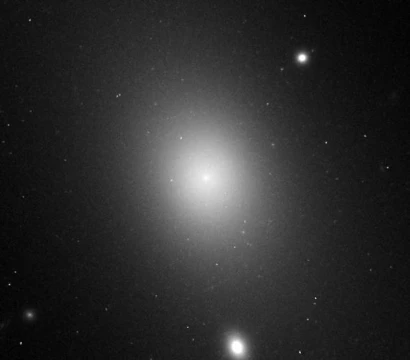
IC 4588
Elliptical galaxy in Serpens with a disputed identity and one supernova.

IC 4588 is a type E elliptical galaxy located in the constellation Serpens. It lies 729 million light-years from the Solar System and has a diameter of 64,000 light-years. Discovered by Stephane Javelle on July 15, 1903, it is notable for a historical identification dispute with NGC 6051, which O'Sullivan and associates (2011) resolved by treating them as separate entities.
Quick Facts
- Constellation Name
- Serpens
- Epoch
- J2000
- Ra
- 16 · 05 · 04.24
- Dec
- +23 · 55 · 01.69
- Z
- 0.053096
- Dist Ly
- 223.5 Mpc
- Appmag V
- 15.8
Facts from the source article.
Lore & Background
IC 4588 was discovered by Stephane Javelle on July 15, 1903. In some galactic catalogues, it has been listed as the same object as NGC 6051. However, O'Sullivan and associates (2011) treat them as separate entities, with NGC 6051 being the central dominant galaxy of a cluster. The galaxy has a diameter of 64,000 light-years and dimensions of 0.30 x 0.3 arcmin.
One supernova, SN 2023ifv, has been discovered in IC 4588. It was detected on May 13, 2023 by ATLAS (Asteroid Terrestrial-impact Last Alert System), developed by the University of Hawaii. The discovery was reported by multiple astronomers from various institutions, using a cyan-ATLAS filter on the ATLAS Haleakala telescope. The supernova reached a magnitude of 18.
On May 19, 2023, C. Fremling, D. Neill, and Y. Sharma, on behalf of the SDEM Team from Caltech and the Zwicky Transient Facility, confirmed SN 2023ifv to be a Type Ia supernova. The supernova probably resulted from the destruction of a white dwarf in a binary system.
Reader's Guide
IC 4588's significance lies in its disputed identity with NGC 6051, a case that O'Sullivan and associates (2011) clarified by distinguishing the two galaxies. This highlights the challenges in galactic cataloguing and the importance of modern reassessments. The galaxy itself is a typical elliptical, with a modest diameter of 64,000 light-years. Its legacy is further marked by the detection of SN 2023ifv, a Type Ia supernova discovered by the ATLAS system and confirmed by the SDEM Team. This supernova, resulting from a white dwarf destruction in a binary system, adds to the galaxy's observational record. The event was reported by a collaboration of astronomers from institutions including the University of Hawaii, South African Astronomical Observatory, ESO, and others, demonstrating the cooperative nature of modern astronomy. The supernova's magnitude of 18 and its classification as Type Ia provide data for studying stellar evolution and distance measurements. Overall, IC 4588 serves as a case study in both galactic identification and transient events.
Did You Know?
- It has been confused with NGC 6051 in some catalogues, but O'Sullivan and associates (2011) treat them as separate.
- One supernova, SN 2023ifv, has been discovered in IC 4588, a Type Ia supernova confirmed on May 19, 2023.
- SN 2023ifv was discovered by ATLAS, developed by the University of Hawaii, using a cyan-ATLAS filter.
Frequently Asked Questions
What is IC 4588?
IC 4588 is a type E elliptical galaxy situated in the constellation Serpens, roughly 729 million light-years from Earth. Its physical diameter spans about 64,000 light-years.
Who discovered IC 4588 and when?
French astronomer Stephane Javelle first catalogued this galaxy on July 15, 1903.
What was the IC 4588 / NGC 6051 identity dispute?
For years, astronomers debated whether IC 4588 and NGC 6051 were actually the same object seen under two catalog numbers. O'Sullivan and colleagues resolved the question in 2011 by demonstrating that the two designations refer to separate galaxies.
How large does IC 4588 appear from Earth?
The galaxy subtends roughly 0.30 by 0.3 arcminutes on the sky, making it a small target even for modest telescopes.
What else is notable about IC 4588 beyond its classification?
The galaxy has a recorded supernova event in its history and carries the lingering cataloging controversy tied to the NGC 6051 misidentification, which kept it in the discussion for decades.
More in Elliptical and Irregular Galaxies, Part 3 1-24
Spotted an error? Know more?
Reader corrections go straight into our review queue. Suggest an edit · How this site is sourced