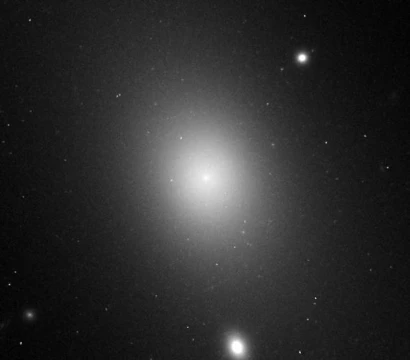
IC 4051
Elliptical galaxy with counter-rotating core and abundant globular clusters.

IC 4051 is a large elliptical galaxy in the northern constellation of Coma Berenices, located 14′ east of the core of the Coma Cluster at a distance of 330 million light-years (100 Mpc) from the Milky Way. It is notable for its peculiar counter-rotating core, an unusually large population of globular clusters comparable to a Type-cD galaxy, and a significant radial velocity difference from the cluster, suggesting it oscillates through the cluster core at high velocity.
Quick Facts
- Epoch
- J2000
- Constellation Name
- Coma Berenices
- Ra
- 13 · 00 · 54.463
- Dec
- +28 · 00 · 27.50
- Z
- 0.0110710.00003
- Dist Ly
- 100 Mpc
- Group Cluster
- Coma Cluster
- Appmag V
- 13.2
- Appmag B
- 14.17
- Absmag V
- -21.62 · 0.35
Facts from the source article.
Lore & Background
IC 4051 was discovered by French astronomer Guillaume Bigourdan on April 12, 1891. It is classified as E2, indicating a slightly oval-shaped elliptical galaxy. The galaxy has a peculiar core that counter-rotates relative to the rest of the galaxy, extending to an angular radius of 4″, corresponding to a physical radius of about 8,800 light-years (2.7 kpc). This core contains an old, metal-rich star population that contributes only 1% of the total galactic luminosity.
The galaxy displays a significant radial velocity difference from the Coma Cluster as a whole, indicating it may oscillate back-and-forth through the cluster and is now passing through the dense core at high velocity. Its structure is relatively compact, suggesting tidal trimming of its halo by the surrounding cluster. IC 4051 hosts an unusually large population of globular clusters, comparable to a Type-cD galaxy, with most appearing metal-rich. Metal-rich globulars lie within about 33,000 light-years (10 kpc) of the center, while metal-poor globulars orbit farther out in a halo.
SN 1950A, a Type I supernova, was discovered by M. L. Humason from photographic plates taken March 20 and April 11, 1950, positioned 13.0″ North and 1.5″ West of the galactic center, with magnitude 17.7±0.1 on March 20.
Reader's Guide
IC 4051 is significant as the fifth brightest galaxy within a degree of the Coma Cluster core, with an apparent visual magnitude of 13.20. Its evolutionary picture suggests it was stripped of most of its gas after its globular cluster population formed in situ, with gas carried away during early passages through the cluster core. The counter-rotating core and high-velocity motion through the cluster provide evidence of dynamical interactions within dense cluster environments. The galaxy's unusually large globular cluster population, comparable to a Type-cD galaxy, offers insights into the formation and survival of such systems under tidal stripping. The presence of SN 1950A, a Type I supernova, adds to its historical observational record. Its compact structure and radial velocity difference underscore its role as a probe of cluster dynamics and galaxy evolution in dense regions.
Did You Know?
- IC 4051 was discovered by Guillaume Bigourdan on April 12, 1891.
- SN 1950A, a Type I supernova, was discovered in IC 4051 at magnitude 17.7±0.1 on March 20, 1950.
Frequently Asked Questions
What is IC 4051?
IC 4051 is a large E2-class elliptical galaxy sitting in the northern sky within Coma Berenices, roughly 330 million light-years away. It resides just 14 arcminutes east of the Coma Cluster's core, making it a nearby member of that massive galaxy grouping.
Who discovered IC 4051 and when?
French astronomer Guillaume Bigourdan first catalogued the object on April 12, 1891. At an apparent visual magnitude of 13.2, it required the larger telescopes available to him at the time to be detected against the faint background of the cluster field.
What makes IC 4051's core unusual?
Its central region rotates in the opposite direction to the rest of the galaxy, a phenomenon known as a counter-rotating core. This suggests a past merger or accretion event that injected material spinning the other way into the galaxy's heart.
Why is IC 4051's globular cluster population noteworthy?
It hosts an unusually dense swarm of globular clusters, a number typically associated with far more massive Type-cD ellipticals. This abundance hints at a rich history of smaller galaxies being absorbed and stripped of their star clusters over billions of years.
How does IC 4051 move relative to the Coma Cluster?
Its radial velocity differs significantly from the cluster's mean, indicating it is not simply orbiting in place. Instead, it appears to be oscillating through the cluster core at high speed, plunging in and out along a stretched trajectory.
More in Elliptical and Irregular Galaxies, Part 3 1-24
Spotted an error? Know more?
Reader corrections go straight into our review queue. Suggest an edit · How this site is sourced