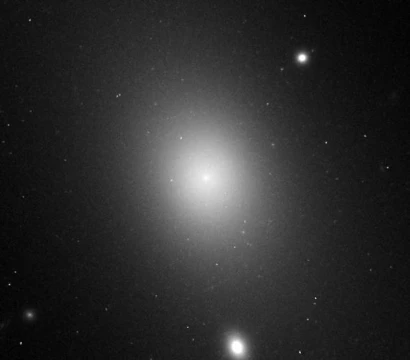
Hydra A
Giant elliptical galaxy with a violently active supermassive black hole.

Hydra A (also known as 3C 218) is a giant elliptical galaxy with an active galactic nucleus, located in the constellation Hydra. It is notable as one of the brightest X-ray sources in the sky as seen from Earth and is categorized as a Type-cD galaxy.
Quick Facts
- Epoch
- J2000.0
- Constellation Name
- Hydra
- Ra
- 09 · 18 · 05.6680
- Dec
- -12 · 05 · 43.806
- Z
- 0.054878 ± 0.00008
- H Radial V
- 16,452 km/s ± 24
- Dist Ly
- 840 Mly
- Appmag V
- 14.31
- Names
- Hydra A, MCG -02-24-007, 3C 218, PKS 0915-11, WISEA J091805.68-120543.9, PGC 26269
Facts from the source article.
Lore & Background
Hydra A was discovered in 1952 by Australian astronomer Bernard Mills during a survey of strong radio sources. It is located in the galaxy cluster ClG 0915.7-1153, which contains six galaxies and is itself part of the larger cluster Abell 780, with Hydra A likely dominating the optical center. A secondary nucleus is suggested to be located around 14 kiloparsecs from the primary nucleus at an angle of 125°.
In 2009, a Chandra X-ray Observatory study revealed that Hydra A's central black hole experienced a violent eruption that propelled iron-rich gas in the form of an extremely hot jet of matter with a temperature of 10 million K. The eruption created cavities in the hot gas, some large enough to contain the entire Milky Way, and the largest cavity spans about 670,000 light-years. The gas along the radio jets is enriched in iron and other metals, believed to have been produced by Type Ia supernova explosions.
The black hole's mass is estimated at 900,000,000 solar masses based on X-ray and radio emissions, though calculations from the eruption imply a mass of 4 billion solar masses. The eruption occurred approximately 2 to 5 million years ago, with jets having an estimated power of 1×10^61 ergs, propelling matter over 300,000 parsecs.
Reader's Guide
Hydra A's significance lies in its role as a laboratory for studying supermassive black hole feedback and galaxy cluster evolution. The 2009 Chandra study provided the first images showing that the central black hole's violent eruption propelled iron-rich gas outward over nearly 400,000 light-years, displacing 10 to 20 percent of the galaxy's iron. This event created a series of cavities in the hot intergalactic gas, with the largest cavity spanning about 670,000 light-years. The case resembles other systems such as NeVe 1, MS 0735.6+7421, and RX J1532.9+3021. The black hole's mass estimates—ranging from 900 million to 4 billion solar masses—highlight the uncertainty in measuring such objects. The eruption, caused by the fall of immense amounts of matter into the black hole (absorbing more than 0.1 to 0.25 solar masses per year), demonstrates the powerful influence of active galactic nuclei on their surrounding environment, enriching the cluster with metals and shaping the hot gas.
Did You Know?
- The galaxy's central black hole eruption created cavities large enough to contain the entire Milky Way.
- The eruption propelled iron-rich gas over distances spanning nearly 400,000 light-years.
Frequently Asked Questions
What is Hydra A?
Hydra A, also catalogued as 3C 218, is a massive elliptical galaxy located in the constellation Hydra. It hosts an extremely energetic active galactic nucleus and is classified as a Type-cD galaxy.
How far away is Hydra A from Earth?
Its redshift of 0.054 places Hydra A roughly 840 million light-years from us, making it a comparatively nearby giant elliptical that can be studied in fine detail.
What makes Hydra A one of the brightest X-ray sources in the sky?
The supermassive black hole at its center, estimated at around 900 million solar masses, drives violent accretion and outflows that generate an enormous X-ray luminosity. This extreme emission is what makes the galaxy stand out in all-sky X-ray surveys.
Who discovered Hydra A and when?
Bernard Mills identified the object in 1952. It later earned its 3C 218 designation as a strong entry in the Third Cambridge radio catalogue.
Why is Hydra A important to galaxy research?
Its combination of a giant elliptical host, a powerful active nucleus, and exceptional X-ray brightness makes it a key benchmark for studying how supermassive black holes feed back into their surroundings. Researchers use it to test models of jet formation, accretion physics, and the long-term evolution of elliptical galaxies.
More in Elliptical and Irregular Galaxies, Part 3 1-24
Spotted an error? Know more?
Reader corrections go straight into our review queue. Suggest an edit · How this site is sourced