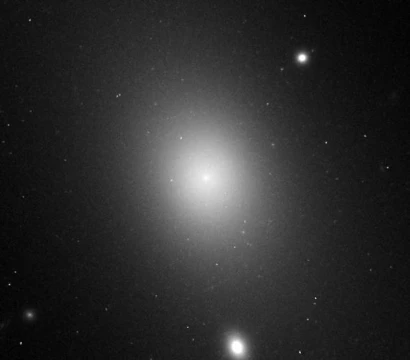
IC 1262
Brightest cluster galaxy with active nucleus and radio lobes.

IC 1262 is an elliptical galaxy in the constellation Hercules, first spotted by American astronomer Lewis Swift in June 1890, who recorded it as a 14th magnitude object. It serves as the brightest cluster galaxy of a small group bearing its name, which contains at least 31 members, and is categorized as a cD galaxy. Classified as an early-type galaxy, it shows signs of a recent merger in the form of a bright, high-surface-brightness arc feature to the east. North of this arc, the galaxy splits into high and low surface brightness regions. Its star formation rate is roughly 4.35 × 10⁻² solar masses per year, and it sits offset from its own X-ray peak.
The galaxy has an active nucleus and is identified as a radio galaxy with an ultra steep radio spectrum. It features two extended radio lobes, one north and one south, with spectral indexes of −2.23 and −19.4, respectively. At 325 MHz, the northern lobe has a flux density of about 341.2 ± 0.25 mJy, while the southern lobe measures around 855.1 ± 0.25 mJy. Radio emission extends over more than 200 kiloparsecs across a wide area. Two inner X-ray cavities lie north and south of the galaxy’s center, with a larger outer X-ray cavity also confirmed. A sharp, narrow filamentary structure runs north to south, and a loop feature 20 kiloparsecs long sits north of the galaxy. Evidence indicates IC 1262 is surrounded by a smooth, symmetric halo of hot gas.
Quick Facts
- Epoch
- J2000
- Constellation Name
- Hercules
- Ra
- 17 · 33 · 02.04
- Dec
- +43 · 45 · 34.88
- Z
- 0.032649
- H Radial V
- 9,788 km/s ± 23
- Dist Ly
- 451 Mly (138.33 Mpc)
- Appmag V
- 13.7
- Names
- 4C +43.46, 2MASX J17330202+4345345, CGCG 226-025, GIN 639, PGC 60479, UGC 10900
Facts from the source article.
Lore & Background
IC 1262 is categorized as an early-type galaxy. Observations reveal an arc-feature located east, suggested as a recent galaxy merger, with high surface brightness. The galaxy is also classified as a bright source of radio emission. A region northwards from the arc-feature is further separated into high and low surface brightness regions. The star formation rate is only around 4.35 × 10⁻² M☉ per year, and the galaxy is found offset from its X-ray peak.
Reader's Guide
The nucleus of IC 1262 is active and classified as a radio galaxy with an ultra steep radio spectrum. It has two extended radio lobes located north and south, with measured spectral indexes of −2.23 and −19.4. The flux density of the northern lobe at 325 MHz is 341.2 ± 0.25 mJy, while the southern lobe at 325 MHz is 855.1 ± 0.25 mJy. Radio emission extends more than 200 kiloparsecs over a wide area. Two inner X-ray cavities have been located north and south from the galaxy's center, with a much larger X-ray cavity on the outer side. A filamentary structure has been detected, running north to south with a sharp, narrow appearance. A loop feature north of IC 1262 has a measured length of 20 kiloparsecs. The galaxy is surrounded by a halo of hot gas with a symmetric and smooth appearance.
Did You Know?
- IC 1262 was discovered by American astronomer Lewis Swift in June 1890.
- It is the brightest cluster galaxy of a group with at least 31 members.
- The galaxy has two extended radio lobes with spectral indexes of −2.23 and −19.4.
- A loop feature north of IC 1262 measures 20 kiloparsecs in length.
Radio Origins and Early Cataloguing
The Spiderweb Galaxy's journey into astronomical awareness began not with a telescope pointed at visible light, but with the crackle of radio waves captured in the southern hemisphere. In 1948, the Council for Scientific and Industrial Research at the University of Sydney established a Radiophysics Division under Bernard Yarnton Mills, who set about developing novel instruments for radio astronomy. His Mills Cross design, eventually installed at Fleurs (today Badgerys Creek), began operations in 1964. Between 1958 and 1961, Mills, Bruce Slee, and Eric Hill compiled the Catalogue of Radio Sources—later the MSH Catalogue—recording roughly 2,200 radio emitters and marking the first systematic radio survey of the southern sky. The object we now call the Spiderweb Galaxy appeared in that catalogue at the 11:36 right-ascension list, with a spectral flux density of 28×10⁻²⁶ W·m²/Hz. Years later, the Parkes Observatory team expanded the work, and the designation 1138−26 entered the record, encoding the same coordinates in hour-minute and declination format, cementing the object's place in radio astronomy's foundational archives.
The Hubble Revelation
For nearly half a century the object existed only as a faint radio source in a catalogue. The breakthrough came when a team led by George K. Miley of the Netherlands' Leiden Observatory turned an advanced survey camera aboard the Hubble Space Telescope toward the Hydra constellation. Between May 17 and May 22, 2005, Hubble captured a mosaic of photographs that, for the first time, revealed what lay behind the radio signature. The findings were formally presented on October 10, 2006, in The Astrophysical Journal Letters (volume 650, issue 1), and the image was publicly released on October 12 of that year. What the mosaic showed shattered the assumption, drawn from decades of radio work, that the source was simply a massive elliptical galaxy. Instead, the visible-light and ultraviolet data exposed a far stranger architecture: an irregular core studded with intensely luminous knots, all woven into a structure that defied any single-galaxy classification. The Hubble mosaic transformed an anonymous catalogue entry into one of the most visually striking examples of cosmic assembly ever recorded.
Anatomy of a Spiderweb
Radio-astronomical surveys had long suggested the source was a conventional, massive elliptical galaxy—the kind that, over billions of years, settles into the gravitational heart of a galactic cluster. Ultraviolet observations complicated that picture, revealing an irregular nucleus and a string of bright knots radiating energy from within the structure. But it was the visible-light data that delivered the full surprise. Rather than a single coherent disk or spheroid, the object presents itself as a continuous, web-like network: a dominant central nucleus connected to numerous smaller nuclei scattered across the periphery, all linked in a filamentary pattern that evokes a spider's web. This architecture is consistent with a galaxy in the act of forming through the merging of entire groups and clusters of galaxies, rather than through the gradual accretion of gas and stars that builds a typical spiral or elliptical. The result is a snapshot of a process so rare and so transient that catching it in progress, let alone resolving its internal knots, was previously beyond the reach of ground-based or earlier space-based instruments.
A Window into the Cosmic Dawn
The Spiderweb Galaxy sits at a redshift of 2.156, placing it roughly 10.6 billion light-years from the Milky Way and meaning the light Hubble captured left the object when the universe was only about two billion years old. That temporal context is what elevates the discovery from a curiosity to a cornerstone of modern cosmology. At that epoch, the large-scale structures we now take for granted—clusters, superclusters, the cosmic web—were still coalescing, and the Spiderweb Galaxy appears to be one of the earliest visible examples of that assembly in action. Its irregular morphology, its network of merging nuclei, and its intense internal radiation all speak to a universe still in the throes of gravitational construction. Because the object preserves a continuous, web-like structure rather than a clean merger of two or three bodies, it offers astronomers a rare, unbroken view of how galaxy groups and clusters fuse into the massive ellipticals that dominate cluster cores today. In that sense, studying the Spiderweb Galaxy is akin to watching a building's scaffolding before the walls go up.
Frequently Asked Questions
What is IC 1262?
IC 1262 is a cD-type elliptical galaxy that serves as the brightest cluster galaxy of a small group containing at least 31 members in the constellation Hercules. It also hosts an active galactic nucleus with associated radio lobes.
Who discovered IC 1262 and when?
American astronomer Lewis Swift first catalogued this faint object in June 1890, recording it at the 14th magnitude. It was one of many deep-sky targets he was surveying during that period.
What makes IC 1262 unusual among elliptical galaxies?
A bright, high-surface-brightness arc to the galaxy's eastern side is interpreted as a remnant of a relatively recent merger. North of that arc the light profile splits into clearly distinct high- and low-surface-brightness regions, giving it a more complex appearance than a typical smooth elliptical.
How bright is IC 1262 and can I see it with a small telescope?
At an apparent magnitude of 14 it is far beyond naked-eye visibility and will require a moderately sized amateur telescope under dark-sky conditions to resolve as a faint smudge.
Is IC 1262 still forming stars?
Yes, but only at a very low rate of roughly 4.35 × 10⁻² solar masses per year, which is typical for an early-type galaxy whose gas reservoir has been largely exhausted.
More in Elliptical and Irregular Galaxies, Part 3 1-24
Spotted an error? Know more?
Reader corrections go straight into our review queue. Suggest an edit · How this site is sourced