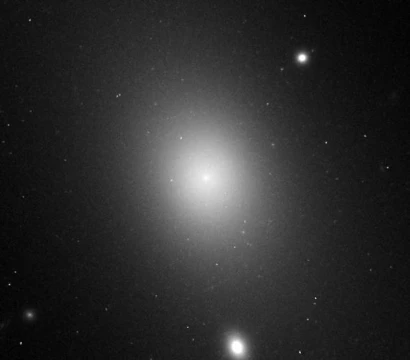
NGC 508
Elliptical galaxy in Pisces, discovered by William Herschel in 1784.

NGC 508 is an elliptical galaxy situated in the constellation Pisces, roughly 247 million light-years from Earth. It was discovered on September 12, 1784, by British astronomer William Herschel, and is also cataloged as PGC 5099 or UGC 939.
Herschel found NGC 508 together with NGC 507, noting them as "Two. Both eF, S, but unequal." John Louis Emil Dreyer, who compiled the New General Catalogue, later described it as "very faint, small, northern of two," with NGC 507 as the other object.
The galaxy spans about 1.1 by 1.1 arcminutes and has a recessional velocity of 5,525 kilometers per second. While it is often considered a group member with NGC 507, no evidence of interaction exists between them, so they may not be a true physical pair. Although NGC 508 is frequently included in the designation Arp 229, that term actually applies only to the larger NGC 507.
Quick Facts
- Epoch
- J2000
- Ra
- 01 · 23 · 40.6
- Dec
- +33 · 16 · 49
- Constellation Name
- Pisces
- Appmag B
- 14.1
- Appmag V
- 13.1
- H Radial V
- (5451 ± 21) km/s
- Dist Ly
- 247 Mly
- Z
- 0.01835 ± 0.00007
- Names
- PGC 5099, UGC 939, GC 295, MGC +05-04-045, 2MASS J01234058+3316502
Facts from the source article.
Lore & Background
Herschel discovered NGC 508 along with NGC 507 and described the objects as 'Two. Both eF, S, but unequal.' His observed position was catalogued and is accurate. John Louis Emil Dreyer, creator of the New General Catalogue, described the galaxy as 'very faint, small, northern of two', with the other object being NGC 507.
The galaxy has an apparent size of 1.1 × 1.1 arcmins and a recessional velocity of 5525 kilometers per second. It is thought to be a group member with NGC 507, but as there is no evidence of interaction between the objects, the two are not necessarily a physical pair. Although NGC 508 is usually treated as part of Arp 229, the description of the Arp-galaxy only applies to the larger NGC 507. Therefore, the term Arp 229 should only be used as an alternative designation for NGC 507.
Reader's Guide
NGC 508 is an elliptical galaxy in Pisces, discovered by William Herschel in 1784. Its significance lies in its historical observation and its ambiguous relationship with neighboring NGC 507. Herschel's original description noted both as faint and small but unequal, and Dreyer later cataloged NGC 508 as the northern of the two. The galaxy's recessional velocity of 5525 km/s and apparent size of 1.1 × 1.1 arcmins are key measured properties. While often grouped with NGC 507 under the Arp 229 designation, the article clarifies that Arp 229 properly refers only to NGC 507, as no evidence of physical interaction exists between the two. This distinction is important for astronomers studying galaxy pairs and groups, as it prevents misattribution of interaction features. The galaxy's inclusion in the New General Catalogue and its observation by Herschel contribute to its legacy as a well-documented but relatively unremarkable elliptical galaxy, notable mainly for its pairing context and the careful historical record of its discovery.
Did You Know?
- NGC 508 was discovered on 12 September 1784 by William Herschel.
- It is located approximately 247 million light-years from the Solar System.
- Although often treated as part of Arp 229, that designation properly applies only to NGC 507.
More in Elliptical and Irregular Galaxies, Part 3 1-24
Spotted an error? Know more?
Reader corrections go straight into our review queue. Suggest an edit · How this site is sourced