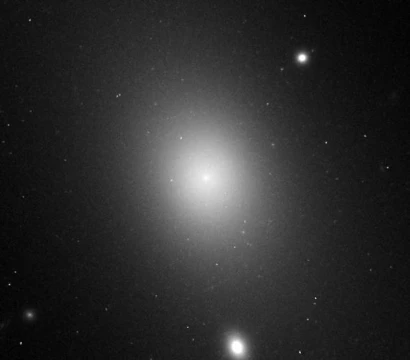
NGC 315
Massive elliptical galaxy in Pisces with a highly prolate shape.

NGC 315 is a large elliptical galaxy in the constellation Pisces. It was first observed by William Herschel in 1784. The galaxy is shaped like a highly elongated triaxial ellipsoid, with its middle axis 85.4% the length of its longest axis and its shortest axis 83.3% of that length. Its stellar mass is about 1.5 trillion times that of the Sun, and a supermassive black hole at its center has a mass of roughly 3 billion solar masses.
Measurements of its motion relative to the cosmic microwave background give a velocity of 4635 km/s, placing it at a Hubble distance of about 223 million light-years. Eight other distance estimates, not based on redshift, yield an average distance of roughly 209 million light-years. The SIMBAD database classifies NGC 315 as a LINER galaxy, meaning its nucleus emits light from weakly ionized atoms.
NGC 315 is the namesake of the NGC 315 Group (also called LGG 14), a collection of 42 galaxies that includes NGC 226, NGC 243, NGC 262, NGC 266, NGC 311, NGC 338, IC 43, IC 66, and IC 69. In a 1937 study by Erik Holmberg, NGC 315 was grouped together with the triple star NGC 313 and the star NGC 316 under the designation Holm 28.
Quick Facts
- Epoch
- J2000
- Ra
- 00 · 57 · 48.8833
- Dec
- +30 · 21 · 08.811
- Dist Ly
- 68.36 ± 4.80 Mpc
- Constellation Name
- Pisces
- Group Cluster
- NGC 315 Group
- Z
- 0.016485
- H Radial V
- 4,942 km/s
- Appmag V
- 12.2
Facts from the source article.
Lore & Background
NGC 315 was discovered by German-British astronomer William Herschel on September 11, 1784. The SIMBAD database lists it as a LINER galaxy, meaning its nucleus exhibits an emission spectrum with broad lines of weakly ionized atoms. Its shape is described as a triaxial ellipsoid that is highly prolate, with a middle-to-long axis ratio of 0.854 and a short-to-long axis ratio of 0.833.
According to A.M. Garcia, NGC 315 is the namesake of the NGC 315 Group (also known as LGG 14), which contains 42 galaxies including NGC 226, NGC 243, NGC 262, NGC 266, NGC 311, NGC 338, IC 43, IC 66, and IC 69, among others. NGC 315, along with triple star NGC 313 and star NGC 316, are listed together as Holm 28 in Erik Holmberg's 1937 work 'A Study of Double and Multiple Galaxies Together with Inquiries into some General Metagalactic Problems.'
The galaxy has a stellar mass of 1.5×10^12 M☉ and hosts a supermassive black hole at its center with a mass of 3.0×10^9 M☉. Its velocity with respect to the cosmic microwave background is 4635 ± 22 km/s, corresponding to a Hubble distance of 223.0 ± 15.7 Mly, while eight non-redshift measurements give a distance of 208.58 ± 22.28 Mly.
Reader's Guide
NGC 315 is significant as a massive elliptical galaxy whose highly prolate triaxial shape is unusual and provides insight into the dynamics of elliptical galaxies. Its classification as a LINER galaxy indicates a specific type of nuclear activity, characterized by broad emission lines from weakly ionized atoms, which helps astronomers study the processes in galactic nuclei. The galaxy's central supermassive black hole, with a mass of 3.0×10^9 M☉, is a key feature for understanding black hole–galaxy scaling relations. As the namesake of the NGC 315 Group, which contains 42 galaxies, it serves as a reference point for studying group dynamics and galaxy interactions. The distance measurements show some tension between the Hubble distance (223.0 ± 15.7 Mly) and the average of eight non-redshift measurements (208.58 ± 22.28 Mly), reflecting ongoing uncertainties in extragalactic distance determinations. Its inclusion in Holmberg's 1937 study as part of Holm 28 highlights its historical role in early investigations of multiple galaxy systems.
Did You Know?
- NGC 315 has a highly prolate triaxial ellipsoid shape with a short-to-long axis ratio of 0.833.
- It was discovered by William Herschel on September 11, 1784.
More in Elliptical and Irregular Galaxies, Part 3 1-24
Spotted an error? Know more?
Reader corrections go straight into our review queue. Suggest an edit · How this site is sourced