NeVe 1
Host of the most energetic astronomical event known.

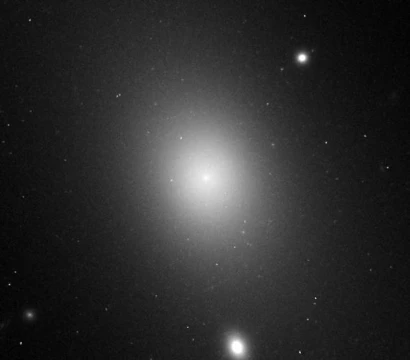
NeVe 1 is a supergiant elliptical galaxy that serves as the central, dominant member and brightest cluster galaxy of the Ophiuchus Cluster. It sits roughly 411 million light-years from Earth, hidden behind the Zone of Avoidance—a region of the sky obscured by the Milky Way’s disk. This galaxy is best known as the home of the Ophiuchus Supercluster eruption, the most energetic astronomical event ever recorded.
Because the Ophiuchus Cluster lies behind the Milky Way’s galactic plane, most of its members, including NeVe 1, are heavily blocked from view and cannot be seen with the naked eye. The galaxy is only observable at wavelengths beyond visible light, such as X-rays and infrared. When first spotted in 1985, astronomers mistook it for a planetary nebula inside the large, star-forming Rho Ophiuchi cloud complex. German astronomers Thorsten Neckel and Hans Vehrenberg cataloged it as the first entry in their Atlas of Galactic Planetary Nebulae (hence the name NeVe, combining their surnames), using data from the Palomar Observatory Sky Survey. This classification stuck, and the object was later included in the Strasbourg-ESO Catalogue of Galactic Planetary Nebulae in 1991. Only after a survey using six films from the ESO/SERC Sky Survey Atlas revealed at least 4,100 galaxies—including NeVe 1—did its true nature become clear. Detection of strong X-ray and radio emissions, typical of an active galactic nucleus, confirmed it was not a nearby dying star’s nebula but a massive galaxy far beyond the Milky Way.
Studying NeVe 1 in optical light is extremely difficult due to its position behind the Milky Way’s plane. Near-infrared and X-ray measurements show it is a large elliptical galaxy, likely one of the biggest near the Milky Way, with a diameter twice that of Messier 87. In 2010, observations with the Chandra X-ray Observatory revealed that NeVe 1 sits at the center of a comet-like structure within its host cluster. This shape suggests ram-pressure stripping and the merger of at least two smaller subclusters. The enormous structure may have slowed NeVe 1’s velocity through interactions involving its stars and dark matter. The head of this comet-like feature lies about 4 kiloparsecs (13,000 light-years) from the galaxy. NeVe 1 is classified as a cooling core, emitting strong X-rays that contrast with the hot intracluster medium of the Ophiuchus Cluster.
Quick Facts
- Epoch
- J2000
- Ra
- 17 · 12 · 27.74
- Dec
- -23 · 22 · 10.8
- Dist Ly
- 126.08 Mpc / (comoving distance)
- Group Cluster
- Ophiuchus Cluster
- H Radial V
- 8530.9 km/s
- Z
- 0.02846
- Appmag V
- not visible
- Constellation Name
- Ophiuchus
- Notes
- Host galaxy of the Ophiuchus Supercluster eruption
- Names
- WISEA J171227.81-232210.7; 2MASX J17122774-2322108; PGC 59827; Ophiuchus Cluster BCG; Ophiuchus A
Facts from the source article.
Lore & Background
Despite being in the relatively nearby, large Ophiuchus Cluster, NeVe 1 is heavily obscured by the Milky Way's galactic disc (the Zone of Avoidance) and is invisible to the naked eye, observable only in X-rays and infrared. When first observed in 1985, it was initially thought to be a planetary nebula within the Rho Ophiuchi cloud complex. German astronomers Thorsten Neckel and Hans Vehrenberg catalogued it as the first entry of their Atlas of Galactic Planetary Nebulae (NeVe, from their surnames). It was later incorporated into the Strasbourg-ESO Catalogue of Galactic Planetary Nebulae in 1991. Subsequent surveys using six films from the ESO/SERC Sky Survey Atlas identified at least 4,100 galaxies including NeVe 1, and detection of luminous X-ray and radio emission indicative of an active galactic nucleus led to its reclassification as a giant galaxy beyond the Milky Way.
Using near-infrared and X-ray measurements, NeVe 1 is shown to be a large elliptical galaxy—probably one of the largest near the Milky Way, with a diameter twice that of Messier 87. Observations with the Chandra X-ray Observatory in 2010 revealed that NeVe 1 sits at the center of a comet-like structure of its host cluster, indicative of ram-pressure stripping and the merger of at least two smaller subclusters. The head of this structure sits about 4 kiloparsecs (13,000 light-years) from NeVe 1, and the galaxy is classified as a cooling core with high X-ray emission in contrast to the hot intracluster medium of the Ophiuchus Cluster.
In a 2020 paper, NeVe 1 and its surrounding region were identified as an extreme example of a giant radio fossil, with a striking concave arc terminating the X-ray halo bubble and smaller mini-lobes from further AGN activity. This concave arc is part of an enormous cavity in the intracluster medium with a diameter of at least 460 kiloparsecs (1.5×10^6 ly), corresponding to an extensive radio-emitting structure. The cavity was created by an extraordinarily large AGN outburst from NeVe 1, requiring energy on the order of 5×10^54 J—the Ophiuchus Supercluster eruption, the most energetic astronomical event known. It was five times more energetic than the outburst at MS 0735.6+7421 and 4.2 million times more energetic than GRB 221009A. The outburst likely occurred no less than 240 million years ago, generated by NeVe 1's central supermassive black hole consuming an equivalent of 270 million solar masses of material, possibly from a cannibalized dwarf galaxy. The eruption occurred slowly over millions of years, releasing as much energy as thousands of gamma-ray bursts per year. The question remains how the cool core survived; it may be due to large-scale hydrodynamic activity distributing energy via Kelvin–Helmholtz instability eddies, similar to structures in the Perseus Cluster and NGC 1275.
Reader's Guide
NeVe 1's significance lies in its hosting the Ophiuchus Supercluster eruption, the most energetic astronomical event known, with an energy output of 5×10^54 J—five times greater than the previous record holder, MS 0735.6+7421, and 4.2 million times more energetic than the most powerful gamma-ray burst, GRB 221009A. This eruption, occurring over millions of years, created an enormous cavity 460 kiloparsecs in diameter in the intracluster medium, revealing the extreme power of AGN feedback in galaxy clusters. The galaxy's location behind the Zone of Avoidance makes it a challenging but important object for studying obscured cluster dynamics and the survival of cooling cores after cataclysmic events. The discovery resulted from collaboration among observatories including the Hubble Space Telescope, Chandra X-ray Observatory, XMM Newton, Murchison Widefield Array, and Giant Metrewave Radio Telescope. NeVe 1's central black hole mass, estimated at 7×10^9 M☉ (range 2.5–19×10^9 M☉), and the eruption's energy provide key benchmarks for understanding supermassive black hole growth and the most violent processes in the universe.
Did You Know?
- NeVe 1 was initially mistaken for a planetary nebula when first observed in 1985.
- Its name comes from the surnames of German astronomers Neckel and Vehrenberg.
- The Ophiuchus Supercluster eruption released 5×10^54 J of energy, the most energetic astronomical event known.
- The central black hole of NeVe 1 may have consumed 270 million solar masses of material, possibly from a cannibalized dwarf galaxy.
More in Elliptical and Irregular Galaxies, Part 3 1-24
Spotted an error? Know more?
Reader corrections go straight into our review queue. Suggest an edit · How this site is sourced