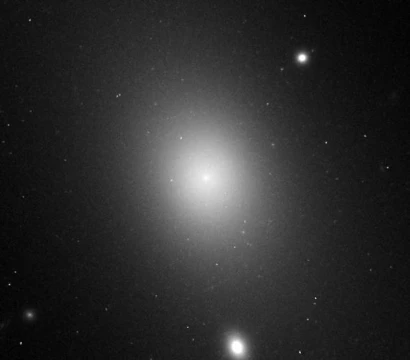
MS 1455.0+2232 BCG
Massive cD galaxy with active nucleus and strong emission lines.

MS 1455.0+2232 BCG (Brightest Cluster Galaxy) is a massive type-cD galaxy located in the constellation of Boötes. It is the brightest cluster galaxy of the galaxy cluster MS 1455.0+2232 and was first discovered as an astronomical radio source in April 1998. Notable for its active nucleus and strong emission lines, it exhibits a blue continuum and a boxy appearance, with ongoing star formation and molecular gas outflows.
Quick Facts
- Epoch
- J2000.0
- Constellation Name
- Boötes
- Ra
- 14 · 57 · 15.08
- Dec
- +22 · 20 · 34.29
- Z
- 0.257620
- H Radial V
- 77,233 km/s ± 0
- Dist Ly
- 3.736 Gly (1145.56 Mpc)
- Group Cluster
- MS 1455.0+2232
- Mag J
- 14.71
- Names
- RX J1457.3+2220, LEDA 1668167, NVSS J145715+222036, SDSS J145715.10+222034.4, 2MASX J14571507+2220341
Facts from the source article.
Lore & Background
MS 1455.0+2232 BCG is classified as a central cluster galaxy (CCG) of MS 1455.0+2232. Its optical spectrum displays strong, narrow emission lines with a full width at half maximum of 500 kilometers per second, and a blue continuum that is enhanced. The galaxy's central core has a blue appearance, and its overall shape is categorized as boxy. The nucleus is active and classified as a radio galaxy, containing a compact radio source described as point-like, with a central compact component surrounded by an extended halo. The radio core remains unresolved, but the source separates into a western component slightly misaligned with the galaxy and an eastern extension.
Reader's Guide
The significance of MS 1455.0+2232 BCG lies in its role as the brightest cluster galaxy of MS 1455.0+2232, offering insights into galaxy evolution in dense environments. Its active nucleus and radio emission, including a compact source with a halo, highlight its nature as a radio galaxy. The detection of molecular gas with a mass of 6.1 ± 2.4 × 10^10 M☉ and outflows at 1,227 M☉ per year indicates ongoing feedback processes. A star formation rate of 36 ± 4 M☉ per year, measured via ultraviolet excess, and young blue stellar populations with mean ages of 3440 ± 680 million years suggest recent moderate star formation. The galaxy's boxy morphology and enhanced blue continuum further characterize its dynamic state, making it a key object for studying galaxy-cluster interactions and active galactic nuclei.
Did You Know?
- Its molecular gas outflow rate is approximately 1,227 M☉ per year.
- The galaxy contains two stellar components in its inner region with mean ages of 3440 ± 680 million years.
- The total flux density of its compact radio component is 11.93 ± 1.24 mJy.
More in Elliptical and Irregular Galaxies, Part 3 1-24
Spotted an error? Know more?
Reader corrections go straight into our review queue. Suggest an edit · How this site is sourced