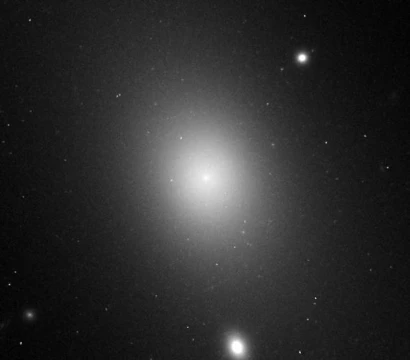
MS 0839.8+2938 BCG
Giant elliptical radio galaxy with a blue color and active nucleus.

MS 0839.8+2938 BCG is a giant elliptical galaxy, classified as type-cD and Hubble type E2, residing in the constellation Cancer. It serves as the dominant and brightest member of the cluster MS 0839.8+2938 (also cataloged as 1E 0839.9+2938), with a redshift of 0.193. Astronomers first identified this galaxy in September 1989.
The galaxy appears blue, and its optical spectrum is dominated by strong emission lines. A faint secondary nucleus lies to the northeast at a position angle of 75°. Its isophotes are described as disky. The far-infrared star formation rate is 4.1 ± 0.5 M☉, with a continuous rate of about 1.05 M☉, and the total stellar mass is roughly 40.7 × 10⁶ M☉. The K-band magnitude is 13.42.
The nucleus is active and hosts a powerful radio source, classifying MS 0839.8+2938 BCG as a radio galaxy. This source has a radio luminosity of 1.1 × 10²⁴ W Hz⁻¹ and a compact structure, dominated by a core with lobes extending 80 kiloparsecs. Radio flux density measurements from the Very Large Array (VLA) in C and B configurations give values of 26 ± 1 mJy and 25 ± 1 mJy, respectively. Low Frequency Array (LOFAR) imaging reveals a central radio component with small lobes, but no clear X-ray cavities are associated with them. Extended hydrogen alpha and doubly ionized oxygen emission centered on the galaxy suggest cooling flows are present.
Quick Facts
- Epoch
- J2000.0
- Constellation Name
- Cancer
- Ra
- 08 · 42 · 55.97
- Dec
- +29 · 27 · 27.03
- Z
- 0.193663
- H Radial V
- 58,059 ± 13 km/s
- Dist Ly
- 855.57 ± 59.89 Mpc
- Group Cluster
- MS 0839.8+2938
- Mag J
- 14.47
- Names
- 2MASX J08425596+2927272, OGC 0376, NVSS J084255+292727, LEDA 139129, RX J0842.9+2927, MS 0839.8+2938:[HDH2012] BCG, GALEX J084256.0+292728
Facts from the source article.
Lore & Background
MS 0839.8+2938 BCG is categorized as a giant elliptical galaxy with an E2 Hubble classification. Its color is blue, and its optical spectrum mainly displays signatures of strong emission lines. The galaxy has a faint secondary nucleus located in the northeast with a position angle of 75°. Its appearance has been described as having disky isophotes. The far-infrared star formation rate is estimated to be 4.1 ± 0.5 M☉, with a continuous star formation rate of around 1.05 M☉ and a total stellar mass of around 40.7 × 10^6 M☉. The nucleus is active and contains a strong radio source, with a radio luminosity of 1.1 × 10^24 W Hz−1. The radio source has a compact appearance, mainly dominated by a radio core with radio lobes extending for 80 kiloparsecs. Radio imaging made with the Low Frequency Array (LOFAR) shows a central radio component with small lobes. There is no clear evidence of any X-ray cavities associated with the lobes. A study also found the BCG displays extended hydrogen alpha emission and doubly ionized oxygen emission mainly centering on it, indicating signs of cooling flows.
Reader's Guide
MS 0839.8+2938 BCG is significant as a dominant cluster galaxy that exhibits both active galactic nucleus activity and ongoing star formation, unusual for a giant elliptical. Its blue color and strong emission lines suggest recent or continuous star formation, with a star formation rate of 4.1 ± 0.5 M☉ per year. The presence of a strong radio source with lobes extending 80 kiloparsecs classifies it as a radio galaxy, while the lack of X-ray cavities around the lobes leaves open questions about the interaction between the radio jets and the intracluster medium. The detection of extended hydrogen alpha and doubly ionized oxygen emission centered on the galaxy indicates cooling flows, where hot gas in the cluster cools and falls toward the galaxy. Its legacy lies in providing a case study of a BCG that combines star formation, a radio-loud active nucleus, and cooling flows, offering insights into the coevolution of galaxies and their cluster environments.
Did You Know?
- MS 0839.8+2938 BCG was first discovered by astronomers in September 1989.
- The galaxy has a blue color and an E2 Hubble classification.
- Its radio lobes extend for 80 kiloparsecs.
- The galaxy displays extended hydrogen alpha and doubly ionized oxygen emission, indicating cooling flows.
More in Elliptical and Irregular Galaxies, Part 3 1-24
Spotted an error? Know more?
Reader corrections go straight into our review queue. Suggest an edit · How this site is sourced