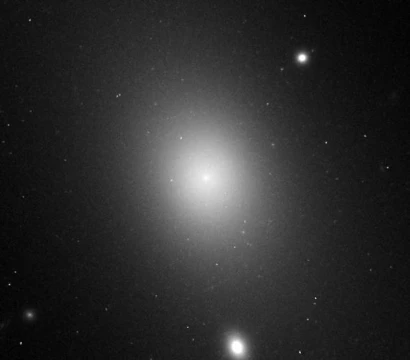
MS 0440+0204 BCG
A merging cD galaxy with multiple nuclei and gravitational lens arcs.

MS 0440+0204 BCG is a massive elliptical galaxy classified as type-cD, situated in the constellation Taurus. It serves as the brightest cluster galaxy at the heart of the MS 0440+0204 galaxy cluster, and its multiple nuclei reveal that it is formed from six merging galaxies or components. The two known components have a velocity difference of about 2,600 kilometers per second, and the entire system is enveloped by a low-surface-brightness halo spanning 157 kiloparsecs in diameter. The galaxy’s core appears red, with a total near-ultraviolet magnitude of 21.84 ± 0.44, and its total mass is estimated at 0.53 × 10¹² solar masses.
The stellar population in the BCG is intermediate in age, lacking any young stellar component. Stars in the inner regions are around 4,370 ± 160 million years old, while those in the outer regions are roughly 15,400 ± 6,280 million years old. A 1993 study using CCD imaging detected 15 gravitational lensing arcs around the BCG; the largest arc is 10 arcseconds long but unresolved, while the other arcs trace a radius of 90 kiloparsecs. Hydrogen-alpha emission has also been detected, suggesting possible cooling flow within the galaxy. In 2009, the BCG was identified as a radio galaxy, with a radio power of 34.2 ± 0.1 × 10²³ W Hz⁻¹ and a radio flux density of 30.2 ± 0.07 mJy.
Quick Facts
- Epoch
- J2000.0
- Constellation Name
- Taurus
- Ra
- 04 · 43 · 09.78
- Dec
- +02 · 10 · 19.83
- Z
- 0.198680
- H Radial V
- 59,563 ± 39 km/s
- Dist Ly
- 877.56 ± 61.43 Mpc
- Group Cluster
- MS 0440+0204
- Mag J
- 13.23
- Names
- 2MASX J04430994+0210190, LEDA 1218292, MS 0440+0204:[BHB2008] BCG, NVSS J044309+021013, RX J0443.1+0210, VLSS J0443.1+0210
Facts from the source article.
Lore & Background
MS 0440+0204 BCG has a compact appearance and is composed of six close galaxies or components merging together. The velocity difference between two known components is estimated at 2,600 kilometers per second. A low surface brightness halo with a diameter of 157 kiloparsecs envelops these components. The core appears red, with a total near ultraviolet magnitude of 21.84 ± 0.44. The galaxy contains an intermediate red stellar population but no young stellar component; stars in the inner regions have an estimated age of 4,370 ± 160 million years, while outer-region stars are around 15,400 ± 6,280 million years old. A study published in 1993 found 15 gravitational lensing arc features surrounding the BCG based on CCD imaging. The largest known arc has a length of 10 arcseconds but is unresolved, while the other arcs trace out a 90 kiloparsec radius. Detections of hydrogen-alpha emission suggest cooling flow may be present. In 2009, the BCG was found to contain a radio source, classifying it as a radio galaxy, with a radio power of 34.2 ± 0.1 × 10^23 W Hz−1 and a radio flux density of 30.2 ± 0.07 mJy.
Reader's Guide
MS 0440+0204 BCG is significant as a massive cD galaxy at the center of its cluster, exhibiting multiple nuclei that reveal an ongoing merger of six components. Its gravitational lensing arcs—15 features detected in 1993, including a 10-arcsecond unresolved arc—provide a natural laboratory for studying dark matter distribution and galaxy cluster mass. The presence of hydrogen-alpha emission and a cooling flow signature suggests ongoing gas accretion and star formation suppression, consistent with its lack of a young stellar population. The galaxy's classification as a radio galaxy, confirmed in 2009, adds to its importance as a source of non-thermal emission. The age gradient—inner stars at 4,370 million years and outer stars at 15,400 million years—indicates a complex formation history, with older stars in the halo and younger stars in the core from mergers. Its total mass of 0.53 × 10^12 M☉ and low surface brightness halo of 157 kiloparsecs make it a key object for understanding the assembly of brightest cluster galaxies.
Did You Know?
- MS 0440+0204 BCG contains six close galaxies or components merging together.
- The largest gravitational lensing arc around the BCG is 10 arcseconds long but unresolved.
- The galaxy's radio power is estimated at 34.2 ± 0.1 × 10^23 W Hz−1.
- Stars in the outer regions of the BCG are around 15,400 ± 6,280 million years old.
More in Elliptical and Irregular Galaxies, Part 3 1-24
Spotted an error? Know more?
Reader corrections go straight into our review queue. Suggest an edit · How this site is sourced