MRC 2011−298
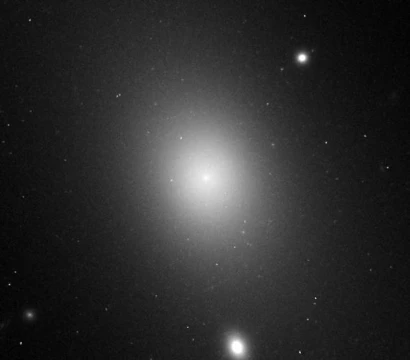
An X-shaped radio galaxy with two nuclei and a dumbbell structure.

MRC 2011−298 is an elliptical galaxy with an active galactic nucleus, located in the constellation of Sagittarius, approximately 2.1 billion light-years from Earth. It is notable as the brightest cluster galaxy in Abell 3670 and is classified as a dumbbell galaxy, featuring two galactic nuclei separated by about 17 kpc. Its peculiar X-shaped radio morphology and high supermassive black hole mass make it a significant object for studying galaxy mergers and jet dynamics.
Quick Facts
- Epoch
- J2000.0
- Constellation Name
- Sagittarius
- Ra
- 20 · 14 · 18.86
- Dec
- -29 · 42 · 36.02
- Z
- 0.136620
- H Radial V
- 40,958 km/s
- Dist Ly
- 2.115 Gly (648.5 Mpc)
- Group Cluster
- Abell 3670
- Appmag V
- 0.229
- Appmag B
- 0.303
- Names
- PMN J2014−2942, PGC 726073, NVSS J201418−294234, TXS 2011−298, 2MASX J20141866−2942364
- Notes
- Radio galaxy
Facts from the source article.
Lore & Background
MRC 2011−298 lies in the rich galaxy cluster which is located at redshift z = 0.142. Its radio source, observed at 5.5 GHz using the Very Large Array, exhibits an X-shaped morphology: a pair of bright lobes oriented north–south and a pair of weak wings oriented east–west, with an angle of about 90° between them. The primary lobes contain jets with hotspots, but the wings do not host jets. The total length of the lobes is about 145 kpc, while the eastern wing extends to about 180 kpc and the western wing to about 145 kpc. The ratio between the projected lengths of the wings and lobes is 2.8. The radio jets are characterized by curvature and an S-shaped structure, with no hotspots present. The galaxy is classified as an FRI-type X-shaped radio galaxy based on its radio power.
Reader's Guide
MRC 2011−298 is significant as an X-shaped radio galaxy (XRG) with a dumbbell optical structure, indicating a recent or ongoing galaxy merger. Its radio power, measured at 1.4 GHz as (1.7 ± 0.1) × 10^25 W Hz⁻¹, is intermediate between typical FRI and FRII radio galaxies, consistent with other XRGs. The hydrodynamical model suggests that jets aligned with the major axis of the high-ellipticity galaxy cause backflow plasma to redirect along the minor axis, forming the wings. A variant of the buoyant backflow model proposes supersonic ejection along the steepest pressure gradient, leading to subsonic evolution of the wings. Evidence of stellar shells and neutral and molecular hydrogen (mass ~4 × 10^7 M☉, density ~4 × 10⁻² cm⁻³) supports a merger with a disk galaxy, which triggered the active black hole. The high supermassive black hole mass may have reoriented the jets, making the primary lobes evolve along a new direction while the wings remain as fossil emissions. This suggests MRC 2011−298 is the end product of several galaxy mergers, sharing characteristics of dominant cluster galaxies.
Did You Know?
- MRC 2011−298 is classified as a dumbbell galaxy with two galactic nuclei separated by about 17 kpc.
- Its X-shaped radio structure includes primary lobes with hotspots and wings without jets.
- The galaxy contains stellar shells and neutral hydrogen with an estimated mass of 4 × 10^7 M☉.
More in Elliptical and Irregular Galaxies, Part 3 1-24
Spotted an error? Know more?
Reader corrections go straight into our review queue. Suggest an edit · How this site is sourced