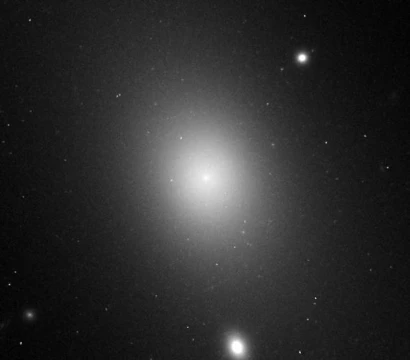
MRC 0051–097
Elliptical radio galaxy in Cetus, brightest cluster galaxy.

MRC 0051–097, which goes by the alternative identifiers OGC 666 and NYU-VAGC 0306384, sits in the constellation Cetus. This elliptical galaxy is the brightest member of the WHL J005354.2–092823 cluster, a grouping that includes 47 confirmed candidate galaxies. Astronomers using the Molongo Radio Telescope first spotted it in February 1981.
The galaxy has an R-band magnitude of 17.03 and an absolute magnitude estimated at -23.62. Its stellar velocity dispersion measures 308 kilometers per second, and its effective radius spans 15.7 kiloparsecs, giving it a physical size of 347 kiloparsecs. On sub-arcsecond scales, the radio source appears mostly compact. The NRAO VLA Sky Survey (NVSS) recorded a total flux density of 0.337 mJy at 1400 MHz, with a solar elongation of 34.9°. The spectral index is -0.83α, and the scintillation index falls below 0.02.
One study revealed the source is a double, with a 162 MHz flux density of 1.634 mJy and a normalized scintillation index of 18.9. Imaging from the Faint Images of the Radio Sky at Twenty-Centimeters (FIRST) survey identified four separate components linked to the source. Evidence indicates the galaxy is powered by an active galactic nucleus (AGN); its total log radio luminosity is 25.86 W Hz⁻¹, and its 1.4 GHz flux density reaches 337.4 mJy. The stellar mass is 11.39 M☉, and the 2MASS survey calculated an isophotal K-band magnitude of 12.681.
Quick Facts
- Epoch
- J2000.0
- Constellation Name
- Cetus
- Ra
- 00 · 53 · 54.20
- Dec
- -09 · 28 · 22.41
- H Radial V
- 80,915 ± 15 km/s
- Z
- 0.269904
- Dist Ly
- 1188.71 ± 83.21 Mpc
- Group Cluster
- WHL J005354.2–092823
Facts from the source article.
Lore & Background
MRC 0051–097 was first discovered by astronomers using the Molongo Radio Telescope in February 1981. It resides as the brightest cluster galaxy of the WHL J005354.2–092823 galaxy cluster, which has 47 confirmed galaxy member candidates. The galaxy's R-band magnitude is 17.03, and its stellar velocity dispersion is 308 kilometers per second, with an effective radius of 15.7 kiloparsecs. Its absolute magnitude is estimated at -23.62, and its physical size is 347 kiloparsecs.
The radio source of the galaxy is mainly compact on sub-arcsecond scales. Its total flux density at 1400 MHz is 0.337 mJy, as measured by the NRAO VLA Sky Survey (NVSS), with a calculated solar elongation of 34.9°. The spectral index is -0.83α, and the scintillation index is less than 0.02. A study found the source is a double with a 162 MHz flux density of 1.634 mJy and a normalized scintillation index of 18.9. Radio imaging by Faint Images of the Radio Sky at Twenty-Centimeters (FIRST) detected four separate components associated with the source.
Evidence indicates the galaxy is powered by its active galactic nucleus (AGN), with a total log radio luminosity of 25.86 W Hz−1 and a 1.4 GHz flux density of 337.4 mJy. The stellar mass of the galaxy is 11.39 M☉, and its K-band magnitude is 12.681, based on its isothopal K magnitude calculated by the 2MASS survey.
Reader's Guide
MRC 0051–097 is significant as a radio galaxy that serves as the brightest cluster galaxy of the WHL J005354.2–092823 cluster, with 47 confirmed galaxy member candidates. Its discovery in February 1981 by the Molongo Radio Telescope marks it as an early identified source in the MRC catalog. The galaxy's compact radio source on sub-arcsecond scales, with a total flux density of 0.337 mJy at 1400 MHz and a spectral index of -0.83α, highlights its nature as an AGN-powered system. The detection of four separate components by FIRST imaging and a double source structure at 162 MHz underscores its complex radio morphology. With a stellar mass of 11.39 M☉ and a log radio luminosity of 25.86 W Hz−1, MRC 0051–097 provides insights into the properties of elliptical galaxies in dense cluster environments and the activity of their central supermassive black holes. Its legacy lies in contributing to studies of radio galaxy evolution and cluster dynamics.
Did You Know?
- MRC 0051–097 is also known as OGC 666 and NYU-VAGC 0306384.
- It was first discovered by astronomers with the Molongo Radio Telescope in February 1981.
- The galaxy has a stellar velocity dispersion of 308 kilometers per second.
More in Elliptical and Irregular Galaxies, Part 3 1-24
Spotted an error? Know more?
Reader corrections go straight into our review queue. Suggest an edit · How this site is sourced