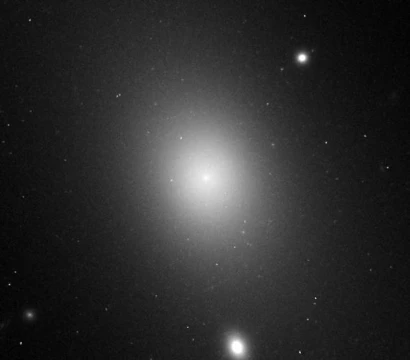
Messier 89
Elliptical galaxy in Virgo with evidence of past quasar activity.

Messier 89 (M89, also known as NGC 4552) is an elliptical galaxy in the constellation Virgo. It was discovered by Charles Messier on March 18, 1781, and is a member of the Virgo Cluster of galaxies. Its notable features include a nearly spherical appearance, a surrounding structure of gas and dust, and evidence of past activity as a quasar or radio galaxy.
Quick Facts
- Epoch
- J2000
- Constellation Name
- Virgo
- Ra
- 12 · 35 · 39.8ned
- Dec
- +12 · 33 · 23
- Appmag V
- 9.8SEDS
- Z
- 0.001134 · 0.000014
- Dist Ly
- 50 ±
- Names
- NGC 4552, UGC 7760, PGC 41968
Facts from the source article.
Lore & Background
Messier 89 may be nearly perfectly spherical, though current observations allow that it could be an ellipsoid oriented to appear spherical from Earth. It features a surrounding structure of gas and dust extending up to 150,000 light-years, with jets of heated particles reaching two-thirds of that distance, indicating it may have once been an active quasar or radio galaxy. The galaxy also has an extensive system of shells and plumes, suggesting one or several notable mergers in its history.
Chandra X-ray studies reveal two ring-like structures of hot gas in M89's nucleus, indicating an outburst 1 to 2 million years ago, as well as ram-pressure stripping as the galaxy moves through the Virgo intracluster medium. The supermassive black hole at its core has a mass of (4.8±0.8)×10^8 M☉. A 2006 survey estimates that M89 hosts 2,000 ± 700 globular clusters within 25 arcminutes, compared to the 150 to 200 thought to surround the Milky Way.
Reader's Guide
Messier 89 is significant as an elliptical galaxy that challenges simple classification due to its possible spherical shape, which is rare among easily measurable comparators. Its surrounding gas and dust structure, along with jets of heated particles, provide evidence that it may have been an active quasar or radio galaxy in the past, linking it to more energetic phases of galactic evolution. The extensive shells and plumes indicate a history of mergers, offering insights into galaxy formation and interaction processes. Chandra X-ray studies add to its legacy by revealing recent outbursts and ram-pressure stripping, which help astronomers understand how galaxies evolve within dense cluster environments. The large population of globular clusters—far exceeding that of the Milky Way—makes M89 a valuable target for studying star cluster systems and their relation to galaxy mass and history. Overall, M89 serves as a key example of how elliptical galaxies can retain evidence of past activity and interactions, informing models of galactic dynamics and evolution.
Did You Know?
- The galaxy may be nearly perfectly spherical, or an ellipsoid oriented to appear spherical from Earth.
- Chandra X-ray studies show two ring-like structures of hot gas in its nucleus, indicating an outburst 1 to 2 million years ago.
- A 2006 survey estimates M89 has 2,000 ± 700 globular clusters, far more than the Milky Way's 150 to 200.
More in Elliptical and Irregular Galaxies, Part 3 1-24
Spotted an error? Know more?
Reader corrections go straight into our review queue. Suggest an edit · How this site is sourced