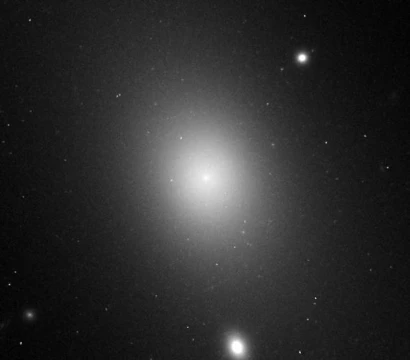
Messier 87
Supergiant elliptical galaxy with a relativistic jet and imaged black hole.

Messier 87, also called Virgo A or NGC 4486, is a supergiant elliptical galaxy located in the constellation Virgo. It contains several trillion stars and ranks among the largest and most massive galaxies in our cosmic neighborhood. Unlike the Milky Way, which has only 150 to 200 globular clusters, M87 hosts about 15,000 of them. From its core, a jet of energetic plasma shoots outward at relativistic speeds, stretching at least 1,500 parsecs (4,900 light-years). The galaxy is one of the sky's brightest radio sources and draws interest from both amateur stargazers and professional researchers.
French astronomer Charles Messier first spotted M87 in 1781, listing it as a nebula. It lies about 16.4 million parsecs (53 million light-years) from Earth and is the second-brightest galaxy in the northern Virgo Cluster, with many smaller satellite galaxies. Unlike spiral galaxies, M87 lacks distinct dust lanes and has a nearly featureless, ellipsoidal shape typical of giant ellipticals, with its light fading steadily from the center. Its stars, making up about one-sixth of its mass, are distributed in a roughly spherical pattern, becoming sparser farther from the core. At its heart sits an active supermassive black hole, the main component of an active galactic nucleus. In 2017, the Event Horizon Telescope collected data that produced the first image of this black hole, released on April 10, 2019. A follow-up polarized image in March 2021 offered new clues about the forces behind quasars.
M87 emits strong radiation across many wavelengths, especially radio waves. Its isophotal diameter measures 40.55 kiloparsecs (132,000 light-years), and a diffuse galactic envelope extends to a radius of about 150 kiloparsecs (490,000 light-years), where it appears cut off—possibly from a past collision with another galaxy. The interstellar medium contains diffuse gas enriched by elements from evolved stars.
In 1781, Charles Messier published a catalog of 103 nebulous objects meant to help avoid confusion with comets; each entry received an "M" prefix, making M87 the 87th object. During the 1880s, John Dreyer included it as NGC 4486 in the New General Catalogue, based largely on observations by John Herschel. In 1918, Heber Curtis noted M87's lack of spiral structure and spotted a "curious straight ray" linked to the nucleus by a thin line of matter, brightest near the center.
Quick Facts
- Epoch
- J2000
- Constellation Name
- Virgo
- Ra
- 12 · 30 · 49.42338
- Dec
- +12 · 23 · 28.0439
- Appmag V
- 8.6seds
- H Radial V
- 1,284 ± 5 km/s
- Z
- 0.00428 ± 0.00002
- Dist Ly
- 16.4 ± 0.5 Mpc
- Names
- Virgo A, Virgo X-1, NGC 4486, UGC 7654, PGC 41361, VCC 1316, Arp 152, 3C 274, 3U 1228+12.
Facts from the source article.
Lore & Background
The French astronomer Charles Messier discovered M87 in 1781 and cataloged it as a nebula. In 1918, American astronomer Heber Curtis noted M87's lack of spiral structure and observed a 'curious straight ray' apparently connected to the nucleus. In 1922, Russian astronomer Innokentii A. Balanowski discovered supernova SN 1919A on a photographic plate of M87. Edwin Hubble categorized M87 as a non-galactic nebula in 1922 and later classified it as an elliptical extragalactic nebula of type E0. By 1931, Hubble described M87 as a member of the Virgo Cluster.
M87 has an almost featureless, ellipsoidal shape typical of most giant elliptical galaxies, diminishing in luminosity with distance from the center. Its stars have a nearly spherically symmetric distribution, and it has no distinctive dust lanes. The galaxy is a strong source of multi-wavelength radiation, particularly radio waves. Its interstellar medium consists of diffuse gas enriched by elements emitted from evolved stars. The galaxy has a diffuse galactic envelope that extends to a radius of about 150 kiloparsecs (490,000 light-years), where it is truncated—possibly by an encounter with another galaxy.
Reader's Guide
M87 is significant as one of the most massive galaxies in the local universe and as a key object for studying supermassive black holes. In 1947, the radio source Virgo A was identified with M87, and the relativistic jet from its core was suggested as the cause. Stellar-dynamical modeling in 1978 gave evidence for a central mass of five billion solar masses, and later Hubble Space Telescope observations in 1993 measured a central black hole mass of 2.4 billion solar masses. The galaxy was observed by the Event Horizon Telescope in 2017, leading to the first direct image of a black hole's shadow, released on 10 April 2019. In March 2021, the EHT Collaboration presented a polarized-based image of the black hole. M87 has been an important testing ground for techniques measuring central black hole masses, and its globular clusters have been used to calibrate metallicity relations. It is the second-brightest galaxy within the northern Virgo Cluster and has many satellite galaxies.
Did You Know?
- M87 contains about 15,000 globular clusters, compared to the 150–200 orbiting the Milky Way.
- The relativistic jet from M87's core extends at least 1,500 parsecs (4,900 light-years) at relativistic speed.
- The first image of a black hole's shadow, from M87's central supermassive black hole, was released on 10 April 2019.
- M87 was discovered by Charles Messier in 1781 and cataloged as a nebula.
More in Elliptical and Irregular Galaxies, Part 3 1-24
Spotted an error? Know more?
Reader corrections go straight into our review queue. Suggest an edit · How this site is sourced