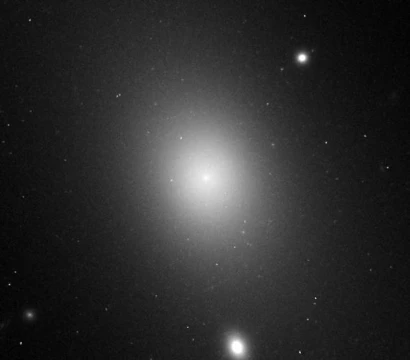
Messier 84
Giant elliptical in Virgo with jets and a supermassive black hole.

Messier 84 (NGC 4374) is a giant elliptical or lenticular galaxy located in the constellation Virgo. Charles Messier added it as the 84th entry in his catalog in 1781 while searching for fuzzy celestial objects. It sits in the dense core of the Virgo Cluster, part of the local supercluster.
Classified as type E1, the galaxy is flattened by about 10%. Its total visual luminosity, corrected for extinction, is roughly 7.64 × 10¹⁰ times that of the Sun. The mass-to-light ratio at the center is 6.5, and this ratio increases steadily outward from the core. A massive dark matter halo surrounds the visible galaxy.
Radio observations and Hubble Space Telescope images reveal two jets of matter shooting from M84’s center, along with a disk of rapidly rotating gas and stars. These features indicate a supermassive black hole with a mass of about 1.5 × 10⁹ solar masses. The galaxy contains a few young stars and star clusters, suggesting a very low rate of star formation. It hosts 1,775 ± 150 globular clusters—far fewer than expected for an elliptical galaxy. From Earth, its half-light radius spans 72.5 arcseconds, just over an arcminute.
Three supernovae have been observed in M84. SN 1957B (Type Ia, magnitude 12.5) was discovered by Howard S. Gates on 28 April 1957 and independently by Giuliano Romano on 18 May 1957. SN 1980I (Type Ia, magnitude 14) was found by M. Rosker on 13 June 1980, though it may actually belong to neighboring galaxy NGC 4387 or M86. SN 1991bg (Type Ia-pec, magnitude 14) was visually discovered by Reiki Kushida on 9 December 1991; a precovery image showed it at magnitude 14.9 on 3 December 1991. This supernova is studied as a peculiar, underluminous Type Ia and serves as a template for similar events, now classified as Type Ia-91bg-like. This high supernova rate is unusual for an elliptical galaxy and may point to a population of intermediate-age stars within M84.
Quick Facts
- Epoch
- J2000
- Ra
- 12 · 25 · 03.74333
- Dec
- +12 · 53 · 13.1393
- Dist Ly
- 16.83 Mpc
- H Radial V
- 999 km/s
- Appmag V
- 9.1seds
- Absmag V
- −22.41 · 0.10
- Constellation Name
- Virgo
Facts from the source article.
Lore & Background
Charles Messier discovered M84 in 1781 during a systematic search for 'nebulous objects' in the night sky. It became the 84th entry in his catalogue. The galaxy resides in the core of the Virgo Cluster, part of the local supercluster, and has a morphological classification of E1, indicating a flattening of about 10%.
Radio observations and Hubble Space Telescope images have revealed two jets of matter shooting from its center, along with a disk of rapidly rotating gas and stars, indicating a supermassive black hole of 1.5 ×10^9 M☉. The galaxy has a few young stars and star clusters, suggesting a very low rate of star formation. Its number of globular clusters, 1,775±150, is much lower than expected for an elliptical galaxy.
Three supernovae have been observed in M84: SN 1957B (Type Ia, mag. 12.5), SN 1980I (Type Ia, mag. 14, though possibly belonging to NGC 4387 or M86), and SN 1991bg (Type Ia-pec, mag. 14). This high supernova rate is rare for elliptical galaxies and may indicate a population of intermediate-age stars.
Reader's Guide
M84's significance lies in its role as a well-studied giant elliptical in the Virgo Cluster, offering insights into galaxy structure, dark matter, and supermassive black holes. The galaxy's visible component is surrounded by a massive dark matter halo, and its central mass-to-light ratio steadily increases away from the core. The detection of two jets and a rotating disk confirms the presence of a 1.5 ×10^9 M☉ black hole. The low number of globular clusters relative to expectations challenges models of elliptical galaxy formation. The three observed supernovae, including the peculiar and underluminous SN 1991bg (now used as a template for Type Ia-91bg-like events), are unusually numerous for an elliptical galaxy, hinting at an intermediate-age stellar population. M84's half-light radius of 72.5″ provides a measure of its angular size. Its legacy includes serving as a key object for studying black hole accretion, jet physics, and supernova diversity in early-type galaxies.
Did You Know?
- M84 has a central supermassive black hole with a mass of 1.5 ×10^9 M☉.
- Three supernovae have been observed in M84, an unusually high number for an elliptical galaxy.
- SN 1991bg in M84 is a template for peculiar, underluminous Type Ia supernovae (Type Ia-91bg-like).
More in Elliptical and Irregular Galaxies, Part 3 1-24
Spotted an error? Know more?
Reader corrections go straight into our review queue. Suggest an edit · How this site is sourced