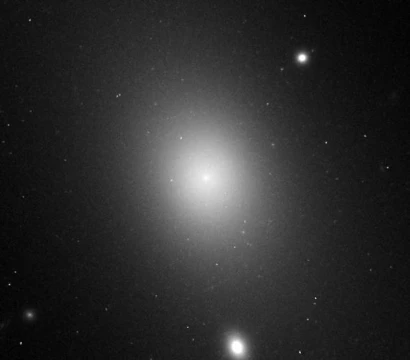
Messier 60
Giant elliptical galaxy with a massive black hole in Virgo.

Messier 60 (M60), also known as NGC 4649, is an elliptical galaxy approximately 57 million light-years away in the constellation Virgo. It is notable as the third-brightest giant elliptical galaxy of the Virgo cluster and the dominant member of the M60 group, the closest-known isolated compact group of galaxies. It hosts one of the largest supermassive black holes ever found, with a mass of 4.5 billion solar masses.
Quick Facts
- Epoch
- J2000
- Constellation Name
- Virgo
- Ra
- 12 · 43 · 40.008
- Dec
- +11 · 33 · 09.40
- Z
- 0.003726
- Dist Ly
- 17.38 Mpc
- Appmag V
- 8.8seds
- Group Cluster
- Virgo Cluster
- Names
- M60, NGC 4649, PGC 42831, UGC 7898.
Facts from the source article.
Lore & Background
Messier 60 was discovered by Johann Gottfried Koehler in April 1779 while observing a comet in the same part of the sky; Charles Messier added it to his catalogue about three days later. The galaxy is classified as type E1+1⁄2 (E1.5), though some sources class it as S0 (lenticular). Its isophotes are boxy rather than simple ellipses, and it has a near-constant mass-to-light ratio of 9.5 in the V band. The effective radius is 128 arcseconds, translating to about 10 kpc, with an estimated mass of ~10^12 solar masses within a threefold volume, nearly half of which is dark matter. X-ray emission gives a mass of (1.0±0.1)×10^12 solar masses within 5 effective radii.
At its center lies a supermassive black hole of 4.5±1.0 billion solar masses, currently inactive. X-ray observations reveal a cavity created by past jets from the hole, corresponding to weak radio lobes, with power in the range (6–7)×10^41 erg/s. One supernova, SN 2004W (Type Ia-pec, magnitude 18.8), was discovered by the Lick Observatory Supernova Search on 28 January 2004, located 51.6 arcseconds west and 78.7 arcseconds south of the nucleus.
M60 is the dominant member of a subcluster of four galaxies, the M60 group, and has several satellite galaxies, including the ultracompact dwarf M60-UCD1 discovered in 2013. Its motion through the intercluster medium causes ram-pressure stripping of gas beyond a radius of 12 kpc. The galaxy NGC 4647 appears about 2.5 arcminutes away; their optical disks overlap, but photographic images show no evidence of gravitational interaction, suggesting they are at different distances. However, Hubble Space Telescope studies indicate a tidal interaction may have just begun.
Reader's Guide
Messier 60 holds a significant place in extragalactic astronomy. It was the fastest-moving galaxy in Edwin Hubble's landmark 1929 paper on the relationship between recession speed and distance; Hubble used a recession speed of 1090 km/s (1.8% less than the modern value of about 1110 km/s) but estimated its distance at only two million parsecs, far less than the accepted value of around 16 million parsecs. This error led him to propose a Hubble constant of 500 km/s/Mpc, whereas the present estimate is about 70 km/s/Mpc. The galaxy's supermassive black hole, one of the largest ever found, and its boxy isophotes make it a key object for studying galaxy structure and dark matter. Its membership in the Virgo cluster and the M60 group, along with its potential interaction with NGC 4647, provides insights into galaxy evolution and environmental effects such as ram-pressure stripping. The discovery of the ultracompact dwarf galaxy M60-UCD1 in 2013 further highlights its role in understanding galaxy formation.
Did You Know?
- It was the fastest-moving galaxy in Edwin Hubble's 1929 paper on the recession speed–distance relationship.
- The galaxy has a boxy isophote shape rather than simple ellipses.
- One supernova, SN 2004W, was observed in M60 on 28 January 2004.
More in Elliptical and Irregular Galaxies, Part 3 1-24
Spotted an error? Know more?
Reader corrections go straight into our review queue. Suggest an edit · How this site is sourced