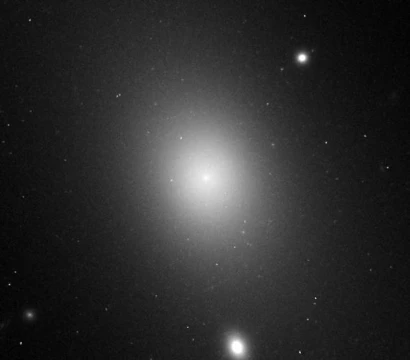
Messier 59
Elliptical galaxy in Virgo with a counter-rotating supermassive black hole.

Messier 59 (M59, NGC 4621) is an elliptical galaxy located in the constellation Virgo and belongs to the Virgo Cluster. Its nearest cluster neighbor, about 8 arcminutes away, is roughly 5 magnitudes fainter; the closest member of comparable brightness is the lenticular galaxy NGC 4638, some 17 arcminutes distant. M59 and the nearby elliptical Messier 60 were both discovered by Johann Gottfried Koehler in April 1779 while observing a comet passing nearby, with Charles Messier adding them to his catalog about three days later.
Classified as an E5 elliptical, M59 has a position angle of 163.3° and a flattening of 50%. However, its isophotes are not perfectly elliptical but pointed, and the galaxy can be mathematically modeled as three components: a main elliptical part (62% of the light), a flatter disk-like feature, and a circular halo (22% of the light). The disk contributes the remaining 16% of the luminosity, with a disk-to-elliptical light ratio of 0.25—lower than the typical 0.5 seen in lenticular galaxies.
At its core lies a supermassive black hole with an estimated mass of 270 million solar masses. This black hole counter-rotates relative to the rest of the galaxy and appears bluer. Though quiescent, it is detectable as an X-ray and radio source, indicating an outflow. The nucleus contains an embedded stellar disk that is bluer (younger) than the surrounding bulge, with a blue component extending along a position angle of about 150°. This extended disk may result from a past galactic merger followed by a starburst.
M59 is rich in globular clusters, with an estimated population of around 2,200. It has two satellite galaxies: the ultra-compact dwarf M59-UCD3 and M59cO, a rare object intermediate between compact ellipticals like Messier 32 and ultra-compact dwarfs.
One supernova has been observed in M59: SN 1939B, a Type Ia event discovered by Fritz Zwicky on 19 May 1939. It reached a peak magnitude of 11.9. The region where it occurred shows no signs of star formation, consistent with a Type Ia origin.
Quick Facts
- Epoch
- J2000
- Constellation Name
- Virgo
- Ra
- 12 · 42 · 02.322
- Dec
- +11 · 38 · 48.95
- Dist Ly
- 15.35 Mpc
- Appmag V
- 9.6seds
- Group Cluster
- Virgo Cluster
Facts from the source article.
Lore & Background
Messier 59 was discovered by Johann Gottfried Koehler in April 1779 while observing a comet that seemed close by. Charles Messier listed it in the Messier Catalogue about three days after Koehler's discovery. It is an elliptical galaxy of type E5 with a position angle of 163.3°, indicating a flattening of 50%. However, its isophotes deviate from perfect ellipticity, showing pointed shapes. These can be decomposed into a three-component model: a main elliptical part (62% of luminosity), a flatter disk-like feature, and a circular halo (22% of luminosity). The light ratio of the disk to the main elliptical body is 0.25, lower than the typical 0.5 in lenticular galaxies.
The core contains a supermassive black hole with an estimated mass of 270 million solar masses, which counter-rotates relative to the rest of the galaxy and is bluer. The black hole is quiescent but detectable as an X-ray and radio source indicating an outflow. The nucleus contains an embedded stellar disk that is bluer (younger) than the bulge, with a blue component stretching along a position angle of around 150°. This extended disk feature may result from a galactic merger followed by a starburst event.
Messier 59 is very rich in globular clusters, with an estimated population of about 2,200. It has two satellites: the ultra compact dwarf galaxy M59-UCD3 and M59cO, a rare example of a galaxy between compact ellipticals and ultra compact dwarfs. One supernova has been recorded: SN 1939B (Type Ia, mag. 15), discovered by Fritz Zwicky on 19 May 1939, reaching a peak magnitude of 11.9. The region shows no trace of star formation, consistent with a Type Ia supernova.
Reader's Guide
Messier 59 is significant as an elliptical galaxy that challenges simple classification due to its complex structure, including a disk-like component and a circular halo. Its supermassive black hole, which counter-rotates and is bluer than the galaxy, provides insight into galaxy mergers and black hole dynamics. The galaxy's rich globular cluster population (about 2,200) and its two satellite galaxies, including the rare M59cO, make it a valuable target for studying galaxy formation and evolution. The detection of a Type Ia supernova (SN 1939B) in a region with no star formation reinforces the standard model for such supernovae. Its legacy lies in its role as a nearby example of an elliptical galaxy with unusual internal motions and structure, contributing to understanding of how galaxies assemble and evolve within the Virgo Cluster.
Did You Know?
- Its supermassive black hole has an estimated mass of 270 million solar masses and counter-rotates relative to the galaxy.
- The galaxy has about 2,200 globular clusters and two satellite galaxies, including the rare M59cO.
- Only one supernova has been recorded in M59: SN 1939B, a Type Ia discovered by Fritz Zwicky.
More in Elliptical and Irregular Galaxies, Part 3 1-24
Spotted an error? Know more?
Reader corrections go straight into our review queue. Suggest an edit · How this site is sourced