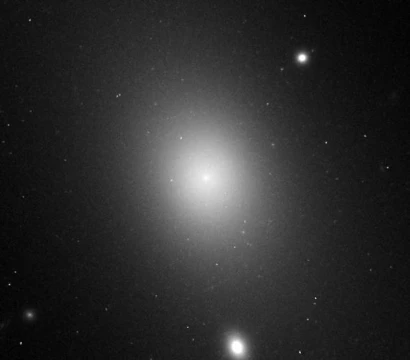
Messier 49
First discovered Virgo Cluster member, a giant elliptical galaxy.

Messier 49, also cataloged as NGC 4472, is a giant elliptical galaxy located roughly 56 million light-years away in the constellation Virgo. Discovered by Charles Messier in 1777, it was the first galaxy found to belong to the Virgo Cluster. It also holds the title of the cluster’s most luminous member, outshining any galaxy closer to our own.
Despite its elliptical shape resembling that of a radio galaxy, M49 emits radio waves at the level of a normal galaxy. Its core contains about 10^53 erg of synchrotron energy. X-ray emissions from the nucleus point to a supermassive black hole with an estimated mass of 565 million times that of the Sun. To the north, the X-ray data reveal a bow-shock-like structure, while the galaxy’s luminous outline extends 260 kiloparsecs to the southwest.
M49 hosts an estimated 5,900 globular clusters—far more than the Milky Way’s 200, but fewer than the 13,450 found in the supergiant elliptical Messier 87. These clusters average about 10 billion years old. Between 2000 and 2009, strong evidence emerged for a stellar-mass black hole within one of them, and a second candidate was announced in 2011.
The galaxy sits in the Virgo B subcluster, about 4.5 degrees from the cluster’s dynamic center near Messier 87. It is gravitationally interacting with the dwarf irregular galaxy UGC 7636, which shows a debris trail spanning roughly 1 by 5 arcminutes—corresponding to 6 by 30 kiloparsecs.
Two supernovae have been observed in M49. SN 1969Q, of unknown type and magnitude 13, was spotted by Evans on June 12, 1969. SN 2024kce, a Type Ia-peculiar event at magnitude 17.5477, was discovered by the Zwicky Transient Facility on June 2, 2024. Located 12.8 arcminutes from M49’s center (a projected distance of 203,000 light-years), its high calcium content suggests it may be a calcium-rich supernova. This supernova, along with five other transients, was still visible in June 2025 when the Vera C. Rubin Observatory imaged the area.
Quick Facts
- Epoch
- J2000
- Constellation Name
- Virgo
- Ra
- 12 · 29 · 46.7
- Dec
- +08 · 00 · 02
- Appmag V
- 8.4
- Z
- 0.003326 · 0.000022
- Dist Ly
- 55.9 +/-
- Names
- NGC 4472, UGC 7629, PGC 41220, Arp 134
Facts from the source article.
Lore & Background
Messier 49 has the physical form of a radio galaxy but only the radio emission of a normal galaxy. The core region contains roughly 10^53 erg of synchrotron energy. X-ray emissions from the nucleus suggest a supermassive black hole with an estimated mass of 565 million times the mass of the Sun. X-ray observations also reveal a bow-shock-like structure to the north of the galaxy. To the southwest, the luminous outline can be traced out to 260 kpc.
The galaxy hosts an estimated 5,900 globular clusters, far more than the Milky Way's roughly 200 but fewer than the 13,450 orbiting Messier 87. On average, these clusters are about 10 billion years old. Between 2000 and 2009, strong evidence for a stellar-mass black hole was discovered in one globular cluster, and a second candidate was announced in 2011.
Messier 49 forms part of the smaller Virgo B subcluster, located 4.5° from the dynamic center of the Virgo Cluster centered on Messier 87. It is gravitationally interacting with the dwarf irregular galaxy UGC 7636, which shows a trail of debris spanning roughly 1 × 5 arcminutes (6 × 30 kpc).
Reader's Guide
Messier 49 holds significance as the first discovered member of the Virgo Cluster, the nearest large galaxy cluster to Earth. It is the most luminous galaxy in that cluster, outshining any galaxy closer to our own. Its status as a giant elliptical with radio-galaxy morphology but normal radio emission makes it an interesting case for studying galaxy evolution. The detection of a supermassive black hole via X-rays and the discovery of stellar-mass black holes in its globular clusters provide insights into black hole populations. Two supernovae have been observed in M49: SN 1969Q (type unknown, magnitude 13) discovered in June 1969, and SN 2024kce (Type Ia-pec, magnitude 17.5477) discovered in June 2024, located 12.8′ from the center. The latter showed high calcium in its spectra, suggesting it might be a calcium-rich supernova. As of June 2025, SN 2024kce and five other transients were still visible when the Vera C. Rubin Observatory imaged the area.
Did You Know?
- Messier 49 was the first member of the Virgo Cluster of galaxies to be discovered, by Charles Messier in 1777.
- A supermassive black hole with an estimated mass of 565 million solar masses is likely present in its nucleus.
- Two supernovae have been observed in M49: SN 1969Q and SN 2024kce, the latter possibly a calcium-rich supernova.
More in Elliptical and Irregular Galaxies, Part 3 1-24
Spotted an error? Know more?
Reader corrections go straight into our review queue. Suggest an edit · How this site is sourced