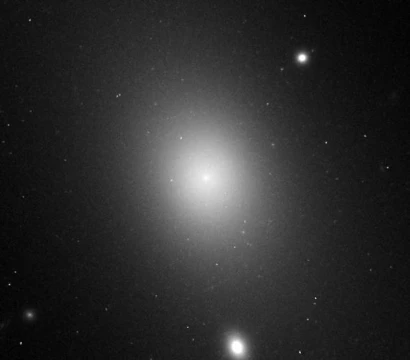
Messier 105
Elliptical galaxy in Leo, largest non-Virgo Messier elliptical.

Messier 105 (also catalogued as NGC 3379) is an elliptical galaxy situated 36.6 million light-years away in the constellation Leo. It holds the distinction of being the largest elliptical galaxy in the Messier catalogue that does not belong to the Virgo cluster. Pierre Méchain discovered it in 1781, only a few days after finding the neighbouring galaxies Messier 95 and Messier 96. Because Charles Messier never personally verified the object, it was left out of his catalogue during his lifetime. It was later added after Helen S. Hogg uncovered a letter from Méchain that gave the galaxy’s location and description, matching the details already published under its earlier designation, NGC 3379.
Classified as type E1, Messier 105 is a standard elliptical galaxy with a flattening of 10%. Its major axis is oriented at a position angle of 71°, and its isophotes are nearly perfect ellipses, twisting by no more than 5° and varying in ellipticity by less than 0.06. No fine structure such as ripples appears in these isophotes. Observations of giant stars in the halo reveal two general populations: a dominant metal-rich group and a weaker metal-poor one.
At its core, Messier 105 hosts a supermassive black hole with an estimated mass between 1.4×10⁸ and 2×10⁸ solar masses. The galaxy has a weak active galactic nucleus classified as a LINER, with a spectral class of L2/T2—meaning it lacks a broad Hα line and shows intermediate emission line ratios between a LINER and an H II region. A small number of young stars and stellar clusters are present, indicating that some elliptical galaxies can still form new stars, albeit very slowly.
Together with its companion, the barred lenticular galaxy NGC 3384, Messier 105 is encircled by a huge ring of neutral hydrogen. This ring has a radius of 200 kiloparsecs (650 kilolight-years) and a mass of 1.8×10⁹ solar masses, and star formation has been detected within it. Messier 105 is one of several galaxies in the M96 Group (also called the Leo I Group), a rich collection of galaxies in Leo that also includes M95 and M96. Unlike the Local Group, this group is dominated by several galaxies rather than just one.
Quick Facts
- Epoch
- J2000
- Ra
- 10 · 47 · 49.600
- Dec
- +12 · 34 · 53.87
- Group Cluster
- Leo I Group
- Constellation Name
- Leo
- Z
- 0.003026 · 0.00000734ned
- Dist Ly
- 11.22 Mpc
- Appmag V
- 9.3
Facts from the source article.
Lore & Background
Messier 105 has a morphological classification of E1, indicating a standard elliptical galaxy with a flattening of 10%. Its major axis is aligned along a position angle of 71°, and its isophotes are near perfect ellipses, twisting no more than 5° out of alignment, with changes in ellipticity of no more than 0.06. There is no fine structure apparent in the isophotes, such as ripples. Observation of giant stars in the halo indicates two general populations: a dominant metal-rich subpopulation and a weaker metal-poor group.
The galaxy is known to have a supermassive black hole at its core with a mass estimated between 1.4×10^8 and 2×10^8 M☉. It hosts a weak active galactic nucleus of the LINER type with a spectral class of L2/T2, meaning no broad Hα line and intermediate emission line ratios between a LINER and an H II region. The galaxy also contains a few young stars and stellar clusters, suggesting some elliptical galaxies still form new stars, but very slowly.
Messier 105, along with its companion the barred lenticular galaxy NGC 3384, is surrounded by an enormous ring of neutral hydrogen with a radius of 200 kiloparsecs (650 kilolight-years) and a mass of 1.8×10^9 M☉, where star formation has been detected. It is one of several galaxies within the M96 Group (also known as the Leo I Group), a group of galaxies in the constellation Leo, the other Messier objects of which are M95 and M96. This group is one of the richest in the Local Volume, and unlike the Local Group, it is dominated by not one but several galaxies.
Reader's Guide
Messier 105 holds significance as the largest elliptical galaxy in the Messier catalogue that lies outside the Virgo cluster, making it a key object for studying elliptical galaxies in a different group environment. Its discovery history is notable: although discovered by Pierre Méchain in 1781, it was not verified by Charles Messier and thus omitted from his catalogue editions; it was later appended after Helen S. Hogg found a letter by Méchain that located and described the object, matching the aspects under its first-published name, NGC 3379. The galaxy's morphological classification of E1, with near-perfect elliptical isophotes and no fine structure, provides a clean example of a standard elliptical. The presence of a supermassive black hole with a mass between 1.4×10^8 and 2×10^8 M☉ and a weak LINER-type active galactic nucleus adds to its astrophysical interest. The detection of a few young stars and stellar clusters challenges the traditional view that elliptical galaxies have ceased star formation, suggesting very slow ongoing star formation. The enormous ring of neutral hydrogen surrounding M105 and NGC 3384, with a radius of 200 kiloparsecs and a mass of 1.8×10^9 M☉, where star formation has been detected, highlights the galaxy's role in a dynamic group environment. As a member of the M96 Group, one of the richest groups in the Local Volume, M105 contributes to understanding galaxy interactions and evolution in a group dominated by several galaxies rather than a single dominant one.
Did You Know?
- Messier 105 is the biggest elliptical galaxy in the Messier catalogue that is not in the Virgo cluster.
- It was discovered by Pierre Méchain in 1781, just a few days after he discovered Messier 95 and Messier 96.
More in Elliptical and Irregular Galaxies, Part 3 1-24
Spotted an error? Know more?
Reader corrections go straight into our review queue. Suggest an edit · How this site is sourced