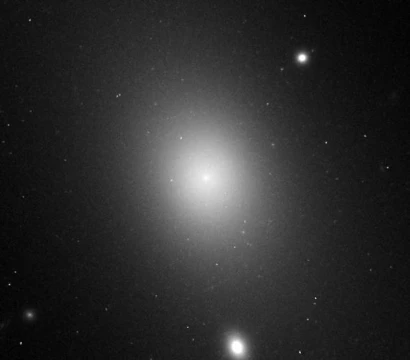
MCG-02-12-039
Brightest cluster galaxy of Abell 496, with a large halo.

MCG-02-12-039, also called A496 cD, sits in the constellation Eridanus as an elliptical galaxy. It holds the title of brightest cluster galaxy within Abell 496 and was first spotted by an astronomical team in March 1985. This galaxy falls under the Type-cD classification.
Surrounding MCG-02-12-039 is a large galactic halo, with numerous distant companion galaxies visible in the background. A December 2008 study labeled it a weak emission line galaxy. Strong extended optical emission, composed mainly of hydrogen-alpha and singly ionized nitrogen, stretches about 10 arcseconds from the central nucleus. The estimated age of a single stellar population in the galaxy is roughly 1.05 ± 0.21 billion years. At its core, three dust lanes curl anticlockwise in a spiral pattern.
The halo’s B-V color profile shows a bluer tint with increasing radius, but visual infrared observations reveal a redder profile. An elongated stellar component exists, with gas components sharing a similar but less pronounced shape. The central nucleus is blueshifted by about 125 kilometers per second. A 2020 study detected gas filaments in the galaxy, with stretched gas components suggesting a common origin. A misalignment between stellar and gas kinematics hints that the interstellar gas was accreted from an external source. The central supermassive black hole is estimated at 8.78 solar masses.
Quick Facts
- Epoch
- J2000
- Constellation Name
- Eridanus
- Ra
- 04 · 33 · 37.83
- Dec
- -13 · 15 · 42.95
- Z
- 0.032806
- H Radial V
- 9835 km/s ± 11
- Dist Ly
- 143.55 ± 10.05 Mpc
- Group Cluster
- Abell 496
- Appmag B
- 14.66
- Names
- 2MASX J04333784-1315430, ABELL 0496:[ZAC2011] BCG, Cul 0431-133, PGC 15524, GIN 189, NVSS J043337-131542
Facts from the source article.
Lore & Background
MCG-02-12-039 is the dominant galaxy of Abell 496, surrounded by a large galactic halo with many distant galaxy companions in the background. A study published in December 2008 described it as a weak emission line galaxy. There is a strong presence of extended optical emission around 10 arcseconds from the central nucleus, mainly composed of hydrogen-alpha and singly ionized nitrogen. The estimated equivalent age of a single stellar population in the galaxy is around 1.05 ± 0.21 billion years. In the center, three dust lanes uncurl in an anticlockwise direction in a spiral pattern.
The halo displays a blue profile per each increasing radius based on a B-V color profile, but when observed in visual infrared colors, the profile is redder. There is an elongated stellar component with gas components having the same morphology but to a lesser extent. The central nucleus has its parts blueshifted by around 125 kilometers per second. A study published in 2020 found gas filaments in the galaxy, with gas components described as stretched, suggesting a common origin. A misalignment between stellar and gas kinematics hints that interstellar gas is externally accreted.
Reader's Guide
MCG-02-12-039 serves as a key example of a Type-cD galaxy, the brightest member of its cluster, Abell 496. Its large galactic halo and numerous background companions highlight its role as the cluster's gravitational anchor. The weak emission line classification and extended optical emission of hydrogen-alpha and singly ionized nitrogen indicate ongoing or recent gas processes. The blueshifted central nucleus and the anticlockwise spiral dust lanes suggest complex internal dynamics. The misalignment between stellar and gas kinematics, along with stretched gas filaments, points to external gas accretion, possibly from mergers or interactions. The estimated single stellar population age of about 1.05 billion years provides a constraint on the galaxy's star formation history. The central supermassive black hole mass of 8.78 M☉ adds to understanding of black hole–galaxy scaling relations. The halo's color profile—blue in B-V but redder in visual infrared—indicates a mix of stellar populations and dust effects. These features make MCG-02-12-039 a valuable subject for studying galaxy evolution in dense cluster environments.
Did You Know?
- MCG-02-12-039 was first discovered by a group of astronomers in March 1985.
- The central supermassive black hole is estimated to be 8.78 M☉.
- Three dust lanes in the center uncurl anticlockwise in a spiral pattern.
- The galaxy's halo displays a blue B-V color profile but redder in visual infrared colors.
More in Elliptical and Irregular Galaxies, Part 3 1-24
Spotted an error? Know more?
Reader corrections go straight into our review queue. Suggest an edit · How this site is sourced