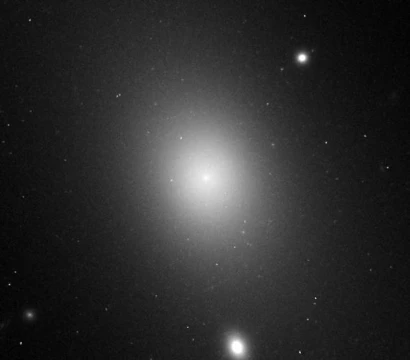
Markarian 876
Distorted elliptical Seyfert galaxy with tidal tails and a merging companion.

Markarian 876 (Mrk 876), also cataloged as PG 1613+658, is an elliptical galaxy in the constellation Draco. It is a Seyfert galaxy, moving at 36,302 ± 60 kilometers per second relative to the cosmic microwave background, placing it about 1.75 billion light-years from Earth.
The galaxy is large and has a distorted shape, with tidal tails stretching more than 50 arcseconds (85 kiloparsecs) from its body. Its structure appears lopsided and complex, featuring a secondary nucleus or bright knot 1.6 arcseconds west of the main nucleus. A barred spiral companion galaxy exists at the same redshift, suggesting the peculiar structure could stem from a strong gravitational interaction. However, since that companion lies 23 arcseconds north and shows no tidal connection, the distortion is more likely due to a past galaxy merger.
At the galaxy’s center, a supermassive black hole has an estimated mass of (2.2 ± 1.0) × 10⁸ solar masses, based on an optical reverberation campaign. An emission line from the galaxy’s source has a rest-frame energy of 4.80 +0.05 −0.04 keV.
Quick Facts
- Epoch
- J2000.0
- Constellation Name
- Draco
- Ra
- 16 · 13 · 57.17
- Dec
- +65 · 43 · 09.98
- Z
- 0.121090
- H Radial V
- 36,302 km/s
- Dist Ly
- 1.752 Gly (537.16 Mpc)
- Appmag V
- 15.49
- Appmag B
- 16.03
- Names
- PGC 57553, PG 1613+658, IRAS 16136+6550, RBS 1567, 2E 3624, 2MASX J16135722+6543096
Facts from the source article.
Lore & Background
Markarian 876 is classified as a large elliptical galaxy with a lopsided and complicated structure. It exhibits tidal tails extending more than 50 arcsecs (85 kpc) from the galaxy. A secondary nucleus or knot of light is located 1.6 arcsec west of the main nucleus, and a barred spiral galaxy companion lies at the same redshift, 23 arcsecs north, though it does not appear to be tidally connected. The distorted morphology is therefore attributed to a galaxy merger rather than direct interaction with the companion.
The mass of the central black hole is estimated at (2.2 ± 1.0) × 10^8 M☉, based on an optical reverberation campaign. An emission line is detected with a rest-frame energy of 4.80+0.05-0.04 keV, associated with the galaxy's source.
Reader's Guide
Markarian 876 is significant as a nearby example of a Seyfert galaxy undergoing a merger, providing insight into the relationship between galactic interactions and active galactic nuclei. Its distorted morphology, including tidal tails and a secondary nucleus, directly evidences a past merger event. The black hole mass estimate from optical reverberation contributes to understanding supermassive black hole demographics in merging systems. The detection of an emission line at 4.80 keV offers a diagnostic for the physical conditions of the active nucleus. The galaxy's companion at the same redshift but without tidal connection underscores the complexity of interpreting galaxy interactions. Its legacy lies in serving as a case study for how mergers can trigger nuclear activity and shape galaxy structure.
Did You Know?
- Markarian 876 is also known as PG 1613+658.
- Its tidal tails extend more than 50 arcsecs, equivalent to 85 kiloparsecs.
- The galaxy has a secondary nucleus or knot of light 1.6 arcsec west of the main nucleus.
- The central black hole mass is estimated at (2.2 ± 1.0) × 10^8 solar masses.
More in Elliptical and Irregular Galaxies, Part 3 1-24
Spotted an error? Know more?
Reader corrections go straight into our review queue. Suggest an edit · How this site is sourced