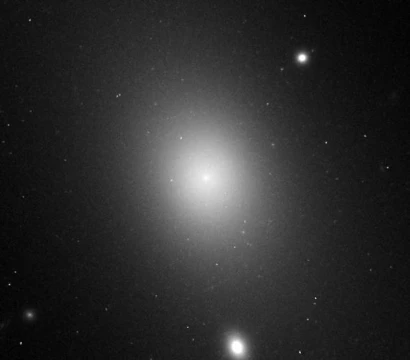
MACS J1447.4+0827 BCG
Massive elliptical BCG with AGN, filaments, and radio jets.

MACS J1447.4+0827 BCG is a massive elliptical galaxy that serves as the brightest cluster galaxy (BCG) of the X-ray luminous galaxy cluster MACS J1447.4+0827, also known as RX J1447.4+0827. It is notable for its active galactic nucleus (AGN), extensive filament structures, and powerful radio jets, making it a key object for studying galaxy-cluster interactions and AGN feedback.
Quick Facts
- Epoch
- J2000.0
- Constellation Name
- Boötes
- Ra
- 14 · 47 · 26.00
- Dec
- +08 · 28 · 25.09
- Z
- 0.375463
- Dist Ly
- 1660.48 ± 116.23 Mpc
- H Radial V
- 112,561 ± 3 km/s
- Mag J
- 15.06
- Mag H
- 14.81
- Names
- 2MASX J14472597+0828253, NVSS J144726+082825, MACS J1447.4+0827 BCG, SDSS J144726.02+082825.1 LEDA 3833752
Facts from the source article.
Lore & Background
MACS J1447.4+0827 BCG is classified as a central galaxy. When observed with the Hubble Space Telescope, it contains filament structures depicted as optically bright with an extent of around 25 kiloparsecs in total. Two of the filament structures are shown positioned from west to south and west to north respectively. The nucleus of the galaxy is active and it has been classified as a radio galaxy with the presence of strong emission lines in its optical spectrum. Radio imaging made by the Very Large Array showed a compact radio component that coincides with an X-ray source and the presence of radio emission extending outwards by 160 kiloparsecs. There is also evidence of two X-ray cavities located both north and south from the BCG, with a cavity power of 6 × 10^44 erg s−1. These cavities have an elliptical morphology and an extent of 32 kiloparsecs. Two collimated radio jets emerge outwards with a measured radius of 20 kiloparsecs. A diffused component extends from the inner jet regions, estimated to have a spectral index of -1.2 ± 1.0 and a total radio power of 3.0 ± 0.3 × 10^24 W Hz−1. A study also found the jets are aligned together with the cavities. The mass of the central supermassive black hole of the BCG is estimated to be in the range of 9 to 10 × 10^9 M☉.
Reader's Guide
MACS J1447.4+0827 BCG is significant as a massive elliptical galaxy hosting an active galactic nucleus, with evidence of AGN-driven feedback through its radio jets and X-ray cavities. The galaxy's filament structures, extending 25 kiloparsecs, and its extended radio emission of 160 kiloparsecs highlight its role in shaping the intracluster medium. The alignment of the radio jets with the X-ray cavities suggests a direct link between the AGN activity and the creation of cavities, which have a power of 6 × 10^44 erg s−1. The galaxy also contains a molecular gas reservoir of 9 × 10^10 M☉, elongated east to west, with carbon oxide detections in the center and eastern/western subregions, including a component with a high velocity dispersion of 200 km/s. Its star formation rate of 60-80 M☉ per year indicates ongoing star formation despite the AGN activity. The estimated supermassive black hole mass of 9–10 × 10^9 M☉ places it among the most massive known, underscoring its importance for studies of black hole growth and galaxy evolution in cluster environments.
Did You Know?
- MACS J1447.4+0827 BCG has a redshift of 0.37.
- Its radio jets have a measured radius of 20 kiloparsecs and are aligned with X-ray cavities.
- The central supermassive black hole mass is estimated between 9 and 10 × 10^9 M☉.
More in Elliptical and Irregular Galaxies, Part 3 1-24
Spotted an error? Know more?
Reader corrections go straight into our review queue. Suggest an edit · How this site is sourced