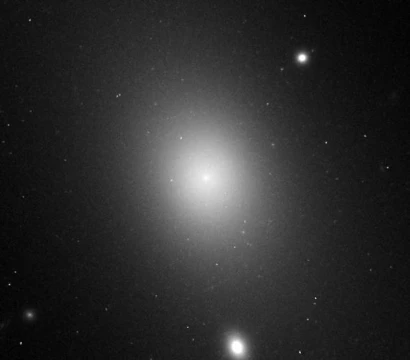
J2341+0018
Elliptical BCG with radio-loud AGN and broad emission lines.

J2341+0018, also cataloged as PKS 2338+000 and OGC 123, sits in the constellation Pisces. This elliptical galaxy is a BL Lacertae object and serves as the brightest cluster galaxy (BCG) within the X-ray galaxy cluster RX J2341.1+0018, at a redshift of 0.276.
It hosts a radio-loud active galactic nucleus (AGN). Based on Sloan Digital Sky Survey (SDSS) data, its R-band magnitude is 12.3. As an early-type galaxy, its total stellar mass comes to about 10^11.58 solar masses, and it produces hydrogen-alpha (Hα) star formation at a rate of 55.84 solar masses per year. The optical spectrum reveals strong emission lines atop a stellar continuum, which rules out a blazar classification. These lines are notably broad, with full width at half maximum speeds reaching 1,400 kilometers per second, indicating disturbed kinematics. The g–r color offset is -0.58 magnitude.
The radio source appears unresolved. Its spectral energy distribution shows a steep radio spectrum at high frequencies but flattens below a few hundred GHz. A turnover frequency is identified from its flux density at 365 MHz. A fit to the data yields component parameters of 2.62 ± 0.01, -0.16 ± 0.06, and -0.15 ± 0.04, consistent with a low-peak gigahertz peaked component.
Very Long Baseline Interferometry (VLBI) imaging reveals a radio core with an inverted spectrum and a radio jet. The core has a total flux density of 70 mJy, while the jet carries 270 mJy. Most radio emission lies within a central radius of 120 parsecs. On parsec scales, the jet’s position angle is 52°, and the median separation between core and jet components is 5.4 milliarcseconds. A 2022 study reports that J2341+0018 is a weak source with 4.5% variability and a mean flux density of 98 mJy at 15 GHz.
Quick Facts
- Epoch
- J2000.0
- Constellation Name
- Pisces
- Ra
- 23 · 41 · 06.91
- Dec
- +00 · 18 · 33.33
- Z
- 0.276720
- H Radial V
- 82,959 ± 4 km/s
- Dist Ly
- 1219.24 ± 85.35 Mpc
- Group Cluster
- RX J2341.1+0018
- Mag J
- 14.83
- Names
- 2MASX J23410687+0018332, BZU J2341+0018, LEDA 1162543, NVSS J234106+001833, OGC 123, PKS 2338+000, PMN J2341+0018, RX J2341.1+0018:[REK2022] BCG, WHL J234106.9+001833 BCG
Facts from the source article.
Lore & Background
J2341+0018 is an early-type elliptical galaxy hosting a radio-loud active galactic nucleus (AGN). Its optical spectrum shows strong emission lines on a stellar continuum, ruling out a blazar source; the lines are broad, with full width at half maximum speeds up to 1,400 kilometers per second, indicating disturbed kinematics. The radio source has an unresolved appearance, with a steep spectrum at high frequencies that flattens below a few hundred GHz, and a turnover frequency based on its 365 MHz flux density. Very Long Baseline Interferometry (VLBI) imaging detected a radio core with an inverted spectrum and a jet, with most radio emission concentrated within a central radius of 120 parsecs. The parsec-scale jet has a position angle of 52°, and the median distance between core and jet components is 5.4 milliarcseconds.
Reader's Guide
J2341+0018 is significant as a bright cluster galaxy in an X-ray cluster, hosting a radio-loud AGN that exhibits both broad optical emission lines and a complex radio structure. Its spectral energy distribution includes a gigahertz peaked component, and its radio variability of 4.5% at 15 GHz, with a mean flux density of 98 mJy, marks it as a weak but variable source. The galaxy's high stellar mass and star formation rate, combined with its disturbed line kinematics, provide insights into AGN feedback and galaxy evolution in cluster environments. The VLBI detection of a core and jet on parsec scales highlights its active, compact radio emission, contributing to studies of AGN jet physics and the nature of BL Lacertae objects.
Did You Know?
- J2341+0018 is the brightest cluster galaxy of the X-ray cluster RX J2341.1+0018.
- Its optical spectrum shows broad emission lines with speeds up to 1,400 km/s, ruling out a blazar.
- The radio jet has a flux density of 270 mJy, while the core has 70 mJy.
- The galaxy has a total stellar mass estimated at 10^11.58 M☉ and an Hα star formation rate of 55.84 M☉ per year.
More in Elliptical and Irregular Galaxies, Part 3 1-24
Spotted an error? Know more?
Reader corrections go straight into our review queue. Suggest an edit · How this site is sourced