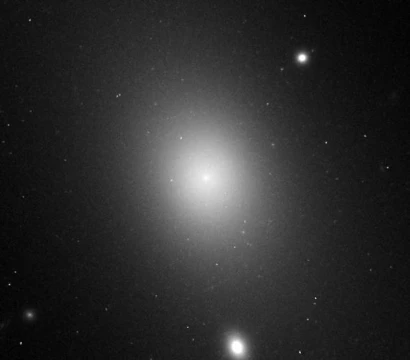
J171328.4+274336.6
Massive elliptical galaxy in Hercules with high velocity dispersion.

J171328.4+274336.6, designated OGC 49 and SDSS J171328.4+274336.6, is a massive elliptical galaxy in Hercules. Its redshift is 0.297. The galaxy has an R-band luminosity of 14.9, an absolute magnitude of -24.28, and an R-band size of 1.08 kiloparsecs. Its total velocity dispersion is 412 kilometers per second. Classified as a core early-type galaxy, it has an effective radius of 4.49 parsecs and an ellipticity of 0.171 ± 0.013. The dynamical mass is 12.09 solar masses. A supermassive black hole at its center, estimated via the M-sigma relation, has a mass of 9.40 solar masses. The total stellar mass is 42.7 solar masses, and a dark matter halo contributes 3% of the dispersion velocity. The half-light radius, from an i-band de Vaucouleurs profile, is 11.2 kiloparsecs. The de Vaucouleurs luminosity is -24.597 magnitude. The bulge-to-total ratio is 0.566; bulge and disk radii are 7.67 and 18.67 kiloparsecs, respectively, from a de Vaucouleurs bulge plus exponential disk model. No dust has been detected. The surface brightness profile, based on a core-Sérsic parameter, is 1372.29.
Quick Facts
- Epoch
- J2000.0
- Constellation Name
- Hercules
- Ra
- 17 · 13 · 28.40
- Dec
- +27 · 43 · 36.37
- Z
- 0.297127
- H Radial V
- 89,076 ± 14 km/s
- Dist Ly
- 1316.14 ± 92.13 Mpc
- Mag J
- 14.64
- Names
- 2MASX J17132838+2743362, [BHF2008] 21, LEDA 1816387, OGC 0049, SDSS J171328.41+274336.6, WHL J171328.4+274337 BCG
Facts from the source article.
Lore & Background
J171328.4+274336.6 is categorized as a 'core' early-type galaxy with a galaxy effective radius of 4.49 parsecs and an ellipticity of 0.171 ± 0.013. The dynamical mass of the galaxy is 12.09 M☉, and it hosts a supermassive black hole at its center with an estimated mass of 9.40 M☉, derived from the M-sigma relation. The galaxy has a total stellar mass of 42.7 M☉ and is surrounded by a dark matter halo, with the dark matter component contributing 3% of the dispersion velocity.
The galaxy's surface brightness profile is estimated to be 1372.29 based on a core-sersic parameter, and its half-light radius is calculated to be 11.2 kiloparsecs from an i-band de Vaucouleurs profile. The de Vaucouleurs luminosity is -24.597 magnitude, and the bulge-to-total ratio is 0.566, with bulge and disk radii of 7.67 and 18.67 kiloparsecs respectively, based on a de Vaucouleurs bulge plus exponential disk model. Dust has not been detected in the galaxy.
Reader's Guide
J171328.4+274336.6 is significant as a massive elliptical galaxy that provides insights into the formation and evolution of early-type galaxies. Its high velocity dispersion of 412 kilometers per second and large dynamical mass of 12.09 M☉ indicate a deep gravitational potential, typical of massive galaxies. The presence of a supermassive black hole with a mass of 9.40 M☉, estimated via the M-sigma relation, underscores the connection between black hole mass and galaxy properties. The galaxy's dark matter halo, contributing 3% of the dispersion velocity, and its lack of detected dust suggest a relatively quiescent evolutionary state. The detailed structural parameters, including a core-Sersic surface brightness profile and a bulge-to-total ratio of 0.566, help classify it as a core early-type galaxy, offering a benchmark for studies of galaxy morphology and dynamics in the Hercules constellation.
Did You Know?
- J171328.4+274336.6 has an R-band absolute magnitude of -24.28, making it one of the most massive galaxies.
- The supermassive black hole at its center has an estimated mass of 9.40 M☉ based on the M-sigma relation.
- Dust has not been detected in this galaxy.
More in Elliptical and Irregular Galaxies, Part 3 1-24
Spotted an error? Know more?
Reader corrections go straight into our review queue. Suggest an edit · How this site is sourced