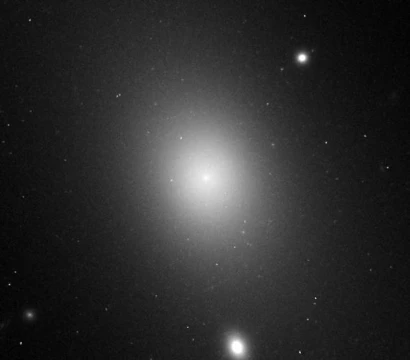
J1328+2752
Double-double radio galaxy with a binary supermassive black hole.

J1328+2752 is a Type 2 Seyfert galaxy located in the constellation of Canes Venatici. It is notable as a double-double radio galaxy, first discovered from a sample of 167 dual active galactic nuclei by astronomers in January 2010. The galaxy hosts a binary supermassive black hole with an estimated separation of only six parsecs, confirmed by a study published in 2021.
Quick Facts
- Epoch
- J2000.0
- Constellation Name
- Canes Venatici
- Ra
- 13 · 28 · 48.45
- Dec
- +27 · 52 · 27.93
- Z
- 0.091144
- H Radial V
- 27,324 ± 4
- Dist Ly
- 403.45 ± 28.24 Mpc
- Mag J
- 14.96
- Names
- LEDA 1820308, 2MASX J13284845+2752280, NGP9 F324-0743354, SDSS J132848.45+275227.8, [KJK2017] J1328+2752
Facts from the source article.
Lore & Background
J1328+2752 is a radio galaxy with a compact radio structure, featuring a visible flat radio spectrum core in the center that shows weak radio emission based on a 607 MHz image. The outer radio lobes have an asymmetric appearance: a hotspot is present in the southern lobe, while the northern lobe lacks a hotspot and exhibits a sharp bending angle toward the northeast. The inner double lobes are also asymmetric and embedded within an area of older radio emission, with a bright hotspot dominating the northern inner component.
The host galaxy is an elliptical galaxy with highly ionized, narrow emission lines. It contains a disk component dominating an area over 2.5 kiloparsecs, with a bulge-dominated inner portion. A study published in 2021 confirmed the presence of a binary supermassive black hole with a separation of six parsecs, based on two radio core components from Very Long Baseline Array (VLBA) imaging and double-peaked emission lines with the same separation gap.
A study published in 2024 found a single central component with an unresolved appearance at all frequencies, and the flux density increasing by around a factor of 3.
Reader's Guide
J1328+2752 is significant as a double-double radio galaxy, a rare subclass of radio galaxies exhibiting two pairs of radio lobes, indicating episodic jet activity from the central active nucleus. Its discovery in January 2010 from a sample of 167 dual active galactic nuclei highlights its role in studying galaxy mergers and supermassive black hole binaries. The confirmed binary black hole with a separation of only six parsecs, based on VLBA imaging and double-peaked emission lines, provides a unique laboratory for understanding black hole dynamics and gravitational wave precursors. The asymmetric radio lobes and hotspot features suggest complex interactions with the intergalactic medium. The 2024 finding of a single unresolved central component with increased flux density may indicate ongoing changes in the core emission, possibly related to the binary's evolution. The host elliptical galaxy's disk and bulge structure further contextualize the galaxy's morphology.
Did You Know?
- J1328+2752 is a double-double radio galaxy, meaning it has two pairs of radio lobes.
- A 2024 study found a single unresolved central component with flux density increased by a factor of 3.
More in Elliptical and Irregular Galaxies, Part 3 1-24
Spotted an error? Know more?
Reader corrections go straight into our review queue. Suggest an edit · How this site is sourced