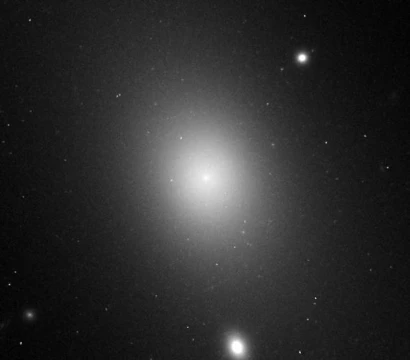
J120011.1+680924.8
Massive elliptical galaxy and brightest cluster galaxy in Draco.

J120011.1+680924.8, also cataloged as OGC 103 and SDSS J120011.11+680924.8, is a giant elliptical galaxy in the constellation Draco. With a redshift (z) of 0.262, it serves as the brightest cluster galaxy for the cluster [BVH2007] 136. Its R-band absolute magnitude of -24.07 and R-band luminosity of 12.7, measured by the Sloan Digital Sky Survey, place it among the most massive galaxies known. The galaxy's R-band size is 1.18 kiloparsecs.
Classified as an intermediate early-type galaxy, its effective radius is roughly 4.69 parsecs, determined by a best Sersic fit. The dynamical mass is 12.22 solar masses, while the stellar mass is 10.2 × 10¹¹ solar masses, with a dark matter halo contributing 6% of the total mass. A fit to its de Vaucouleurs profile gives a total projected half-light radius of 16.2 kiloparsecs. The galaxy appears rounded and sits at the cluster center, with an inner profile best described by a shallow core. Its velocity dispersion is 383 kilometers per second, and its de Vaucouleurs luminosity is -24.47 magnitude, with a high ellipticity of 0.32. The bulge-to-total ratio is 0.72; the bulge and disk radii are 10.35 and 13.44 kiloparsecs, respectively, based on a de Vaucouleurs bulge plus exponential disk model. No dust features are present.
Quick Facts
- Epoch
- J2000.0
- Constellation Name
- Draco
- Ra
- 12 · 00 · 11.10
- Dec
- +68 · 09 · 24.80
- Z
- 0.262741
- H Radial V
- 78,768 ± 13 km/s
- Dist Ly
- 1163.61 ± 81.45 Mpc
- Group Cluster
- [BVH2007] 136
- Mag J
- 14.86
- Names
- 2MASX J12001112+6809250, [BHF2008] 13, LEDA 2713000, GMBCG J180.04632+68.15690 BCG, OGC 103, SDSS J120011.11+680924.8, WHL J120011.1+680925 BCG
Facts from the source article.
Lore & Background
J120011.1+680924.8 is an elliptical galaxy categorized as an intermediate early-type galaxy. Its effective radius is approximately 4.69 parsecs based on a best Sersic fit technique, and its inner profile is best described by a shallow core. The galaxy has a rounded appearance and is located in the center of its cluster, with a high ellipticity of 0.32 and a bulge-to-total ratio of 0.72.
The galaxy is surrounded by a dark matter halo, with the dark matter component displaying a contribution of 6%. Its total projected half-light radius is estimated to be 16.2 kiloparsecs based on a fit measurement to its de Vaucouleurs profile. The de Vaucouleurs luminosity of the galaxy is estimated to be -24.47 magnitude, and dust features are not present.
The galaxy's bulge and disk radius are 10.35 and 13.44 kiloparsecs respectively, based on an estimation of its de Vaucouleurs bulge plus an exponential disk model. Its calculated velocity dispersion is 383 kilometers per second.
Reader's Guide
J120011.1+680924.8 is significant as one of the most massive galaxies known, with a stellar mass of 10.2 × 10^11 M☉ and a dynamical mass of 12.22 M☉. As the brightest cluster galaxy of [BVH2007] 136, it provides a key example of a massive elliptical at a redshift of 0.262. Its structural parameters, including a shallow core and high ellipticity, offer insights into the formation and evolution of early-type galaxies in dense cluster environments. The galaxy's dark matter halo contribution of 6% and its de Vaucouleurs profile measurements contribute to understanding the mass distribution in such systems. The absence of dust features suggests a relatively quiescent evolutionary state. Its legacy lies in serving as a benchmark for studies of galaxy mass, structure, and dark matter content in the local universe.
Did You Know?
- J120011.1+680924.8 has an R-band absolute magnitude of -24.07, making it one of the most massive galaxies known.
- The galaxy's dark matter halo contributes 6% of its total mass.
- The galaxy has a high ellipticity of 0.32 and no dust features.
More in Elliptical and Irregular Galaxies, Part 3 1-24
Spotted an error? Know more?
Reader corrections go straight into our review queue. Suggest an edit · How this site is sourced