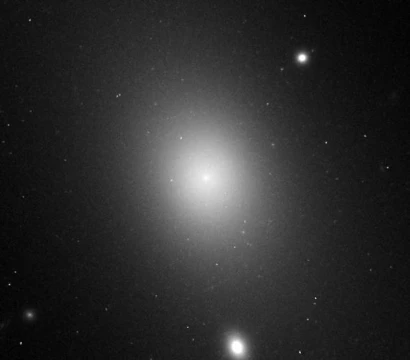
J114403.9+440022.0
Brightest cluster galaxy in Ursa Major with bent-tail radio lobes.

J114403.9+440022.0, also cataloged as OGC 266, J114403+440021, and RGZ J114403.8+440021, is a radio galaxy in the constellation Ursa Major. It sits at the center of the WHL J114403.9+440022 galaxy cluster as its brightest member, with 14 confirmed galaxy candidates in the cluster. This elliptical galaxy has an estimated R-band magnitude of 17.22 and an absolute magnitude of -23.70. Its central supermassive black hole is estimated at 9.09 solar masses, and it is also listed as 7C B114125.4+441658 in the Seventh Cambridge Survey. The galaxy shows emission lines from hydrogen-alpha and doubly ionized oxygen, with luminosities of 0.000 and 7.111 solar luminosities, respectively, and a g–r color value of 1.68 magnitudes.
The active nucleus classifies it as a Fanaroff-Riley Class Type II radio galaxy, featuring a bent-tail FR II-like radio source. The NRAO VLA Sky Survey (NVSS) measured a total radio flux density of 49.60 millijanskys at 1.4 GHz, corresponding to a radio luminosity of 14.1 × 10²⁴ watts per hertz. Both radio lobes are resolved, with projected lengths of 125.3 and 145.4 kiloparsecs, and angular separations of 16.7 and 19.4 arcseconds. A radio core is present, but no hotspot features are detected. The total angular size is 55 arcseconds, with a linear size of 244.54 kiloparsecs.
A 2025 study reclassified it as a wide-angle-tail radio galaxy. Its radio jets have an opening angle of 145.6°, a curvature radius of 65.8 arcseconds, and a jet power of 44.65 ergs per second. The source's angular size was measured at 63 arcseconds, with a largest linear size of 289.0 kiloparsecs. The spectral index is 0.78α, and the bending angle is 11.0°, confirming the source is indeed bent.
Quick Facts
- Epoch
- J2000.0
- Constellation Name
- Ursa Major
- Ra
- 11 · 44 · 03.88
- Dec
- +44 · 00 · 21.97
- Z
- 0.299049
- H Radial V
- 89,653 ± 19 km/s
- Dist Ly
- 1325.72 ± 92.80 Mpc
- Group Cluster
- WHL J114403.9+440022
- Mag K
- 13.82
- Names
- 2MASX J11440384+4400214, NYU-VAGC 1120250, NVSS J114404+440019, OGC 0266, SDSSCGB 11250.01, RGZ J114403.8+440021, WHL J114403.9+440022 BCG, [YHW2016] J176.01616+44.00609, LEDA 3545497
Facts from the source article.
Lore & Background
J114403.9+440022.0 is an elliptical galaxy that serves as the brightest cluster galaxy of the WHL J114403.9+440022 galaxy cluster, which contains 14 confirmed galaxy member candidates. Its R-band magnitude is estimated at 17.22, with an absolute magnitude of -23.70. The galaxy is also designated as 7C B114125.4+441658 in the Seventh Cambridge Survey, and its central supermassive black hole mass is estimated at 9.09 M☉. Detections of hydrogen-alpha and doubly ionized oxygen emission lines have been made, with line luminosities estimated at 0.000 and 7.111 L☉, respectively, and the g–r color value is 1.68 magnitude.
The nucleus is active and categorized as a Fanaroff-Riley Class Type II radio galaxy with a bent-tail FR II-like radio source. The total radio flux density is estimated at 49.60 mJy at 1.4 GHz frequencies by the NRAO VLA Sky Survey, with a radio luminosity of 14.1 × 10^24 W Hz−1. Both radio lobes are resolved, with projected lengths of 125.3 and 145.4 kiloparsecs, and angular separations of 16.7 and 19.4 arcseconds. A radio core is present, but no hotspot features are detected. The total angular size is 55 arcseconds, and the linear size is 244.54 kiloparsecs.
A study published in 2025 found it to be a wide-angle-tail radio galaxy, with radio jets having an opening angle estimated at 145.6° and a curvature radius of 65.8 arcseconds. The jet power is calculated at 44.65 erg s−1. An angular size of 63 arcseconds and a largest linear size of 289.0 kiloparsecs were measured. The spectral index is estimated as 0.78α, and evidence indicates the source is bent, with a bending angle of 11.0°.
Reader's Guide
J114403.9+440022.0 is significant as a bright elliptical galaxy that anchors a galaxy cluster with 14 confirmed members, providing a laboratory for studying cluster dynamics and galaxy evolution. Its classification as a Fanaroff-Riley Class Type II radio galaxy with a bent-tail structure, later refined to a wide-angle-tail radio galaxy by a 2025 study, highlights its role in understanding radio source morphology and jet physics. The resolved radio lobes, with projected lengths of 125.3 and 145.4 kiloparsecs, and the absence of hotspot features, offer insights into the interaction of jets with the intracluster medium. The measured jet power of 44.65 erg s−1 and bending angle of 11.0° contribute to models of jet propagation and bending in dense environments. The galaxy's legacy lies in its multi-wavelength data, including emission line detections and radio flux measurements, which support studies of active galactic nuclei feedback and the evolution of radio galaxies in clusters.
Did You Know?
- J114403.9+440022.0 is the brightest cluster galaxy of the WHL J114403.9+440022 galaxy cluster, which has 14 confirmed galaxy member candidates.
- The galaxy has a bent-tail FR II-like radio source with a bending angle of 11.0°.
- A 2025 study classified it as a wide-angle-tail radio galaxy with an opening angle of 145.6°.
More in Elliptical and Irregular Galaxies, Part 3 1-24
Spotted an error? Know more?
Reader corrections go straight into our review queue. Suggest an edit · How this site is sourced