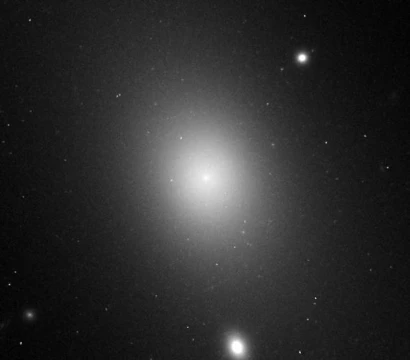
J10405643–0103584
A massive lenticular galaxy with the highest known bulge fraction.

J10405643–0103584, also cataloged as 2MASX J10405643–0103584, is a giant lenticular galaxy located in the constellation Sextans. It sits at the heart of a low-mass galaxy cluster designated SDSS CE J160.241898–01.069106, where it serves as the brightest cluster galaxy (BCG). With an estimated redshift of 0.25, it ranks among the most massive galaxies ever observed.
This galaxy has an absolute R-band magnitude of -24.27 and an R-band size of roughly 1.30 kiloparsecs. Classified as a supermassive early-type elliptical, its inner structure shows a shallow core, and its velocity dispersion is measured at 424 kilometers per second. Based on a de Vaucouleurs bulge and exponential disk model, its total bulge radius is about 29.34 kiloparsecs, while its disk radius is around 18.75 kiloparsecs. The disk itself has a low inclination of 2° at a position angle of 74°, with an exponential scale length of 12.43.
The galaxy has a symmetrical shape and is surrounded by several low-mass satellite galaxies. It is bulge-dominated, with a bulge-to-total ratio (B/T) of roughly 0.66—the highest known for such a galaxy when studied. This suggests it may have transitioned from an elliptical to a lenticular galaxy after its disk was reformed through galaxy mergers. Its total star formation rate is estimated at 9.3 solar masses per year, and its total stellar mass is about 4.7 × 10¹¹ solar masses, based on a 2018 study. The galaxy is offset by 15.5 kiloparsecs from the cluster’s X-ray peak.
Quick Facts
- Epoch
- J2000.0
- Constellation Name
- Sextans
- Ra
- 10 · 40 · 56.42
- Dec
- -01 · 03 · 58.65
- Z
- 0.250242
- H Radial V
- 75,021 ± 10 km/s
- Dist Ly
- 1110.67 ± 77.75 Mpc
- Group Cluster
- SDSS CE J160.241898–01.069106
- Mag J
- 14.66
- Names
- 2dFGRS N294Z024, 2MASX J10405643–0103584, [BHF2008] 23, LEDA 1127620, OGC 0073, SDSS J104056.42–010358.7, WHL J104056.4–010358 BCG
Facts from the source article.
Lore & Background
The galaxy is classified as a supermassive early-type elliptical galaxy whose inner profile is best described by a shallow core. Its velocity dispersion is calculated as 424 kilometers per second. The total bulge and disk radii have been estimated as 29.34 and 18.75 kiloparsecs respectively, based on a de Vaucouleurs bulge and exponential disk model. The disk itself has an inclination of 2° at a position angle of 74° and a measured disk exponential scale length of 12.43.
The galaxy has a symmetric morphology and is bulge-dominated, with a bulge fraction ratio roughly estimated as B/T = 0.66, making this the highest known when studied. This suggests it transitioned into a lenticular galaxy from an elliptical galaxy when its galactic disk was reformed via galaxy mergers. Several satellite galaxies of low masses surround it. The total star formation is estimated to be 9.3 M☉ per year with a total stellar mass of 4.7 × 10^11 M☉ based on a study published in 2018. It is offset by 15.5 kiloparsecs from the X-ray peak of the cluster.
Reader's Guide
J10405643–0103584 is notable as one of the most massive galaxies known, with an absolute R-band magnitude of -24.27 and an R-band size of approximately 1.30 kiloparsecs. Its significance lies in its extreme bulge fraction ratio of 0.66, the highest known when studied, which indicates a rare evolutionary path from an elliptical to a lenticular galaxy through disk reformation via mergers. As the brightest cluster galaxy of a low-mass cluster, it provides a laboratory for studying galaxy formation and evolution in dense environments. The galaxy's offset of 15.5 kiloparsecs from the cluster's X-ray peak suggests dynamical interactions within the cluster. Its measured velocity dispersion of 424 kilometers per second and stellar mass of 4.7 × 10^11 M☉ underscore its status as a supermassive system. The shallow core in its inner profile and symmetric morphology further characterize its structure. The galaxy's legacy is tied to understanding how massive galaxies acquire disks and how bulge-dominated systems form, with its high bulge fraction serving as a benchmark for models of galactic transformation.
More in Elliptical and Irregular Galaxies, Part 3 1-24
Spotted an error? Know more?
Reader corrections go straight into our review queue. Suggest an edit · How this site is sourced