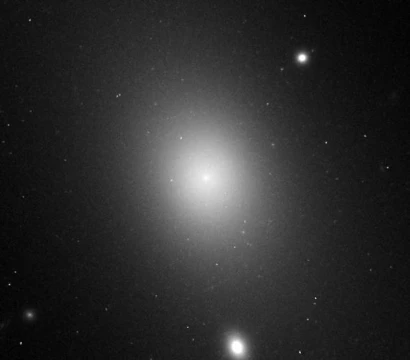
J1017+6352
A reclassified bent wide-angle tail radio galaxy in Ursa Major.

J1017+6352, also cataloged as J101801.6+635228 and NYU-VAGC 0205375, is a radio galaxy in the constellation Ursa Major. It was first identified in February 1990 during the Sixth Cambridge Survey of Radio Sources, and its redshift (z) is 0.233.
This galaxy is the brightest member of the cluster GMBCG J154.50781+63.87501. It is a red, luminous elliptical galaxy with an r-band absolute magnitude of -23.73. Its stellar velocity dispersion is 261 kilometers per second, and its effective radius is 18.4 kiloparsecs. The galaxy's physical size spans 160 kiloparsecs, and its g–r color value is 1.42 magnitude.
The galaxy's nucleus is active. Originally classified as a narrow-angle tail Fanaroff-Riley Class Type II radio galaxy, a 2025 study reclassified it as a bent wide-angle tail (WAT) Fanaroff-Riley Class Type I radio galaxy, characterized by its bent radio lobes. It contains a radio source with a power of 36.01 × 10²⁴ W Hz⁻¹. The total flux density at 1400 MHz is 222 mJy, and at 150 MHz it is 1349 mJy, giving a spectral index of -0.81α between those frequencies. The source is also C-shaped and small, with a total extent of only 0.09 megaparsecs. Its total radio luminosity at 1.4 GHz is 25.56 W Hz⁻¹.
The galaxy features a radio jet with an opening angle of 105.7° and a curvature of 18.2 arcseconds. Its largest known angular size is 56 arcseconds, and its largest known linear size is 215 kiloparsecs.
Quick Facts
- Epoch
- J2000.0
- Constellation Name
- Ursa Major
- Ra
- 10 · 18 · 01.88
- Dec
- +63 · 52 · 29.97
- Z
- 0.233601
- H Radial V
- 70,032 ± 11 km/s
- Dist Ly
- 1034.64 ± 72.43 Mpc
- Group Cluster
- GMBCG J154.50781+63.87501
- Mag H
- 14.08
Facts from the source article.
Lore & Background
J1017+6352 was first discovered in February 1990 by astronomers using the Sixth Cambridge Survey of Radio Sources. It is a red luminous elliptical galaxy and the brightest cluster galaxy of the cluster GMBCG J154.50781+63.87501. Its nucleus is active, and it was originally classified as a narrow-angle tail Fanaroff-Riley Class Type II radio galaxy. The galaxy hosts a radio source with a total extent of only 0.09 megaparsecs, making it a small C-shaped radio galaxy. A study published in 2025 reclassified it as a bent wide-angle tail (WAT) Fanaroff-Riley Class Type I radio galaxy, characterized by bent radio lobes. The radio jet has an opening angle of 105.7°, and the curvature of the jet is 18.2 arcseconds. The galaxy's stellar velocity dispersion is 261 kilometers per second, and its effective radius is 18.4 kiloparsecs.
Reader's Guide
J1017+6352 is significant as a reclassified radio galaxy that illustrates the evolving understanding of Fanaroff-Riley classifications. Originally identified as a narrow-angle tail Type II source, a 2025 study reclassified it as a bent wide-angle tail Type I galaxy, highlighting the complexity of radio morphology. Its status as the brightest cluster galaxy of GMBCG J154.50781+63.87501 makes it a key object for studying galaxy cluster dynamics. The galaxy's small radio source extent of 0.09 megaparsecs and its C-shaped structure provide insights into jet interactions with the intracluster medium. The measured spectral index of -0.81α between 1400 and 150 MHz and the flux densities at those frequencies contribute to understanding its radio emission properties. The galaxy's large linear size of 215 kiloparsecs and its bent radio lobes underscore its role as a laboratory for studying active galactic nuclei feedback and environmental effects in clusters.
Did You Know?
- J1017+6352 was first discovered in February 1990 in the Sixth Cambridge Survey of Radio Sources.
- It was reclassified in a 2025 study from a narrow-angle tail Type II to a bent wide-angle tail Type I radio galaxy.
More in Elliptical and Irregular Galaxies, Part 3 1-24
Spotted an error? Know more?
Reader corrections go straight into our review queue. Suggest an edit · How this site is sourced