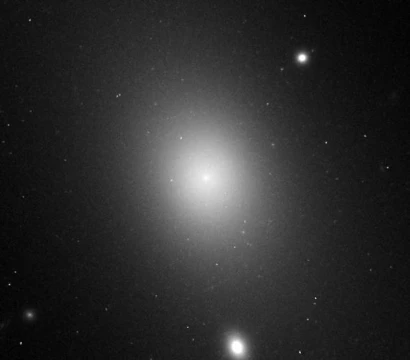
J082504.56+315957.0
Giant elliptical galaxy with a young CSS radio source.

J082504.56+315957.0, also cataloged as OGC 407 and 0821+321, is a giant elliptical galaxy in the constellation Cancer. It is a low-excitation radio galaxy featuring a young compact steep spectrum (CSS) radio source. Its active galactic nucleus is classified as a low-ionization nuclear emission-line region (LINER). The Sloan Digital Sky Survey estimates its r-band apparent magnitude at roughly 10.1. The galaxy forms stars at a rate of about 2.98 solar masses per year, and its total stellar mass is around 11.93 solar masses. At its center lies a supermassive black hole with a mass of approximately 9.66 solar masses. The radio emission is low-luminosity and mostly compact, with two weak lobes lacking prominent hot spots and a resolved core. At 1.4 GHz, the total flux density is 0.076 Jy, and the radio luminosity at 4.85 GHz is about 25.21 watts per hertz. The largest linear extent of the radio source is 7.69 kiloparsecs. The galaxy also emits weak gamma rays, with a flux below 0.18 × 10⁻⁹ photons per square centimeter per second and a luminosity under 0.50 × 10⁴⁴ ergs per second. Its redshift is 0.265.
Quick Facts
- Epoch
- J2000.0
- Constellation Name
- Cancer
- Ra
- 08 · 25 · 04.55
- Dec
- +31 · 59 · 57.08
- Z
- 0.265000
- H Radial V
- 79,445 ± 0 km/s
- Dist Ly
- 1171.17 ± 81.98 Mpc
- Mag J
- 15.25
- Names
- 2MASX J08250453+3159569, 7C 082156.79+320942.00, SDSS J082504.56+315957.0, LEDA 1975088, NVSS J082504+315957, OGC 407, TXS 0821+321
Facts from the source article.
Lore & Background
J082504.56+315957.0 is an elliptical galaxy with an approximate r-band luminosity of 10.1 magnitude based on its r-band estimation made by the Sloan Digital Sky Survey (SDSS). The nucleus is active and has been classified as a low-ionization nuclear emission-line region (LINER) galaxy. The total star formation of the galaxy is 2.98 M☉ per year and it has a stellar mass of 11.93 M☉. The supermassive black hole lying in the center of the galaxy has a mass of 9.66 M☉.
Reader's Guide
The galaxy's radio source has a low luminosity and is mainly compact, classified as a double-lobed source with two weak radio lobes that have no prominent hot spot features and a resolved radio core. The total flux density has been calculated as 0.076 Jy at 1.4 GHz frequencies, while the total radio luminosity has been found to be 25.21 W Hz−1 at 4.85 GHz. The largest linear size of the source is 7.69 kiloparsecs. Gamma-ray emissions are present in the galaxy although mainly weak, with a gamma-ray flux of less than 0.18 × 10⁻⁹ ph cm−2 s−1 and gamma-ray luminosity of less than 0.50 × 1044 erg s−1. Its classification as a low-excitation radio galaxy with a young compact steep spectrum source makes it a significant object for studying the early stages of radio source evolution in giant ellipticals.
Did You Know?
- The galaxy is also known as OGC 407 and 0821+321.
- The supermassive black hole at its center has a mass of 9.66 M☉.
- Gamma-ray emissions are present but weak, with a flux less than 0.18 × 10⁻⁹ ph cm−2 s−1.
More in Elliptical and Irregular Galaxies, Part 3 1-24
Spotted an error? Know more?
Reader corrections go straight into our review queue. Suggest an edit · How this site is sourced