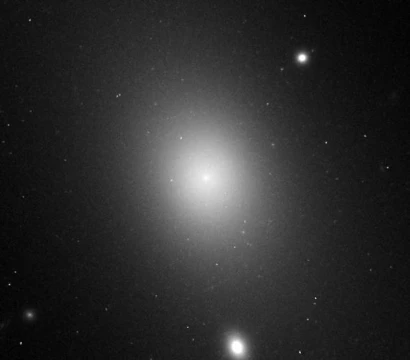
IRAS 14026+4341
Hyperluminous infrared galaxy merging with a small companion.

IRAS 14026+4341 is a Seyfert type 1 galaxy located in the constellation of Canes Venatici. It is notable as a hyperluminous infrared galaxy and a broad absorption-line quasar, first discovered as an infrared source from the IRAS catalogue in 1987 and identified as a quasar in 1988. The object is also classified as a radio-quiet quasar and a Type 1 active galactic nucleus.
Quick Facts
- Epoch
- J2000.0
- Constellation Name
- Canes Venatici
- Ra
- 14 · 04 · 38.80
- Dec
- +43 · 27 · 07.51
- Z
- 0.322894
- H Radial V
- 96,801 km/s
- Dist Ly
- 3.740 Gly
- Appmag V
- 15.76
- Appmag B
- 16.12
- Notes
- Luminous infrared galaxy, broad absorption-line quasar
- Names
- CSO 409, LEDA 84105, PB 1309, FBS 332, 2MASS J14043881+4327072, SDSS J140438.80+432707.4, FBS 1402+436, LAMOST J140438.80+432707.52, CXO J140438.8+432707
Facts from the source article.
Lore & Background
IRAS 14026+4341 was first cataloged as an infrared source by the Infra Red Astronomical Satellite in 1987 and recognized as a quasar the following year. Hubble Space Telescope imaging reveals its host as a bright, medium-sized elliptical galaxy that is bulge-dominated, round, and featureless. The galaxy is currently merging with a small companion that appears to be obliterated by tidal forces, producing a long, curved tidal tail extending more than seven arcseconds. The tail has an elongated head toward the radius vector, a bright knot with luminosity of -18, and an outer end that is brighter, sharply bounded, and widens with distance from the nucleus. Two compact faint knots are superimposed on both sides of the galaxy, and the nucleus itself is reddened and luminous.
Reader's Guide
IRAS 14026+4341 is significant as a hyperluminous infrared galaxy and a broad absorption-line quasar, exhibiting extreme luminosity and heavy dust reddening. Its classification as a radio-quiet quasar and Type 1 AGN places it among active galaxies where the central engine dominates. The object's broadband spectral energy distribution shows a steep increase at short wavelengths below 3,000 Å but no significant reddening at longer wavelengths. Ultraviolet and optical spectropolarimetry reveal high polarization, an extremely steep flux spectrum with oxidized iron emission and Balmer lines in polarized light, and evidence of lowly polarized doubly ionized oxygen lines, suggesting dust scattering grains are mixed with narrow-line gas. X-ray variability was first detected in 2012. The ongoing merger with a small companion and the detailed tidal tail structure provide insights into galaxy interactions and the fueling of AGN activity.
Did You Know?
- IRAS 14026+4341 was first discovered as an infrared source in 1987 and identified as a quasar in 1988.
- The galaxy is merging with a small companion that is being obliterated by tidal forces.
- Its tidal tail extends more than seven arcseconds and has a bright knot with luminosity of -18.
- X-ray variability was detected for the first time in 2012.
More in Elliptical and Irregular Galaxies, Part 3 1-24
Spotted an error? Know more?
Reader corrections go straight into our review queue. Suggest an edit · How this site is sourced