ILT J160811.30+325427.2
A hybrid FR I/FR II radio galaxy in Corona Borealis.

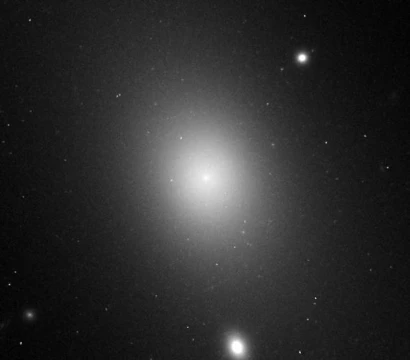
ILT J160811.30+325427.2 is a radio galaxy in the constellation Corona Borealis, with a redshift of 0.303. It serves as the brightest cluster galaxy in the WHL J160810.9+325419 cluster, which contains nine confirmed galaxy member candidates. The galaxy has an R-band magnitude of 17.57 and an absolute magnitude of -23.54.
Classified as an elliptical galaxy, it hosts an active galactic nucleus and is considered a bend-tail radio source, specifically a Fanaroff-Riley Class Type II (FR II) galaxy. Its total flux density, measured by the NRAO VLA Sky Survey at 1.4 GHz, is 87.00 mJy. Imaging from the Faint Images of the Radio Sky at Twenty-Centimeters survey reveals a hybrid radio morphology: one lobe is Fanaroff-Riley Type I, the other is Type II. The radio core has a flux density of 3.91 mJy, while the overall radio emission measures 65.60 mJy.
The galaxy is also identified as a giant double-double radio galaxy, with components oriented east to west. Its inner and outer radio lobes have projected sizes of 740 and 142 kiloparsecs, respectively. The misalignment angle between the outer lobes and the radio core is 26.4°, while the misalignment between the outer and inner lobes is 5.5°. It is a C-shaped radio galaxy situated in a poor galaxy environment, with a total source extent of 0.23 megaparsecs. Its total radio luminosity is 25.33 W Hz⁻¹, and its total radio power is 26.61 × 10²⁴ W Hz⁻¹.
Quick Facts
- Epoch
- J2000.0
- Constellation Name
- Corona Borealis
- Ra
- 16 · 08 · 10.899
- Dec
- +32 · 54 · 18.70
- Z
- 0.303826
- H Radial V
- 91,085 ± 17 km/s
- Dist Ly
- 1344.33 ± 94.10 Mpc
- Group Cluster
- WHL J160810.9+325419
- Mag K
- 15.04
- Names
- 2MASX J16081090+3254194, [PFR2025] J242.0471+32.908, [YHW2016] J242.04532+32.90520, SDSS J160810.80+325418.9, WHL J160810.9+325419 BCG, LEDA 3569818
Facts from the source article.
Lore & Background
ILT J160811.30+325427.2 is an elliptical galaxy that serves as the brightest cluster galaxy of the WHL J160810.9+325419 cluster. It hosts an active galactic nucleus and is categorized as a bend-tail or Fanaroff-Riley Class Type II radio galaxy, yet radio imaging from the Faint Images of the Radio Sky at Twenty-Centimeters (FIRST) reveals a hybrid morphology: one radio lobe is Fanaroff-Riley Type I while the other is Fanaroff-Riley Type II. The radio core is detected with a flux density of 3.91 mJy, and the overall radio emission has a flux density of 65.60 mJy.
The galaxy is also identified as a giant double-double radio galaxy, with its components positioned from east to west. The projected sizes of its inner and outer radio lobes are 740 and 142 kiloparsecs, respectively. The misalignment angle between the outer lobes and the radio core is 26.4°, while the misalignment between the outer and inner lobes is 5.5°. It is described as a C-shaped radio galaxy residing in a poor galaxy environment, with a total source extent of 0.23 megaparsecs.
Reader's Guide
ILT J160811.30+325427.2 is significant as a rare example of a hybrid radio galaxy that exhibits both Fanaroff-Riley Type I and Type II characteristics in its lobes, challenging simple classification schemes. Its status as a giant double-double radio galaxy with distinct inner and outer lobes, along with measured misalignment angles, provides insight into episodic jet activity and reorientation of the active galactic nucleus. The galaxy's role as the brightest cluster galaxy in a poor cluster environment, combined with its C-shaped morphology, offers a case study for how radio sources evolve in low-density surroundings. The total radio luminosity of 25.33 W Hz⁻¹ and total radio power of 26.61 × 10²⁴ W Hz⁻¹, derived from NVSS and FIRST observations, contribute to understanding the energy output of such systems. Its legacy lies in illustrating the complexity of radio galaxy morphology and the interplay between jet dynamics and environmental conditions.
Did You Know?
- It is a giant double-double radio galaxy with inner and outer lobe sizes of 740 and 142 kiloparsecs.
- The misalignment angle between its outer lobes and the radio core is 26.4°.
- It is the brightest cluster galaxy of the WHL J160810.9+325419 cluster, which has nine confirmed galaxy member candidates.
More in Elliptical and Irregular Galaxies, Part 3 1-24
Spotted an error? Know more?
Reader corrections go straight into our review queue. Suggest an edit · How this site is sourced