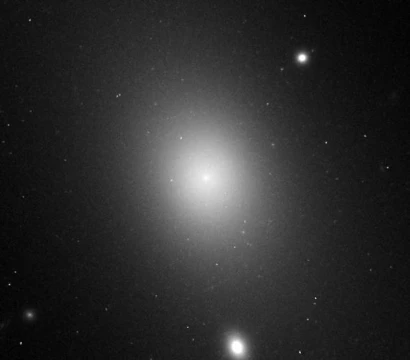
IERS B2352+495
A prototype compact symmetrical object with Gigahertz peaked spectrum.

IERS B2352+495 is a radio galaxy in the constellation Cassiopeia, roughly 2.7 billion light-years from Earth. It was first detected as a radio source with a flat radio spectrum in 1978, and its optical counterpart was identified the following year. The galaxy is elliptical and serves as a prototype for compact symmetrical objects, with a radio luminosity of 4.8 × 10⁴³ h⁻² erg s⁻¹. It is classified as a Gigahertz peaked spectrum source, showing weak variability over time and low polarization levels between 0.2% and 0.7%. Its central supermassive black hole has an estimated mass of 1.58 × 10⁸ solar masses.
The radio structure is symmetrical, as noted by P.N. Wilkinson, who identified two mini-lobes in the outer region. The source is triple: a compact component, a much fainter but larger component, and a middle component split into two subcomponents. Multi-epoch observations with the Very Long Baseline Array reveal hotspots and a radio core, with no evidence of superluminal motion in the hotspots. Milliarcsecond imaging shows multiple components, with most of the flux concentrated in two core-region components. A narrow radio jet extends south of one component, possibly disrupted by interstellar material.
The hotspot components are well separated, with an estimated angular separation of 21.06 ± 2.70 milliarcseconds per year, corresponding to a velocity separation of 0.20 ± 0.02 per hour. Their pressure masses are estimated at 2 × 10¹¹ solar masses. H I absorption has been detected toward the galaxy, with broad and narrow spectral components redshifted by 129.9 ± 0.8 kilometers per second. In August 1994, the source underwent an extreme scattering event. The galactic foreground aligns with the galactic continuum and shows no shell-like structure.
Quick Facts
- Epoch
- J2000.0
- Constellation Name
- Cassiopeia
- Ra
- 23 · 55 · 09.458
- Dec
- +49 · 50 · 08.33
- Z
- 0.237900
- H Radial V
- 71,321 km/s
- Dist Ly
- 2.711 Gly
- Appmag B
- 21.10
- Notes
- Compact symmetrical object
- Names
- NVSS J235509+495008, DA 611, OZ +488, TXS 2352+495, ICRF J235509.4+495008, 2352+495
Facts from the source article.
Lore & Background
IERS B2352+495 was first discovered as a radio source displaying a flat radio spectra by astronomers in 1978 and subsequently identified with its counterpart in 1979. The radio structure is symmetrical, identified by P.N. Wilkinson as showing two mini-lobes in the outer part. It is a triple source, mainly made up of a compact component, a much weaker but large component, and a middle component split into two subcomponents. Multi-epoch observations by the Very Long Baseline Array reveal hotspots and a radio core, with no evidence of superluminal motion. A narrow radio jet is seen south of the component, possibly disrupted by interstellar material. The hotspot components are well separated, with angular separations of 21.06 ± 2.70 per year, corresponding to a velocity separation of 0.20 ± 0.02 per hour. H I absorption has been discovered towards the galaxy, with the spectrum displaying broad and narrow components redshifted by 129.9 ± 0.8 kilometers per second.
Reader's Guide
IERS B2352+495 is significant as a prototype compact symmetrical object, providing a key example for studying radio galaxy morphology and evolution. Its Gigahertz peaked spectrum and low polarization (0.2% to 0.7%) indicate a young or confined source. The symmetrical radio structure with mini-lobes and a triple component layout, as identified by P.N. Wilkinson, offers insights into jet propagation and interaction with the interstellar medium. The lack of superluminal motion in the hotspots suggests the source is not undergoing relativistic beaming. The detection of H I absorption with broad and narrow components provides a means to probe the surrounding gas kinematics. The extreme scattering event observed in August 1994 highlights the influence of foreground material. The estimated black hole mass of 1.58 × 10^8 M☉ and hotspot pressure masses of 2 × 10^11 M☉ contribute to understanding the energetics and dynamics of such systems.
Did You Know?
- IERS B2352+495 was first discovered as a radio source in 1978 and identified with its optical counterpart in 1979.
- The galaxy's central supermassive black hole mass is estimated to be 1.58 × 10^8 M☉.
- In August 1994, the source displayed an extreme scattering event.
More in Elliptical and Irregular Galaxies, Part 3 1-24
Spotted an error? Know more?
Reader corrections go straight into our review queue. Suggest an edit · How this site is sourced