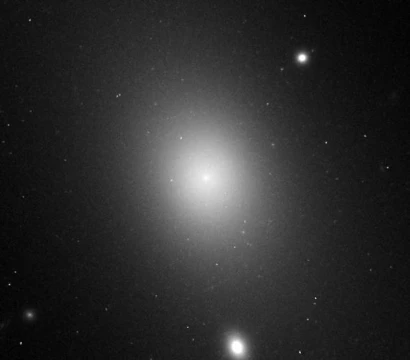
IERS B1946+708
A compact symmetric radio galaxy with a circumnuclear disk and fast jets.

IERS B1946+708 is a radio galaxy located in the constellation Draco, first discovered as an extragalactic radio source in 1983. It is notable for its classification as a compact symmetric object (CSO) with a gigahertz peaked spectrum, and for its well-studied jet structure and circumnuclear disk.
Quick Facts
- Epoch
- J2000.0
- Constellation Name
- Draco
- Ra
- 19 · 45 · 53.520
- Dec
- +70 · 55 · 48.727
- Z
- 0.100830
- H Radial V
- 30,228 km/s
- Dist Ly
- 1.256 Gly
- Appmag V
- 16.70
- Appmag B
- 18.72
- Names
- S5 1946+70, WN B1946+7048, LEDA 2739486, 87GB 194612.4+704824, NVSS J194553+705548, 1946+708
Facts from the source article.
Lore & Background
IERS B1946+708 is an elliptical galaxy with an inclined disk measured at 600 parsecs in radius via Hubble Space Telescope three-band imaging. Its nuclear regions are much redder than its outer regions, with B and R band magnitude differences of 2–3. A companion galaxy lies 67 kiloparsecs away. The radio source is compact and exhibits an S-symmetry, with the radio core located midway between two hotspots in the north and south. The hotspots have an expansion velocity of 0.024c, corresponding to an age of 4000 ± 1000 years, while the core has an inverted spectrum. Two narrow jets emerge from the core, bending and ending in the hotspot regions; these jets contain four components moving at speeds between 0.6 and 0.9c, with the fastest at 1.09 h⁻¹ c. Low polarization in the jet components indicates Faraday depolarization by ionized gas and a tangled magnetic field. Neutral hydrogen has been detected in all components, with narrow lines toward the north hotspot likely caused by H I clouds associated with a warm gas region. X-ray observations by BeppoSAX revealed strong iron K-alpha emission lines. H I observations by A.B. Peck and G.B. Taylor found multi-peaked absorption across the radio continuum, with maximum column density toward the core and a velocity dispersion of 350 km/s, suggesting a circumnuclear disk.
Reader's Guide
IERS B1946+708 is significant as a compact symmetric object (CSO) with a gigahertz peaked spectrum, providing a laboratory for studying young radio galaxies and their interaction with the interstellar medium. Its well-resolved jet structure, with components moving at relativistic speeds up to 1.09 h⁻¹ c, and the measured hotspot expansion age of 4000 ± 1000 years indicate a young, active source. The detection of neutral hydrogen absorption with multi-peaked profiles and a circumnuclear disk suggests complex gas dynamics near the active nucleus. The strong iron K-alpha emission line observed by BeppoSAX points to the presence of dense, ionized material in the nuclear region. The low polarization and Faraday depolarization in the jets reveal the influence of ionized gas and tangled magnetic fields. The galaxy's inclined disk and redder nuclear regions, along with a companion 67 kiloparsecs away, place it in a broader context of galaxy interactions and evolution. Its legacy lies in its detailed multi-wavelength characterization, from radio to X-rays, which informs models of jet propagation, feedback, and the early stages of radio galaxy evolution.
Did You Know?
- The fastest jet component moves at 1.09 h⁻¹ c.
- X-ray observations by BeppoSAX detected strong iron K-alpha emission lines in its spectrum.
Frequently Asked Questions
What is IERS B1946+708?
IERS B1946+708 is an elliptical galaxy that also functions as a radio source, sitting roughly 1.25 billion light-years away in the constellation Draco. It is classified as a compact symmetric object (CSO) with a gigahertz-peaked spectrum, making it a relatively young radio galaxy.
When and how was IERS B1946+708 first identified?
The object was first catalogued as an extragalactic radio source back in 1983. Its compact, symmetric radio morphology and distinctive spectral peak later earned it the CSO/GPeS classification that sets it apart from older, more evolved radio galaxies.
What are the most studied structural features of IERS B1946+708?
Astronomers have mapped its pair of fast, collimated jets and a circumnuclear disk surrounding the central engine. These features together make it a key laboratory for studying how young active galactic nuclei launch and sustain outflows.
Why do researchers consider IERS B1946+708 important in galaxy studies?
As a compact symmetric object, it represents an early evolutionary stage of radio galaxies, offering a snapshot of jet formation before the lobes have had time to expand. Its well-characterised jets and disk structure provide a benchmark for models of AGN feedback in elliptical galaxies.
What are the basic positional and distance parameters for IERS B1946+708?
It resides in Draco with a redshift of about 0.101, placing it at a cosmological distance of roughly 1.25 billion light-years from Earth. Those coordinates and the redshift value are what allow observers to plan radio and optical follow-up campaigns.
More in Elliptical and Irregular Galaxies, Part 3 1-24
Spotted an error? Know more?
Reader corrections go straight into our review queue. Suggest an edit · How this site is sourced