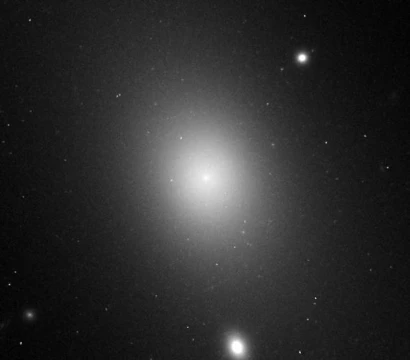
ID2299
A galaxy dying from catastrophic gas loss after a merger.

ID2299 is an elliptical galaxy located 9 billion light-years away, notable for its catastrophic gas loss that is rapidly ending its star-forming ability. Discovered and detailed in January 2021, it represents an extreme instance of a galaxy's 'death' due to a catastrophic merger, which has produced a tidal tail that now comprises nearly half the galaxy's size.
Quick Facts
- Distance
- 9 billion light years
- Dec
- +01 · 54 · 5.3
- Ra
- 10 · 02 · 15.4
- Constellation
- Sextans
- Detected By
- ALMA
- Duration
- few minutes
- Start Time
- 11 January 2021
- Event Type
- observation
Facts from the source article.
Lore & Background
ID2299 was first observed using the Atacama Large Millimeter Array (ALMA), the largest radio telescope worldwide, located in Chile. The galaxy is seen as it was 4.5 billion years ago, with its light having traveled 9 billion years to reach Earth; it is now extrapolated to be about 13 billion light-years away. The galaxy is undergoing extreme gas loss, ejecting a tidal tail that has grown to approximately half its size. This tail contains 46% of the galaxy's gas, being augmented at a rate of about 10000 M☉ per year, while the remaining 54% hosts intense star formation zones producing about 550 M☉ per year—far exceeding the Milky Way's 3 M☉ per year. Despite this high star formation rate, the gas loss far outweighs it, and the galaxy is expected to remain active for only a few tens of millions of years.
Reader's Guide
ID2299's significance lies in providing strong evidence for a catastrophic merger as the primary mechanism driving its gas loss, challenging earlier models that attributed such loss to stellar winds, star formation, or supermassive black hole activity. The study, published in Nature Astronomy on 11 January 2021, used ALMA observations to reveal a tidal tail resulting from a collision between two galaxies. This mechanism, if confirmed by similar observations, is hypothesized to have shaped the makeup and distribution of later surviving galaxies, including their host clusters and superclusters in the local universe. The galaxy's rapid gas ejection—at 10000 M☉ per year—ensures its star formation will cease within tens of millions of years, a tiny fraction of cosmic history. This extreme case underscores how mergers in the early universe, when galaxies were closer together, could dislodge vast quantities of interstellar matter, contributing to the diversity of galaxy types observed today.
Did You Know?
- ID2299's tidal tail contains 46% of its gas and is growing at a rate of 10000 M☉ per year.
- The galaxy's star formation rate of 550 M☉ per year is over 180 times that of the Milky Way.
- An impression of ID2299 was created by Martin Kornmesser, a graphic artist at ESA.
Frequently Asked Questions
What is ID2299?
ID2299 is an elliptical galaxy roughly 9 billion light-years from Earth that is rapidly losing its gas supply. It is considered an extreme, near-terminal case of a galaxy being killed off after a violent merger.
How and when was ID2299 discovered?
Astronomers using the Atacama Large Millimeter Array (ALMA) identified and characterized the galaxy in January 2021. The results were published in Nature Astronomy on 11 January 2021.
What is happening to ID2299's star formation?
The galaxy is still forging stars at roughly 550 solar masses per year, yet it is simultaneously ejecting gas at about 10,000 solar masses per year. This means its fuel reservoir is being drained far faster than new stars can be born, effectively shutting down star formation.
What caused the catastrophic gas loss in ID2299?
A violent merger event tore a huge tidal tail out of the galaxy, and that tail now spans nearly half of ID2299's total size. The extreme stripping of gas driven by this merger is what's accelerating the galaxy's decline.
Why is ID2299 considered significant to galaxy research?
It captures a galaxy in the final, dramatic stages of merger-driven death rather than showing an already-dead remnant. Its extraordinarily high gas-ejection rate makes it one of the most extreme known examples of a galaxy being stripped of its ability to form new stars.
More in Elliptical and Irregular Galaxies, Part 3 1-24
Spotted an error? Know more?
Reader corrections go straight into our review queue. Suggest an edit · How this site is sourced