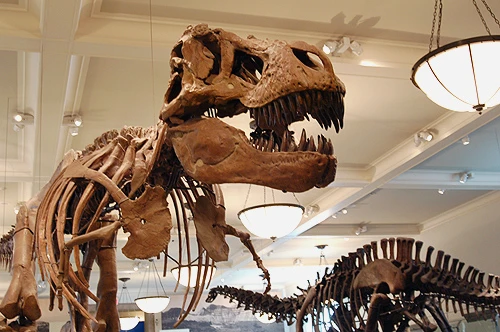
Agathaumas
Dubious ceratopsid dinosaur from the Late Cretaceous of Wyoming.

Agathaumas, meaning "great wonder" from the Greek words for "much" and "wonder," is a dubious genus of large ceratopsid dinosaur. It lived in what is now Wyoming during the late Maastrichtian stage of the Late Cretaceous, about 66 million years ago. At the time of its discovery, it was considered the largest land animal known. Although it was the first ceratopsian known to science from more than just teeth, the original specimen is fragmentary, consisting only of hip bones, hip vertebrae, and ribs. Because these postcranial bones vary little between ceratopsid species, Agathaumas is usually treated as a nomen dubium. It is provisionally considered a synonym of *Triceratops* or *Torosaurus*, but direct comparison is difficult.
The holotype remains were first found in 1872 in southwestern Wyoming by Fielding Bradford Meek and Henry Martyn Bannister, who were searching for fossil shells in the Laramie Formation near Black Butte and Bitter Creek. They worked for Ferdinand Vandeveer Hayden's Geological Survey of the Territories and notified paleontologist Edward Drinker Cope of the find. Cope later searched the ridge near Black Butte, rediscovered the site, and found huge bones protruding from rocks near a coal vein. The bones were preserved in sand and clay sediments packed with fossil sticks and leaves, indicating a heavily forested habitat. Cope described the skeleton as "the wreck of one of the princes among giants." His team recovered complete hip bones, sacral vertebrae, and several ribs. In 1873, Cope published the formal description of *Agathaumas sylvestris*, or "marvelous forest-dweller," referencing its great size and the environment. The name reflects Cope's excitement; he believed it was the largest land animal ever. Several years later, with the discovery of giant sauropods in the Morrison Formation, it became clear that British forms like *Cetiosaurus* and *Pelorosaurus* were also land animals.
Cope originally did not know to which group *Agathaumas* belonged, though he noted similarities to *Cetiosaurus* and differences from *Hadrosaurus* and *Dryptosaurus*. In 1882, Othniel Charles Marsh suggested it was a hadrosaurid, along with *Cionodon*. In 1883, Cope also suggested his taxa *Agathaumas*, *Monoclonius*, and *Dysganus* could be hadrosaurids. Cope did not assign *Agathaumas* to Ceratopsia until 1889, after Marsh described *Triceratops*. Marsh
- field
- Paleontology
- known_for
- First ceratopsian known from more than teeth; considered a nomen dubium
- type_species
- Agathaumas sylvestris
- discovery_year
- 1872
- discovered_by
- Fielding Bradford Meek and Henry Martyn Bannister
Lore & Background
The holotype remains of Agathaumas were first found in 1872 in southwestern Wyoming by Fielding Bradford Meek and Henry Martyn Bannister while they were looking for fossil shells in the Laramie Formation near the Black Butte and Bitter Creek. Meek and Bannister were employed by Ferdinand Vandeveer Hayden's Geological Survey of the Territories and notified paleontologist Edward Drinker Cope of the find. Cope himself searched the ridge near Black Butte and re-discovered Meek's site, finding huge bones protruding from the rocks near a coal vein. The bones were preserved in sand and clay sediments, packed with fossil sticks and leaves, indicating a heavily forested habitat. Cope later described the skeleton as "the wreck of one of the princes among giants." Cope and his team eventually recovered
Reader's Guide
Agathaumas holds a notable place in the history of dinosaur paleontology as the first ceratopsian known from more than isolated teeth, even though its remains are fragmentary. Its discovery in 1872 by Meek and Bannister, and subsequent description by Edward Drinker Cope, occurred during the height of the Bone Wars, a period of intense fossil rivalry between Cope and Othniel Charles Marsh. The name Agathaumas, meaning "great wonder," reflects Cope's excitement; he considered it the largest land animal known at the time. However, because the holotype consists only of hip bones, vertebrae, and ribs—elements that vary little among ceratopsids—the genus is now regarded as a nomen dubium. It is provisionally considered a synonym of Triceratops or Torosaurus, but cannot be confidently assigned due to the lack of skull material. The taxonomic history is complex: Cope originally thought it might be related to Cetiosaurus, later considered it a hadrosaurid, and finally placed it in his own family Agathaumidae. Subsequent work by Hatcher, Lull, and others showed that all Agathaumidae genera are dubious. Agathaumas also appears in paleoart: Charles R. Knight's 1897 painting titled "Agathaumas sphenocerus" used a composite of other dinosaur fossils, none from the actual Agathaumas sylvestris. This painting later inspired a stop-motion model in the 1925 film The Lost World. Despite its uncertain status, Agathaumas remains a historically significant taxon that illustrates the challenges of classifying fragmentary fossils.
Did You Know?
- Agathaumas was the first ceratopsian known to science from more than just teeth.
- The name Agathaumas comes from Ancient Greek words meaning 'much' and 'wonder'.
- The holotype was discovered in 1872 by Fielding Bradford Meek and Henry Martyn Bannister while searching for fossil shells.
- Charles R. Knight's 1897 painting of 'Agathaumas sphenocerus' used no bones from the actual Agathaumas sylvestris.
More in Dinosaur genera 1-24
Spotted an error? Know more?
This is a living reference — every entry is fact-audited, and reader corrections feed straight into our audit queue. Suggest an edit · See this site's audit record