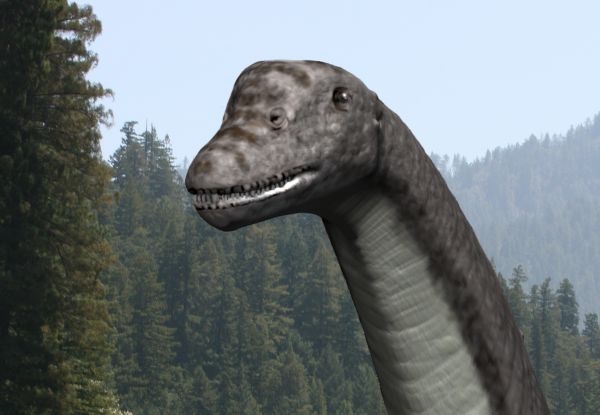
Abydosaurus
Brachiosaurid sauropod known from rare complete skull material.

Nobu Tamura ( http://spinops.blogspot.com ) · CC BY-SA 3.0
Abydosaurus is a brachiosaurid sauropod dinosaur whose remains—including skull and postcranial bones—were unearthed in Early Cretaceous rocks in northeastern Utah. It stands out among sauropods because skull material is rare for the group, and this genus provided the first complete skull ever described for a Cretaceous sauropod from the Americas. Its teeth are notably narrow, unlike the broader teeth of earlier brachiosaurids.
The species is based on a nearly complete skull and lower jaws, along with the first four neck vertebrae. At the same site, researchers also found partial skulls from three other individuals, plus a partial hip, tail vertebrae, a shoulder blade, an upper arm bone, and hand bones. These fossils came from a sandstone layer at the base of the Mussentuchit Member of the Cedar Mountain Formation, near the old visitor center of Dinosaur National Monument. Zircons from mudstones below the sandstone indicate the bones are less than about 104.5 million years old, placing them in the Albian stage of the Early Cretaceous.
The name Abydosaurus comes from Egyptian mythology: Abydos was a city on the Nile where the head and neck of the god Osiris were buried, and the holotype specimen consists of a head and neck found in rocks overlooking the Green River. The type species, *A. mcintoshi*, honors physicist John S. McIntosh for his work at Dinosaur National Monument and his studies of sauropod dinosaurs.
Though Abydosaurus lived about 50 million years after *Giraffatitan*, the skulls of the two are similar, except that Abydosaurus had narrower, sharper teeth and a smaller nose. It can be distinguished from all other sauropods by subtle features of the nasal and maxillary bones, its relatively small nostrils, and certain tooth characteristics. In 2012, Thomas Holtz estimated its length at 18.3 meters (60 feet).
- field
- Paleontology
- known_for
- First complete skull for a Cretaceous sauropod from the Americas; narrow teeth unlike earlier brachiosaurids
- type_species
- A. mcintoshi
- age
- Less than 104.46 ± 0.95 million years (Albian stage, Early Cretaceous)
- length
- 18.3 metres (60 ft) per 2012 estimate by Thomas Holtz
Lore & Background
Abydosaurus was named in 2010 by Daniel Chure and colleagues. The holotype, DINO 16488, is a nearly complete skull and lower jaws with the first four neck vertebrae. Abundant additional fossils were found at the same site, including partial skulls from three other individuals, a partial hip and associated tail vertebrae, a shoulder blade, an upper arm bone, and hand bones. These fossils were discovered in a sandstone bed at the base of the Mussentuchit Member of the Cedar Mountain Formation, near the old visitor center of Dinosaur National Monument. Zircons from mudstones beneath the bone-bearing sandstone indicate the age is less than 104.46 ± 0.95 million years, in the Albian stage of the Early Cretaceous.
Reader's Guide
Abydosaurus is significant primarily because it provides one of the few sauropod skulls known from the Cretaceous, and the first complete skull for a Cretaceous sauropod from the Americas. Its narrow teeth contrast with the broader teeth of earlier brachiosaurids, suggesting dietary or ecological differences. Although it lived some 50 million years after Giraffatitan, the skulls are similar except for the narrower, sharper teeth and smaller nose of Abydosaurus. It can be differentiated from all other sauropods by subtle features of the nasal and maxillary bones, its relatively small external nares, and some features of the teeth. The type species, A. mcintoshi, honors John S. McIntosh for his contributions to Dinosaur National Monument and the study of sauropod dinosaurs. The discovery highlights the rarity of sauropod cranial material and helps fill gaps in understanding brachiosaurid evolution.
Did You Know?
- Abydosaurus is one of the few sauropods known from skull material, with the first described complete skull for a Cretaceous sauropod from the Americas.
- Its narrow teeth are notable because earlier brachiosaurids had broader teeth.
- The holotype consists of a nearly complete skull and lower jaws with the first four neck vertebrae.
- The genus name references the Egyptian city Abydos, where the head and neck of Osiris were buried.
Taxonomic Standing
Abydosaurus occupies a position of straightforward acceptance within the broader catalog of non-avialan dinosaurs. In the comprehensive listing that encompasses 1,863 names ever proposed for dinosaur genera, roughly 1,424 are regarded as either valid genera or nomina dubia. Abydosaurus falls among the commonly accepted names, carrying no special annotations that would flag it as a junior synonym, a nomen nudum, a preoccupied name, or a taxon subsequently reclassified as something other than a dinosaur. Unlike entries such as Aachenosaurus (later identified as petrified wood) or Aggiosaurus (reassigned to metriorhynchid crocodilians), Abydosaurus stands unmarked, indicating that its status as a recognized dinosaur genus has not been challenged or reinterpreted in the sources consulted. This clean listing reflects a name that has passed through the scrutiny of the International Code of Zoological Nomenclature and the editorial judgments of The Dinosauria (2004) without requiring reassignment, synonymy, or exclusion.
Place in the Dinosaurian Record
Abydosaurus belongs to the vast assemblage of reptilian lineages that first emerged during the Triassic period, between 243 and 233.23 million years ago. Following the Triassic–Jurassic extinction event approximately 201.3 million years ago, dinosaurs rose to become the dominant terrestrial vertebrates, a position they maintained throughout both the Jurassic and Cretaceous periods. As a non-avialan dinosaur, Abydosaurus is part of the lineage that did not survive into the modern era; the Cretaceous–Paleogene extinction event around 66 million years ago eliminated all non-avian dinosaur lineages, leaving only the feathered theropod descendants—modern birds—as the sole living representatives of the dinosaur clade. Abydosaurus thus exists purely as a fossil record, a name preserved in the taxonomic literature rather than in any living population. Its inclusion in the comprehensive listing underscores the sheer breadth of dinosaurian diversity that once characterized Earth's terrestrial ecosystems.
Nomenclatural Framework
The name Abydosaurus is governed by the International Code of Zoological Nomenclature, the same regulatory framework that applies to every entry in the dinosaur genera listing. Under ICZN rules, a valid generic name must be formally published, and the first name assigned to a taxon takes precedence as the senior synonym. Abydosaurus carries no indication that it is a junior synonym of another genus, nor is it flagged as a nomen nudum—a name that appeared in print without meeting formal publication standards—or a nomen oblitum, a name unused for over fifty years. It is also not marked as a preoccupied name, meaning no prior taxon had already claimed the name before its formal description. The fact that Abydosaurus appears in the list without any of these qualifying annotations suggests that its nomenclatural history is unproblematic: the name was properly published, has not been superseded by a senior synonym, and has not fallen into disuse or conflict with an existing taxonomic designation.
Curation and Source Authority
The placement of Abydosaurus in the comprehensive dinosaur genera list reflects a careful curation process drawing on multiple authoritative sources. The primary backbone of the listing is the Dinosaur Genera List compiled by George Olshevsky, first published online in 1995 and updated regularly until June 2021. The most authoritative general reference in the field is the second edition of The Dinosauria, published in 2004, which serves as the basis for all subjective determinations such as junior synonymy or non-dinosaurian status. Abydosaurus appears in the alphabetical A section alongside names ranging from Aardonyx to Acrotholus, with no special notations distinguishing it from its neighbors. This unremarkable presentation is itself meaningful: in a list where many A entries carry annotations—Actiosaurus identified as a choristoderan, Aggiosaurus as a crocodilian, Aetonyx as a possible synonym of Massospondylus—Abydosaurus's clean entry signals that no such reclassification or synonymy dispute has been recorded against it in the consulted literature.
Gallery
Frequently Asked Questions
What is Abydosaurus?
Abydosaurus is a brachiosaurid sauropod from the Early Cretaceous, known from a nearly complete skull, lower jaws, and the first four neck vertebrae found in northeastern Utah. Its type species is A. mcintoshi.
Why is Abydosaurus's skull considered so significant?
Complete skull material is exceedingly rare among sauropods, and Abydosaurus yielded the first fully described Cretaceous sauropod skull from the Americas. That made it a landmark specimen for understanding sauropod cranial anatomy in that time window.
How did Abydosaurus's teeth differ from those of earlier brachiosaurids?
Its teeth were distinctly narrow, setting them apart from the broader, more spatulate teeth typical of earlier brachiosaurid relatives. This dental distinction was a key feature in recognizing it as a separate genus.
How large was Abydosaurus?
A 2012 estimate by Thomas Holtz placed its total body length at roughly 18.3 metres (about 60 feet). That makes it a large sauropod, though not the absolute giant among its contemporaries.
Where and when did Abydosaurus live?
Its fossils come from Albian-stage deposits in northeastern Utah, dating to approximately 104.5 million years ago in the Early Cretaceous. Partial skulls of other sauropods were also recovered from the same locality.
More in Dinosaur genera 1-24
Spotted an error? Know more?
This is a living reference — every entry is fact-audited, and reader corrections feed straight into our audit queue. Suggest an edit · See this site's audit record