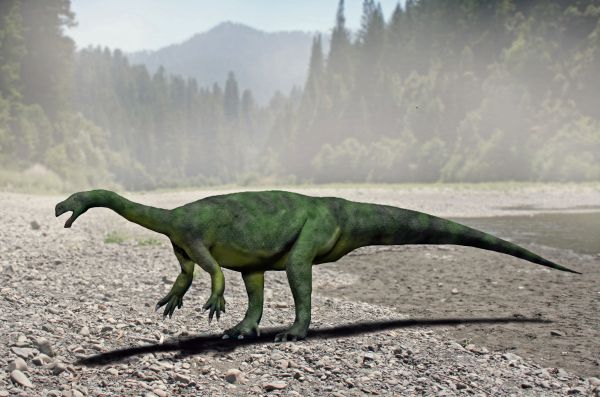
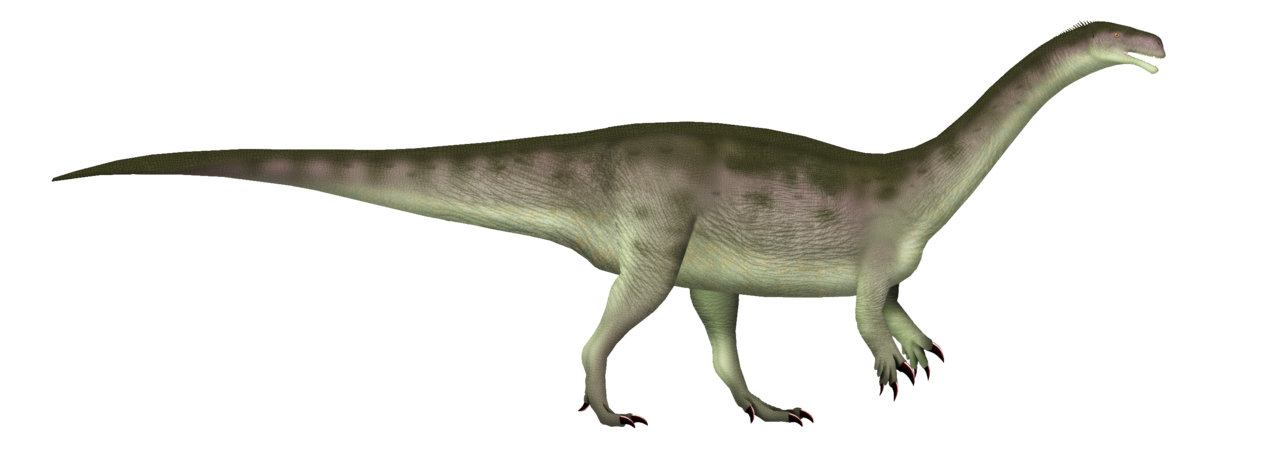
Aardonyx
Transitional sauropodomorph bridging bipedal and quadrupedal locomotion.

IJReid · CC BY 4.0
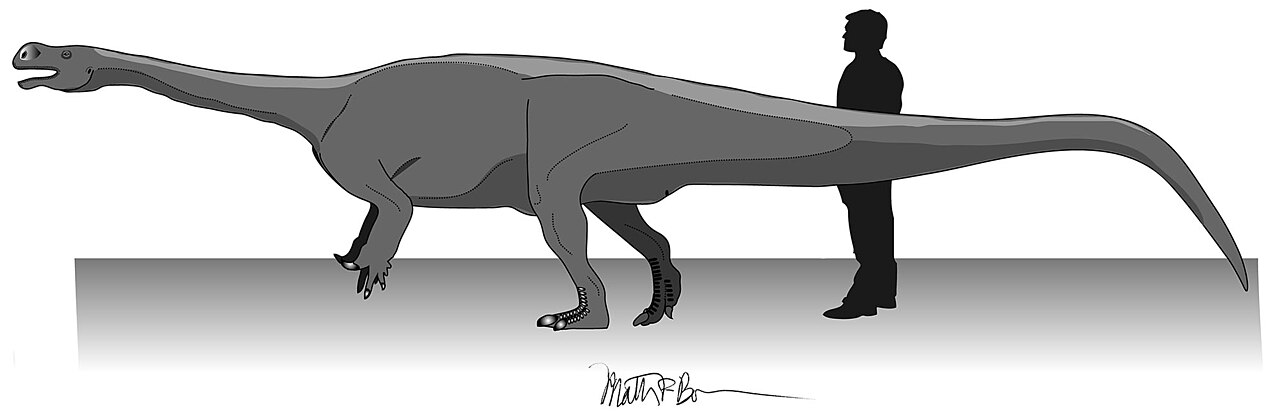
Aardonyx is a genus of basal sauropodomorph dinosaur known from the type species Aardonyx celestae, found in the Early Jurassic Elliot Formation of South Africa. The genus name combines the Afrikaans word aard, meaning 'earth,' with the Greek onyx, meaning 'nail' or 'claw.' Aardonyx is significant because its anatomy shows intermediate features between bipedal basal sauropodomorphs and the fully quadrupedal sauropods, helping to fill a gap in understanding how large, four-legged sauropods evolved from two-legged ancestors.
- field
- Paleontology
- known_for
- Transitional dinosaur showing bipedal to quadrupedal locomotion
- type_species
- Aardonyx celestae
- formation
- Early Jurassic Elliot Formation, South Africa
Lore & Background
The genus Aardonyx is known from disarticulated bones belonging to two immature individuals, including cranial elements, vertebrae, ribs, gastralia, chevrons, pectoral and pelvic girdle elements, and limb bones. The bones were found in a single dense accumulation in a localized channel fill, suggesting relatively complete carcasses. Both individuals were less than 10 years old at death, based on the lack of peripheral rest lines in bone cortices and the presence of calcified cartilage at the articular end of the scapula.
Aardonyx celestae was named after Celeste Yates, who prepared much of the first known fossil material. The discovery was made by Australian paleontologist Adam Yates and his team, and published online before print in Proceedings of the Royal Society B in November 2009, scheduled for the March 2010 issue. British paleontologist Paul Barrett, not involved in the research, commented that Aardonyx helps fill a gap in knowledge of sauropod evolution, showing how a primarily bipedal animal could acquire features for quadrupedal life.
Phylogenetic analysis places Aardonyx as the sister taxon of a clade containing Melanorosaurus and sauropods, which are obligatory quadrupeds. Derived traits in the vertebrae and appendicular skeleton support this relationship. The cladogram published by Yates et al. in 2010 and a later 2020 analysis by Rauhut and colleagues both show Aardonyx within Sauropodomorpha.
Reader's Guide
Aardonyx is significant because it provides direct fossil evidence for the transition from bipedal to quadrupedal locomotion in sauropodomorph dinosaurs. Its forelimb features, such as the incipient craniolateral process on the ulna and the shifted radius, indicate a trend toward greater quadrupedalism, while its hindlimb retains bipedal traits like a convex proximal lateral femur profile. The femur's straighter shaft and more distal fourth trochanter suggest a slower, more powerful gait than in earlier prosauropods.
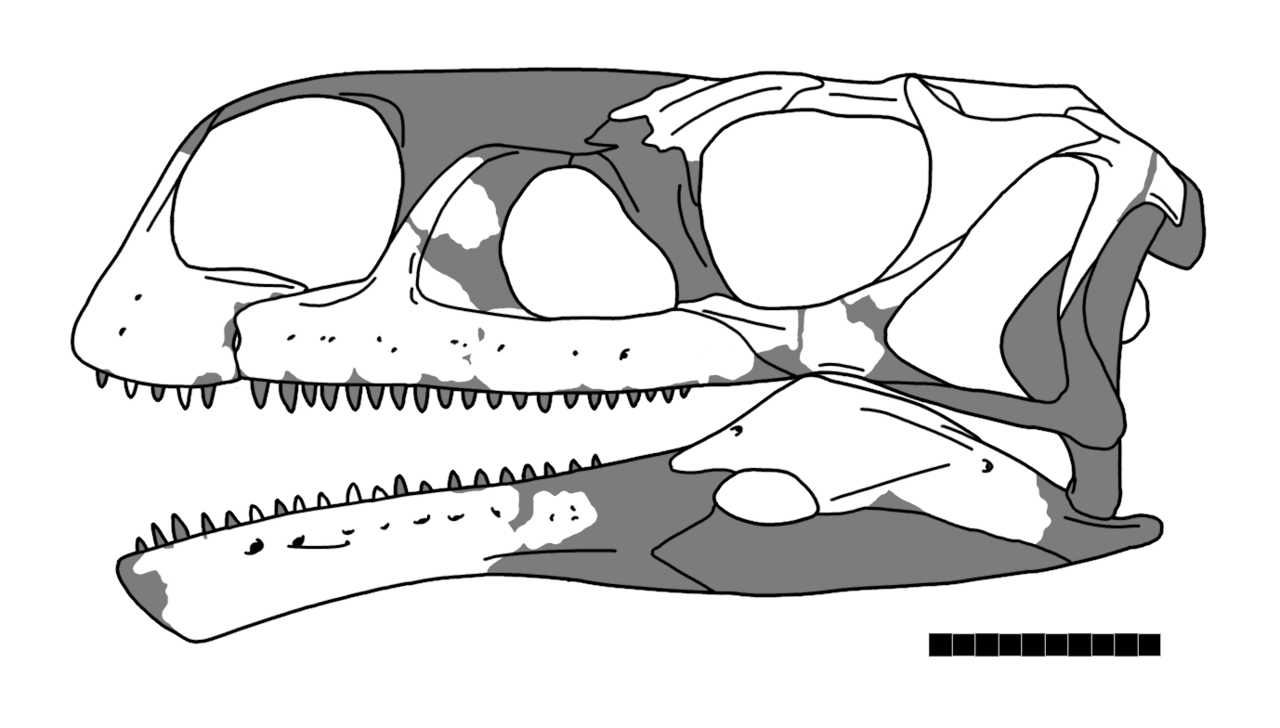
In feeding, Aardonyx shows a unique combination: narrow, V-shaped jaws (a primitive trait) alongside a loss of fleshy cheeks (a derived trait for bulk browsing). This challenges the previous assumption that broader jaws evolved before cheek loss. The sauropod Chinshakiangosaurus had U-shaped jaws with cheeks, suggesting that a wide, cheekless gape may have evolved twice in Sauropodomorpha.
Co-author Matthew Bonnan noted that Aardonyx shows quadrupedal walking and weight-bearing on the inside of the foot began earlier than hypothesized. The development of entaxony (medial weight-bearing axis) in the foot further supports reduced cursorial ability and a wider gait, preceding obligatory quadrupedalism. Osteohistology reveals rapid, seasonally interrupted growth with fibrolamellar complexes in early and mid-ontogenetic stages.
Did You Know?
- Aardonyx means 'earth claw' in Afrikaans and Greek.
- The type species Aardonyx celestae was named after Celeste Yates, who prepared much of the first known fossil material.
- Both known individuals were less than 10 years old at death, based on bone histology.
- Aardonyx had narrow V-shaped jaws but lacked fleshy cheeks, an unusual combination for a sauropodomorph.
Aardonyx's Standing Among Valid Dinosaur Genera
Aardonyx occupies a position of quiet acceptance within the broader catalog of non-avian dinosaurs. In the comprehensive listing of all genera ever considered to be non-avialan dinosaurs, the name appears without any qualifying annotation—no flag marking it as a nomen nudum, no note identifying it as a junior synonym of another taxon, no correction indicating it was subsequently reclassified as something entirely different. This unadorned presentation places Aardonyx among the roughly 1,424 names out of the list's total 1,863 entries that are regarded as either valid dinosaur genera or nomina dubia. In a field where names like Aachenosaurus turned out to be petrified wood, Actiosaurus was reidentified as a choristoderan, and Aggiosaurus proved to be a metriorhynchid crocodilian, the simple, unqualified listing of Aardonyx signals that its dinosaurian identity has withstood scrutiny and remains a commonly accepted member of the group.
The Nomenclature Framework Governing Aardonyx's Name
The name Aardonyx exists within a rigorous regulatory structure governed by the International Code of Zoological Nomenclature. Under this code, a valid generic name must be formally published with proper scientific backing; names that appear in print without meeting these standards are classified as nomina nuda and are considered invalid. Similarly, if a name has already been used for another taxon, any subsequent use is preoccupied and must be replaced. Aardonyx does not carry any of these disqualifying markers in the reference materials. The primary source for its inclusion is the Dinosaur Genera List compiled by George Olshevsky, first published online in 1995 and updated through June 2021, with subjective determinations cross-referenced against the second edition of The Dinosauria from 2004. This dual-sourcing approach means Aardonyx's standing rests on both a dedicated nomenclatural compilation and the most authoritative general reference in paleontological taxonomy.
Aardonyx in the Deep Timeline of Dinosaurian History
Aardonyx belongs to a lineage whose members first appeared during the Triassic period, between 243 and 233.23 million years ago, as part of a diverse assemblage of reptiles that would eventually reshape terrestrial ecosystems. The group's rise to dominance came after the Triassic-Jurassic extinction event approximately 201.3 million years ago, an event that cleared ecological space and allowed dinosaurs to become the prevailing terrestrial vertebrates throughout the Jurassic and Cretaceous periods. Aardonyx, as a non-avian dinosaur, exists within this vast span of evolutionary history. The fossil record ultimately demonstrates that birds descended from earlier theropods during the Late Jurassic, making them the only dinosaur lineage to survive the Cretaceous-Paleogene extinction around 66 million years ago. Aardonyx, as a member of the non-avialan branch, represents a lineage that did not carry forward into the modern world, its descendants absent from today's fauna.
Aardonyx Amid Taxonomic Uncertainty and Reclassification
The landscape of dinosaur taxonomy is one of perpetual revision. The comprehensive list from which Aardonyx draws its placement contains 1,863 names, yet only approximately 1,424 are considered valid genera or nomina dubia. The remaining entries include junior synonyms, preoccupied names, nomina nuda, and taxa that have been reclassified into entirely different groups. Neighbors in the alphabetical listing illustrate this instability: Aachenosaurus was found to be petrified wood, Albisaurus reclassified as a non-dinosaurian reptile, and Aggiosaurus identified as a crocodilian. Against this backdrop of frequent reassignment, Aardonyx's unannotated entry suggests its classification has not been challenged or overturned in the same manner. The absence of a nomen dubium designation—reserved for fossils lacking unique diagnostic features—further implies that Aardonyx possesses sufficient distinguishing characteristics to maintain its standing as a recognized genus within the non-avian dinosaur record.
Gallery
Frequently Asked Questions
What is Aardonyx?
Aardonyx is a genus of early sauropodomorph dinosaur represented by the type species A. celestae, which lived during the Early Jurassic in present-day South Africa. It is recognized for displaying a blend of anatomical traits found in both two-legged and four-legged early sauropod relatives.
What does the name Aardonyx mean?
The genus name fuses the Afrikaans word 'aard,' meaning earth, with the Greek 'onyx,' meaning nail or claw. Put together, it essentially translates to 'earth claw.'
Why is Aardonyx important to paleontology?
Its skeleton captures an intermediate stage between bipedal basal sauropodomorphs and the later, fully quadrupedal sauropods. That makes it a crucial piece of evidence for tracking how sauropods shifted from walking on two legs to carrying their massive bodies on four.
Where and when did Aardonyx live?
Fossils of Aardonyx celestae were recovered from the Elliot Formation in South Africa, placing the animal in the Early Jurassic period.
What is Aardonyx best known for?
It is celebrated as a transitional form that bridges the locomotor gap between two-legged and four-legged early sauropodomorphs. Its anatomy offers one of the clearest snapshots of that evolutionary shift.
More in Dinosaur genera 1-24
Spotted an error? Know more?
This is a living reference — every entry is fact-audited, and reader corrections feed straight into our audit queue. Suggest an edit · See this site's audit record